
The Complete History of Canon Lens Mounts: From Screw Mount to RF
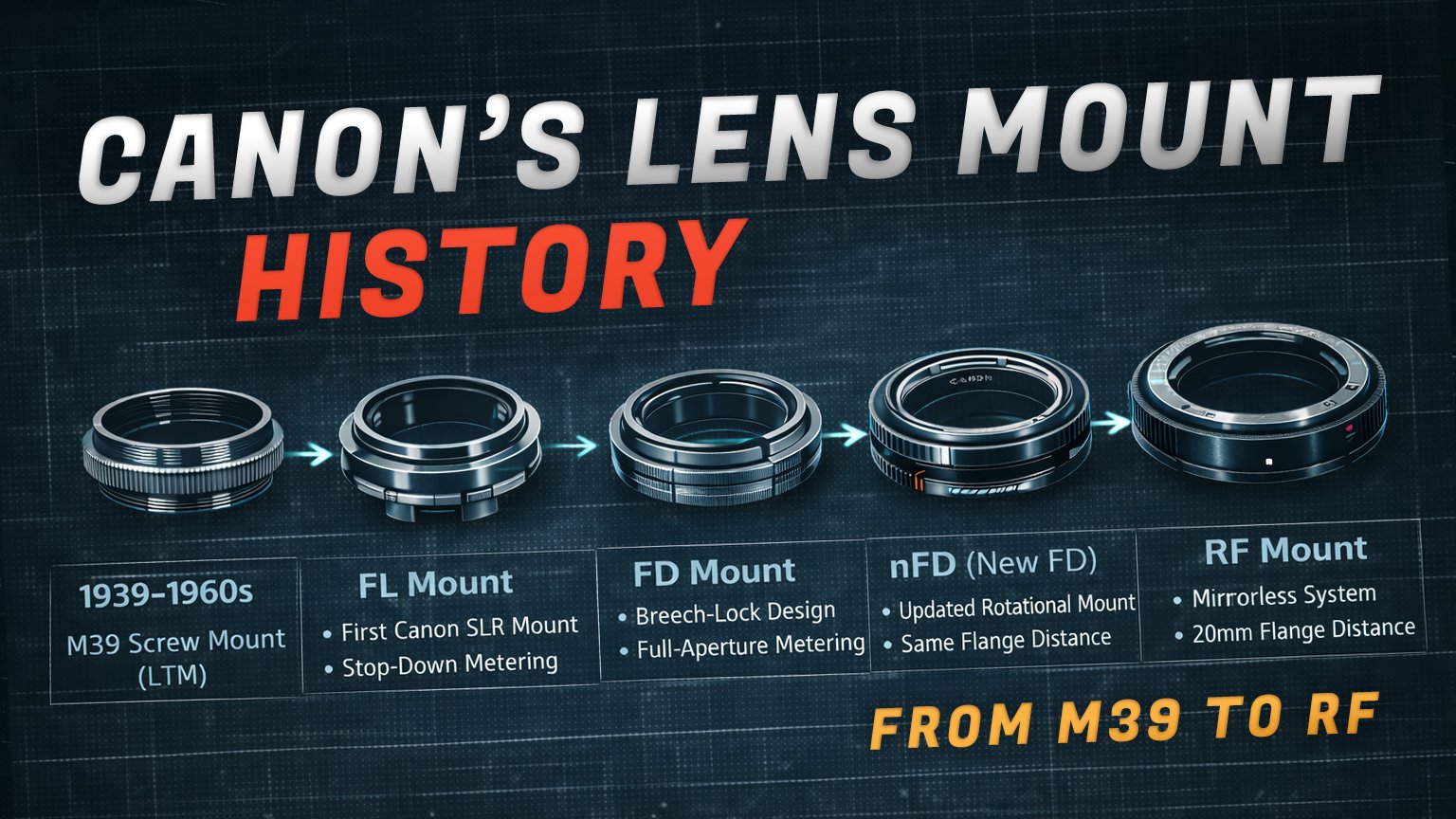
If you shoot Canon, or adapt vintage glass like I do, understanding the history of Canon’s lens mount systems completely changes how you see modern gear and ads an interesting layer to your Canon lens collection. What looks like a simple metal interface on your camera is actually the result of nearly 80 years of engineering evolution. From screw-mount rangefinders to fully electronic mirrorless systems, Canon’s mount progression tells the story of photography itself. Let’s walk through it.
Table of Contents:
Before FL: Canon’s Screw Mount Era (LTM / M39)
Before Canon became known for SLRs, autofocus systems, and modern mirrorless cameras, the company began its journey in photography with rangefinder cameras using the Leica Thread Mount (LTM), also known as the M39 screw mount. In fact, Canon started as a camera manufacturer in the 1930s with a clear mission: to build high-quality Japanese cameras that could compete with German optics. Its earliest commercially successful models, including the Canon II and later the Canon P, embraced the 39mm x 1mm screw mount standard that had already gained popularity through Leica’s ecosystem.
This decision was strategic. By adopting the M39 thread mount, Canon ensured compatibility with existing Leica thread-mount lenses as well as third-party optics, instantly giving photographers access to a broad and respected lens lineup. At a time when lens ecosystems were fragmented and proprietary, this compatibility helped Canon establish credibility in the growing global photography market.
Technically, these early screw-mount systems were entirely mechanical. There was no electronic communication between lens and body, no automatic aperture control, and no autofocus. Photographers manually focused the lens and manually set the aperture, often relying on external light meters. Everything was tactile, deliberate, and hands-on, a shooting experience that many vintage lens enthusiasts still appreciate today.
Canon remained committed to the M39 screw mount throughout the 1940s and 1950s, refining its rangefinder cameras before eventually transitioning into SLR development in the 1960s. That shift would lead to the introduction of the FL mount and begin a new chapter in Canon lens mount evolution. But the M39 era laid the groundwork. It established Canon not just as a camera maker, but as a serious player in the optical world, a foundation that shaped every mount system that followed.
Canon FL Mount (1964)
By the early 1960s, photography was changing rapidly. Single-lens reflex (SLR) cameras were gaining popularity because they allowed photographers to view directly through the taking lens, something rangefinders simply couldn’t match, especially with telephoto and close-up work. Canon recognized that if it wanted to compete seriously on the global stage, it needed to move beyond screw-mount rangefinders and fully commit to an SLR system.
In 1964, Canon introduced the FL mount alongside the Canon FX SLR, marking the company’s official transition into interchangeable-lens SLR cameras. This was a pivotal moment in Canon lens mount history. Unlike the earlier M39 screw mount, the FL system used a bayonet design, allowing lenses to mount more quickly and securely. This shift wasn’t just about convenience, bayonet mounts offered better alignment, stronger mechanical coupling, and faster lens changes, which were becoming increasingly important for professional photographers.
The FL mount was entirely mechanical. It featured a mechanical aperture linkage, but unlike later systems, it required stop-down metering. That meant photographers had to manually stop the lens down to the selected aperture before taking a light meter reading. In practical terms, this darkened the viewfinder while metering, a workflow that feels slow and cumbersome today but was standard for the era.
Despite this limitation, the FL system represented Canon’s first serious attempt at building a cohesive SLR lens ecosystem. The company began developing a broader lineup of primes and specialty lenses, laying the groundwork for what would later become the highly respected FD system. The FL mount also established the flange focal distance that Canon would maintain through the FD and New FD generations, an important design decision that allowed a degree of backward compatibility in later years.
Historically, the FL era reflects a company in transition. Canon was shifting from being a respected rangefinder manufacturer to becoming a full-fledged SLR innovator. The FL mount may not have been as refined as the FD system that followed, but it was the foundation of Canon’s modern lens strategy, a bold move that positioned the company for the explosive growth it would experience in the 1970s.
For vintage lens enthusiasts, FL lenses represent an early chapter in Canon’s SLR story: fully mechanical, thoughtfully engineered, and unmistakably part of the era when photography was becoming faster, more versatile, and more ambitious. FL lenses alcked “good coatings” so if you’re looking for vintage lenses with a lot of vintage character this is a good place to start.
From Left to right: Canon nFD 28mm f/2.8 and FD 28mm f/3.5 SC Chrome
Canon FD Mount (1971)
In 1971, Canon introduced the FD mount, and with it, the company entered what many consider its golden age of mechanical SLR design. The Canon FD mount was more than just an update to the earlier FL system, it was a major refinement that dramatically improved usability, metering accuracy, and lens-body integration. For anyone researching Canon FD lens history or exploring vintage Canon lenses today, this is the mount that truly put Canon on the global map.
One of the most important design decisions Canon made was retaining the same flange focal distance as the FL mount. This ensured a degree of backward compatibility, allowing FL lenses to be used on FD bodies with certain limitations. That continuity gave photographers confidence that Canon was building a long-term system rather than a short-lived experiment.
Canon FD 50mm f1.8 S.C. (II) Chrome Nose Mounted on a Canon AE-1 Program
Technically, the FD mount introduced several meaningful advancements. It supported full-aperture metering, allowing photographers to compose and focus with the lens wide open while the camera automatically accounted for the selected aperture. This kept the viewfinder bright and significantly improved shooting speed. The system also incorporated automatic diaphragm control, meaning the lens would stop down only at the moment of exposure. Compared to stop-down metering in the FL era, this was a major leap forward.
FD lenses used a distinctive breech-lock ring system. Instead of rotating the entire lens barrel to mount it, photographers would seat the lens into the mount and then rotate a locking ring to secure it. This design reduced wear on the camera body’s mount and ensured precise alignment, a thoughtful engineering detail that still feels intentional today.
Canon FD 50mm f/1.8 SC Chrome Nose
The Canon FD mount powered some of the most iconic cameras in Canon’s history, including the Canon F-1, aimed at professionals, and the hugely popular Canon AE-1, which helped bring SLR photography to the masses in the mid-to-late 1970s. During this era, Canon’s reputation for reliability, innovation, and optical quality grew rapidly. The FD system expanded to include an extensive lineup of primes, zooms, specialty lenses, and even L-series optics, establishing one of the most complete manual focus ecosystems ever built.
Even decades later, Canon FD lenses remain highly sought after in the vintage lens community. Photographers and filmmakers appreciate their mechanical precision, smooth focus throw, robust metal construction, and distinctive optical rendering. When people search for “best Canon FD lenses” or “Canon FD lens review,” they’re often discovering glass from this era, lenses that combine classic character with serious engineering.
The FD mount represents the moment Canon transitioned from contender to industry leader. It bridged mechanical craftsmanship with practical innovation and set the stage for everything that would follow, including the bold electronic leap to EF in 1987.
Canon New FD (nFD) Mount (1979)
Canon AE-1 Program released in 1981 to go along with the New FD mount lenses.
Canon FD breech lock system vs the (new) FD bayonet mount system
By the late 1970s, Canon’s FD system was firmly established, but the company wasn’t finished refining it. In 1979, Canon introduced the New FD mount, commonly referred to today as nFD (or sometimes FDn), as a streamlined redesign of the original FD lenses. For photographers researching the differences between Canon FD vs nFD lenses, this era represents a subtle yet meaningful evolution in Canon lens mount history. The core mount specifications remained the same, but Canon improved usability, reduced weight, and modernized construction to keep pace with a rapidly advancing SLR market.
One important detail from this transition period involves lens coatings. As Canon shifted into the nFD lineup, it standardized the use of its Super Spectra Coating (S.S.C.), an upgraded multi-coating designed to reduce flare, improve contrast, and enhance color fidelity. Earlier FD lenses often featured Spectra Coating (S.C.), which was effective but less advanced. Canon actively marketed S.S.C. as a performance upgrade, and you’ll often see “S.C.” or “S.S.C.” printed directly on the lens barrel. For vintage lens shooters today, that small marking offers a useful clue about the lens’s generation and coating technology, and in real-world use, the improved flare resistance and contrast can be noticeable, especially in backlit conditions.
Notes for vintage lens enthusiasts:
If you’re drawn to pronounced lens flares, organic contrast loss in backlit scenes, and a stronger vintage aesthetic, earlier FD lenses with the S.C. coating are a great choice. They tend to flare more easily and render with a softer, more classic film-era look. If you prefer a cleaner, more modern image with just a subtle touch of vintage character, the newer S.S.C. lenses offer improved contrast and flare resistance while still maintaining that warm, nostalgic feel.
Interestingly, nearly all nFD lenses were updated with Canon’s Super Spectra Coating (S.S.C.), with one notable exception: the standard nFD 50mm f/1.8 kit lens, which retained the earlier S.C. coating. Because the FD 50mm f/1.8 and nFD 50mm f/1.8 share the same optical design, it’s likely (I’m assuming) Canon continued using existing element stock rather than redoing the production with new coatings, a cost-effective decision during the transition. As a result, the nFD 50mm f/1.8 carries a bit more vintage charm than most lenses from the nFD era, with slightly more flare and character than you might expect.
The nFD era also saw the launch of Canon’s “L” series lenses.
My collection of Canon New FD lenses. You can see more here
L Primes:
nFD 14mm f/2.8 L
nFD 24mm f/1.4 L
nFD 35mm f/2 L
nFD 50mm f/1.2 L
nFD 100mm f/2 L
nFD 135mm f/2 L
nFD 200mm f/2.8 L
nFD 300mm f/2.8 L
nFD 300mm f/4 L
nFD 400mm f/2.8 L
nFD 400mm f/4.5 L
nFD 500mm f/4.5 L
nFD 600mm f/4.5 L
nFD 800mm f/5.6 L
L Zooms:
nFD 20-35mm f/3.5 L
nFD 24-35mm f/3.5 L
nFD 35-105mm f/3.5 L
nFD 50-300mm f/4.5 L
nFD 100-300mm f/5.6 L
nFD 150-600mm f/5.6 L
Canon AE-1 Program + New FD 85mm f/1.2 L
Crucially, the mount itself did not change mechanically. The flange focal distance remained identical to the original FD and FL mount, and compatibility between FD, FL and nFD lenses was fully preserved. This continuity meant photographers could upgrade to newer lenses without replacing their camera bodies, a smart move that reinforced trust in the Canon FD ecosystem.
The biggest change was in the mounting mechanism. Traditional FD lenses used a breech-lock ring, where the lens seated into the mount and a separate locking ring was rotated to secure it. With the New FD system, Canon redesigned the lens so the entire lens barrel rotated and locked directly into place, similar to modern bayonet mounts. This made lens changes faster and more intuitive while reducing complexity during mounting.
Canon also modernized the construction. Many nFD lenses were lighter than their predecessors thanks to updated materials (plastic parts) and streamlined mechanical design. While still solid and well-built, they reflected a shift toward efficiency and portability, qualities that were becoming increasingly important as SLR cameras grew more mainstream.
Optically, nFD lenses continued to benefit from Canon’s advanced coatings and design philosophy developed throughout the 1970s. Many of these lenses maintained the sharpness, contrast, and mechanical precision that FD shooters had come to expect. At the same time, this era marked the final chapter of Canon’s fully mechanical SLR systems before the company made its dramatic transition to the fully electronic EF mount in 1987.
Lenses like the Canon nFD 70-210mm f/4 Macro and the Canon nFD 85mm f/1.2L are perfect examples of this transitional era in Canon lens history. They reflect mature mechanical engineering, refined ergonomics, and optical formulas that still hold up remarkably well on modern digital sensors. In my own experience, the optical character of nFD lenses feels closer to modern glass than to earlier “classic” vintage lenses. Stopped down, they deliver the sharpness, contrast, and detail you’d expect from a more contemporary design. At the same time, color rendering often carries a subtle nostalgia from days gone by, a slightly vintage tonal quality that gives images a gentle, organic feel without sacrificing clarity.
What I especially enjoy is how their personality shifts depending on how you use them. Shoot them wide open, and you start to see more of that vintage charm come through, softer edges, smoother transitions, and a touch more character in the rendering. Stop them down, and they tighten up into crisp, controlled performers. That versatility makes them incredibly fun to work with. For vintage lens enthusiasts, the nFD generation represents the peak of Canon’s manual-focus SLR craftsmanship, the final refinement of a mechanical system just before the autofocus revolution reshaped everything.
The Radical Shift: Canon EF Mount (1987)
EF mount on the Canon EOS 20D
In 1987, Canon made one of the most consequential decisions in modern camera history: it abandoned the FD mount entirely and introduced the EF (Electro-Focus) mount with the launch of the EOS system. There was no mechanical backward compatibility, no hybrid transition system, just a completely new electronic architecture. At the time, this was a risky move. Canon effectively asked its entire professional user base to start over. But the company believed autofocus and electronic integration were the future of photography, and it was willing to make a clean break to fully commit to that vision.
The decision was driven largely by technological limitations of the FD system. FD lenses relied on complex mechanical linkages to control aperture and communicate exposure information. Retrofitting reliable, fast autofocus into that mechanical framework would have been difficult and restrictive. Rather than compromise, Canon designed EF from the ground up as a fully electronic mount. The EF system eliminated mechanical aperture couplings entirely and replaced them with electronic contacts. Autofocus motors were placed inside the lenses themselves, allowing for faster performance and greater design flexibility. This architecture also paved the way for innovations like ultrasonic (USM) motors, image stabilization (IS), and advanced lens communication protocols that would arrive in the following decades.
The EF mount featured a 44mm flange focal distance and a wide 54mm throat diameter, giving Canon engineers room to design brighter lenses and more sophisticated optics. Over time, the EF ecosystem expanded into one of the most comprehensive lens lineups ever produced, powering EOS film cameras throughout the late 1980s and 1990s and later becoming the foundation of Canon’s DSLR dominance in the digital era. Canon’s gamble paid off, the EF mount became one of the most successful and long-lasting lens systems in photography history.
EF 35mm f/1.4 L II - Image of the lens mount and electronic contacts.
Canon EF 35mm f/1.4 L II mounted on a Canon EOS R5 Mark II
Lens coatings also continued to evolve during the EF era. Canon refined its multi-coating technologies to improve contrast, reduce ghosting, and handle the increasing demands of autofocus-era optics. As digital sensors emerged in the late 1990s and early 2000s, coatings were further optimized to reduce reflections from highly reflective sensor surfaces, something film never had to contend with. Later EF lenses introduced advanced coatings such as Super Spectra Coating updates, Subwavelength Structure Coating (SWC), and Air Sphere Coating (ASC), all designed to suppress flare and maintain high contrast in challenging lighting conditions.
The EF 35mm f/1.4 L II was one of the most advanced EF lenses ever produced featuring:
Blue Spectrum Refractive (BR) Optics
This lens was the first Canon lens to feature BR (Blue Spectrum Refractive) optics, a special organic optical material designed to dramatically reduce chromatic aberration, especially axial (longitudinal) chromatic aberration that fast wide-aperture lenses often struggle with.Subwavelength Structure Coating (SWC)
SWC is applied to reduce flare and ghosting, particularly when shooting into strong light sources. It uses microscopic structures smaller than the wavelength of light to minimize reflections.Air Sphere Coating (ASC)
ASC further reduces flare and ghosting by incorporating a layer of air-filled silica spheres to lower refractive index transitions between glass and air.Fluorine Coating
The front and rear elements also feature a fluorine coating, which repels dust, oil, and moisture for easier cleaning and improved durability.
The downside of this bold transition was clear: FD lenses could not mount directly on EF bodies without optical correction adapters, which introduced additional glass elements and often degraded image quality. For photographers heavily invested in FD glass, the break felt abrupt, and it remains a point of debate among vintage Canon enthusiasts today. Yet in hindsight, Canon’s clean slate approach gave it a technological advantage that shaped the autofocus era and ultimately secured its position as a leader in professional and consumer photography for decades.
Canon RF Mount (2018)
RF mount on the Canon EOS R5 Mark II showing the additional electrical contacts on the RF mount
Canon RF-16mm F/2.8 showing the additional electrical contacts on the RF mount
In 2018, Canon introduced the RF mount alongside its full-frame mirrorless EOS R system. On the surface, it may have looked like history repeating itself, another clean break, another new mount. But unlike the abrupt FD-to-EF transition in 1987, the move from EF to RF was more strategic than radical. Canon wasn’t abandoning its users this time. It was responding to a fundamental shift in camera design: the rise of mirrorless technology.
The biggest difference between EF and RF is flange focal distance, the space between the lens mount and the sensor. The EF mount was designed for SLR cameras with a mirror box, which required a 44mm flange distance. That mirror assembly physically limited how close a lens could sit to the film or sensor. The RF mount, designed for mirrorless cameras with no mirror mechanism changed the game. As shown in the Canon EF vs RF flange distance diagram below, removing the mirror box reduced the flange distance from 44mm to 20mm. This shorter flange distance gives optical engineers far more freedom when designing lenses, especially wide-angle and ultra-fast primes. It also allows for more robust electronics and cooling systems to be placed behind the sensor. Especially important when shooting high end video with a mirrorless camera because for the first time ever your camera could overheat.
Side-by-side cross-section diagram comparing Canon EF mount DSLR and Canon RF mirrorless camera designs, highlighting the 44mm flange focal distance in SLR cameras versus the 20mm flange distance in mirrorless bodies.
While the inner diameter of the mount remains the same at 54mm, a design advantage Canon retained from EF, the RF mount significantly increases electronic communication speed between lens and body. The new 12-pin contact system allows faster data transfer, improved autofocus performance, better image stabilization coordination, and more precise lens corrections in real time. In practical terms, this enables features like coordinated IBIS + lens stabilization, advanced subject tracking, and real-time distortion correction.
Optically, the RF mount also opens the door to designs that were difficult or impractical under EF constraints. Lenses like the RF 28-70mm f/2 L and RF 85mm f/1.2 L demonstrate just how far Canon has pushed optical performance in the mirrorless era. These lenses benefit not only from improved mount geometry but also from decades of advancements in coating technologies such as Air Sphere Coating (ASC), Subwavelength Structure Coating (SWC), and refined Super Spectra Coatings optimized for digital sensors.
Unlike the FD-to-EF transition, Canon handled the EF-to-RF shift carefully. Official EF-to-RF adapters preserve full electronic functionality, meaning EF lenses work seamlessly on RF bodies with no optical penalty. This was a crucial difference. Rather than forcing users to abandon their lens collections, Canon created a bridge that protects investment while encouraging gradual adoption of RF glass. Even third party adapters such as the JJC EF to RF adapter work perfectly bridging EF features to the RF system while saving you money.

In hindsight, the move to RF wasn’t about replacing EF overnight. It was about future-proofing Canon’s system for a mirrorless world. Where EF was built for the autofocus revolution of the late 20th century, RF is built for the computational, high-speed, electronically integrated future of digital imaging. And for photographers who appreciate both modern performance and vintage adaptability, RF bodies may be the most flexible Canon platform ever created.
My only gripe with the name is this: Canon called it the “RF” mount because the “R” comes from the EOS R system, and the “F” continues its long-standing mount naming convention. (FL, FD, EF, and now RF) From a branding perspective, it makes sense. But for vintage lens enthusiasts like myself, it created an unexpected annoyance. Before Canon introduced the RF mount, searching for “RF lenses” typically meant looking for rangefinder lenses. Now, when you type “RF lenses” into Google, nearly every result points to Canon’s mirrorless glass. It’s a small thing, but for those of us who spend a lot of time digging through vintage optics history, it definitely changed the search landscape.
Adapting Older Canon Lenses to Modern RF Bodies
One of the biggest advantages of the Canon RF mount is its short 20mm flange focal distance, which makes it incredibly easy to adapt older lenses. If you’ve ever searched “Can you adapt Canon FD lenses to RF?” or “Best lenses to adapt to Canon R,” the answer is yes, and that’s one of the most exciting aspects of the EOS R system. Because mirrorless cameras remove the DSLR mirror box, there’s extra physical space between the lens and sensor, allowing simple mechanical adapters to bridge the gap without degrading image quality.
Canon FD and nFD lenses can be adapted to Canon RF bodies using inexpensive FD-to-RF adapters, giving classic manual-focus lenses a second life on modern mirrorless cameras. EF lenses adapt even more seamlessly. With Canon’s official EF-to-RF adapter, you retain full electronic functionality, including autofocus, aperture control, and image stabilization. For photographers upgrading from a Canon DSLR to a Canon R-series camera, this makes the transition almost effortless.
The adaptability of the RF mount goes even further. Popular search terms like “M42 to Canon RF adapter” and “M39 lens on Canon R” reflect how many photographers are mounting vintage screw-mount lenses onto RF bodies. With the proper adapter, M39 (Leica Thread Mount or SLR there are actually two M39 mounts), M42 screw-mount lenses, and even older SLR lenses from Nikon F, Olympus OM, and Pentax K systems can be used on Canon RF cameras.
Side-by-side graphic comparing adapting vintage M42 screw mount lenses to Canon EF DSLR versus Canon RF mirrorless cameras, illustrating the need for an optical correction adapter on EF bodies and a simple mechanical adapter on RF bodies.
Adapting vintage M42 lenses and other vintage glass to Canon RF mirrorless cameras requires only a simple mechanical adapter, unlike Canon EF DSLRs which often need optical correction. Unlike the FD-to-EF transition in 1987, which required optical correction adapters and often reduced image quality, adapting lenses to RF is straightforward and optically clean. That’s why many photographers consider the Canon RF mount one of the best mirrorless systems for adapting vintage lenses.
For anyone who enjoys shooting vintage glass, this is huge. It means lenses from the 1960s, 70s, and 80s can be mounted on modern high-resolution Canon R-series cameras with nothing more than a simple adapter. If you’re interested in learning more about choosing the right FD-to-RF or M42-to-RF adapter or want more info on adapters in general, be sure to check out my growing collection of helpful posts here.
The Evolution in Perspective
Looking back at Canon’s mount history, you can see clear eras:
Mechanical Era
M39 → FL → FD → nFD
Electronic Revolution
EF
Digital Mirrorless Era
RF
Each transition wasn’t just about mounting lenses, it reflected a technological shift in photography itself.
Final Thoughts
Canon’s lens mount evolution is ultimately a story of bold engineering choices and long-term vision. From adopting the Leica screw mount in its early rangefinder days, to developing the FL and FD systems that defined the mechanical SLR era, to making the risky leap into fully electronic autofocus with EF, and finally embracing the flexibility of mirrorless with RF, Canon has never been afraid to reinvent itself.
Very few camera companies have reshaped their entire ecosystem multiple times and remained industry leaders through every transition. Each mount change reflected a deeper technological shift happening in photography. Who knows what the future holds. Will we see another mount in 10 years?
As someone who genuinely enjoys shooting vintage glass, what fascinates me most is how RF mirrorless bodies have quietly brought Canon’s mount history full circle. With the right adapter, lenses from the screw-mount era, the FD golden age, and the EF autofocus revolution can all find new life on modern digital cameras. That kind of cross-generational compatibility is something photographers decades ago could never have imagined.
Mounts evolve. Technology advances. But the glass, the character, the rendering, the tactile experience, remains timeless. And for me, that’s what makes exploring Canon’s lens mount history so rewarding. Hope you guys enjoyed the blog post. It was fun to take all the knowledge I’ve had bouncing around in my head and get it out into a blog post. Photography truly is a craft of endless learning.
If you want keep learning subscribe to my blog or join me on my YouTube channel were we talk photography and videography.
Cheers.
🤓 Read Next:
For lens reviews and sample photos check out my lens Hub
Where to Buy Used Lenses and Red Flags to Watch For