
CONTAX Zeiss Vario-Sonnar 28-70mm f/3.5-4.5 Mini Review - Specs, Build, History & Features

CONTAX Zeiss Vario-Sonnar 28-70mm f/3.5-4.5
The CONTAX Zeiss Vario-Sonnar 28-70mm f/3.5-4.5 is one of those lenses that quietly flies under the radar, yet delivers far more than you’d expect. Originally released in the mid-1980s for the Contax/Yashica (C/Y) system, this lens represents a time when zoom lenses were still fighting for credibility against primes. And surprisingly… Zeiss got very close.
If you’ve been seeing this lens pop up in search results lately, there’s a good reason. It’s compact, affordable (for a Zeiss), and delivers a classic rendering that many modern lenses struggle to replicate. Knowing how flawed zoom lenses from this era were I was honestly surprised at how clean the images from this lens are. This post will look at the CONTAX Zeiss Vario-Sonnar 28-70mm f/3.5-4.5 from a physical perspective. If you want a review that looks at optical performance check out this post here.

CONTAX Zeiss Vario-Sonnar 28-70mm f/3.5-4.5
LENS SPECS
Release Date: 1998 (MM Version)
Format: 35mm
Mount: C/Y
Filter: 67mm
Aperture Blades: 9
Aperture Range: 3.5 - 22
Min Focus Distance: 0.50m
Weight 320g
Optical Design: 9 elements in 8 groups
Weather Sealing: No
Lens IS.: No
APS-C Conversion Approx.: 44 - 112mm
Overview
I’ve been spending time with the CONTAX Zeiss Vario-Sonnar 28-70mm f/3.5-4.5, and it’s honestly a bit of a sleeper lens. Designed as a compact, do-it-all zoom, it covers a highly practical focal range, from wide-angle to short telephoto, making it ideal for travel, street photography, and general walkaround use. Back in the 1980s, zoom lenses didn’t have the best reputation. They were often seen as compromises, convenient, but optically inferior. Zeiss set out to challenge that idea with this lens, and for the most part, they succeeded. While it doesn’t quite match the clinical sharpness of Zeiss prime lenses, as i’m often reminded of whenever talking to a Zeiss prime lens owner, it delivers impressive performance for its class, and more importantly, it has a touch of character.
Build Quality & Physical Design
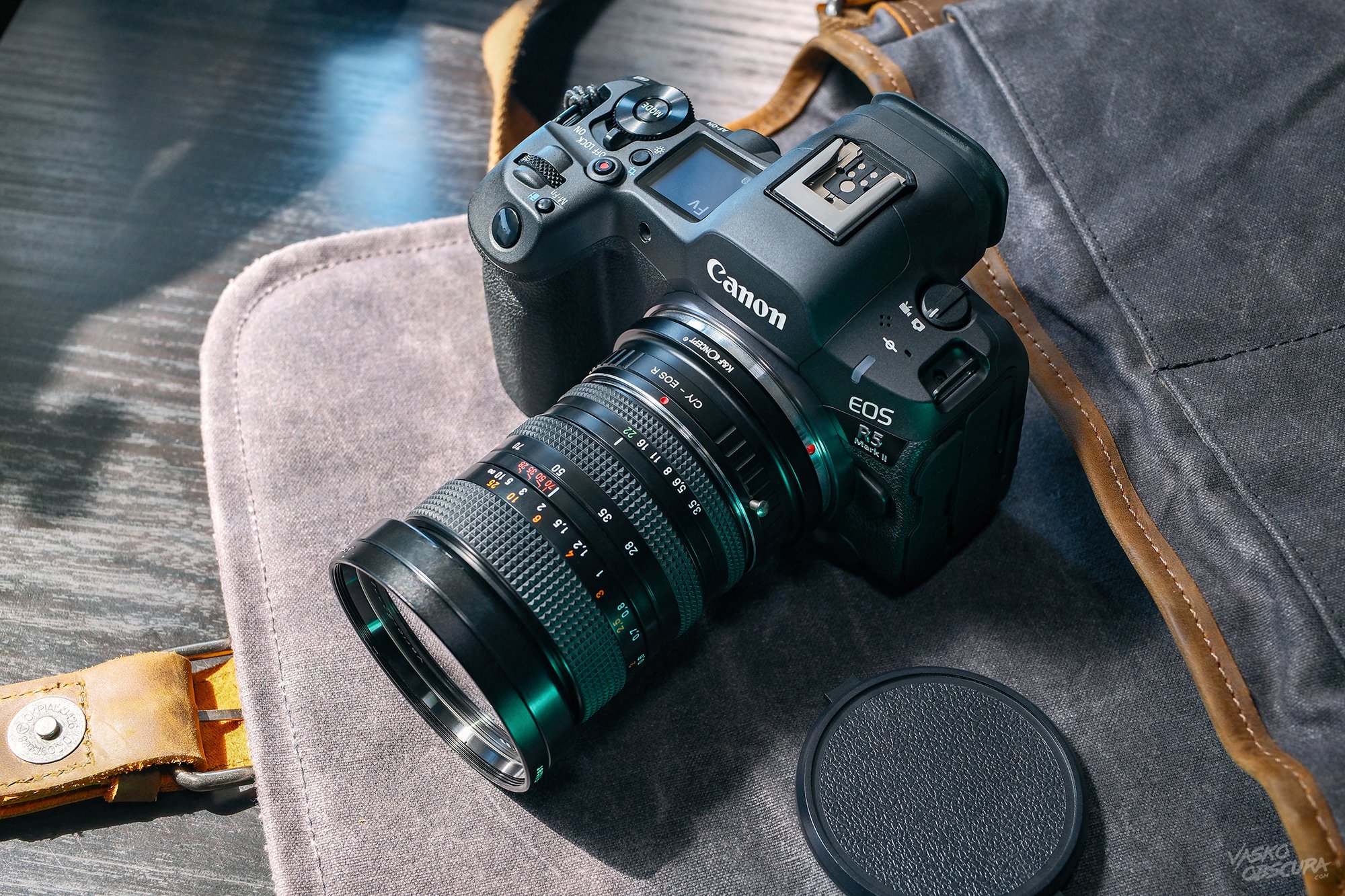
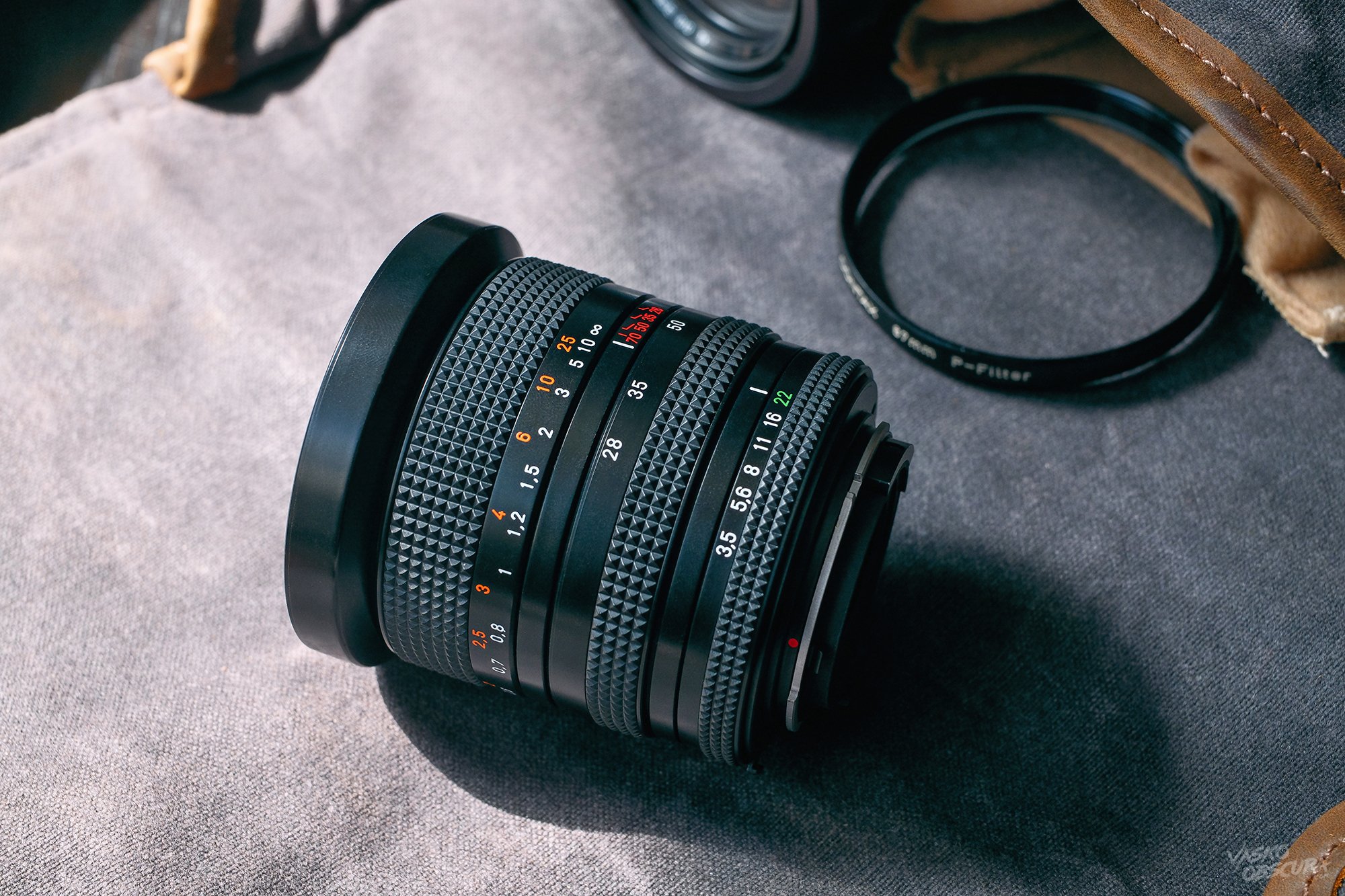
Typical of vintage Zeiss glass, the build quality is excellent. The lens features a solid metal construction with a smooth, well damped focus ring that feels precise and deliberate. The zoom ring has a slightly firmer resistance, which actually adds to the confidence when composing shots, no accidental focal length shifts here. Keep in mind these are vintage lenses so your copy of the lens might be different. It’s a fully manual lens, so there’s no autofocus or electronic communication. What you gain, though, is a highly tactile shooting experience that feels intentional and engaging, something many modern lenses have lost.
Optical Design & Zeiss Engineering
Optical diagram of the Contax Zeiss Vario-Sonnar 28-70mm f/3.5-4.5 lens showing lens element layout (this is based on what I was able to find on the internet)
For a variable aperture zoom from the 1980s, the optical design here is genuinely impressive.
The lens features:
9 elements in 8 groups
An aspherical element
Special glass with anomalous partial dispersion
In practical terms, this translates to:
Strong sharpness (especially stopped down)
Good control of chromatic aberration
Clean color rendering
This is classic Zeiss engineering, focused not just on resolution, but on overall image quality and rendering.
Compact Size & Everyday Usability
One of the standout features of this lens is just how compact it is. At only 320g, it’s incredibly lightweight for a zoom covering 28-70mm. Compared to modern full-frame zooms, this thing feels almost pocketable. This makes it an excellent choice for:
Travel photography
Street photography
Everyday carry setups
Mirrorless adaptations
Mounted on a modern mirrorless camera, it balances beautifully and doesn’t feel front-heavy like many modern zoom lenses.
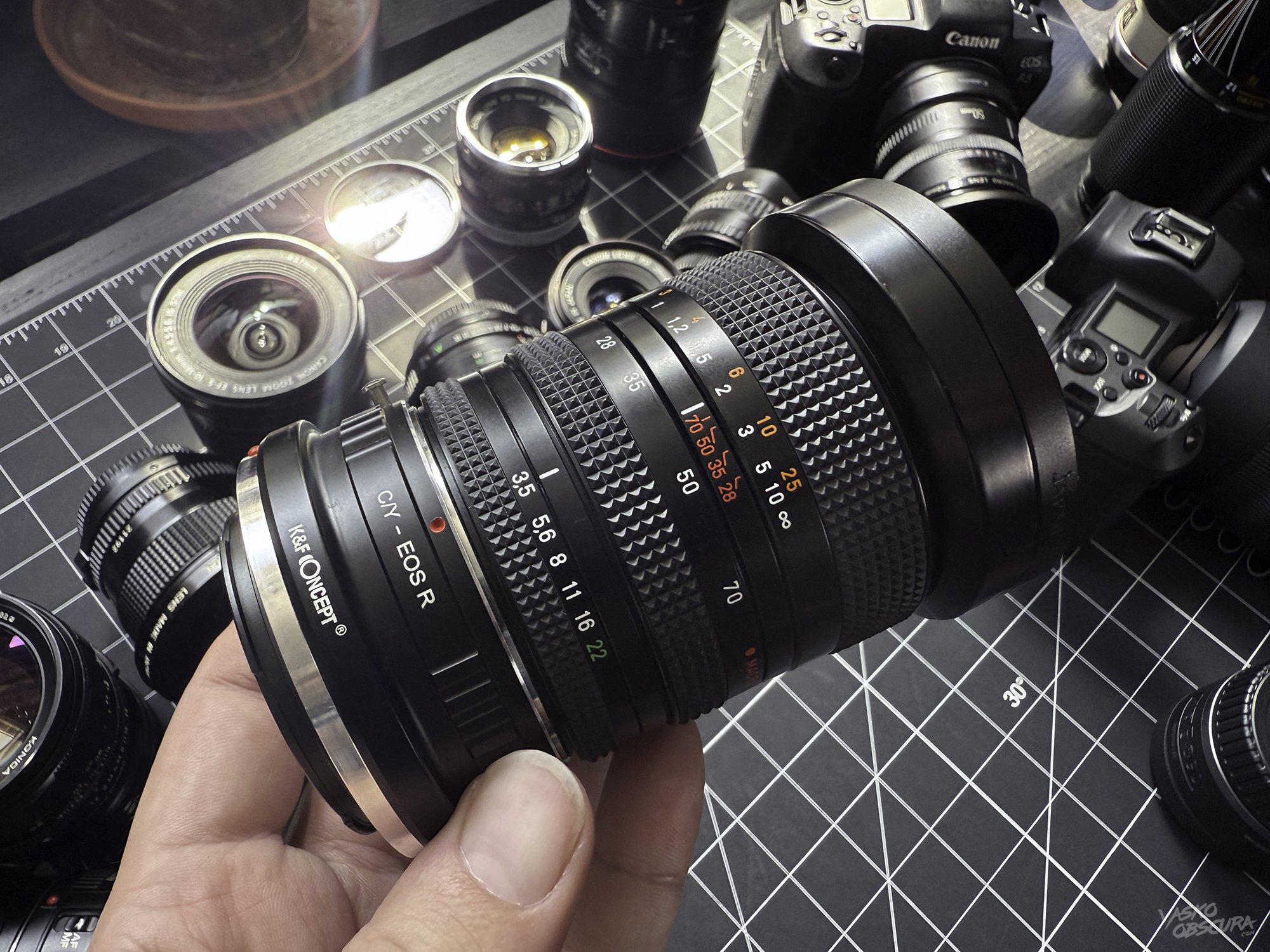
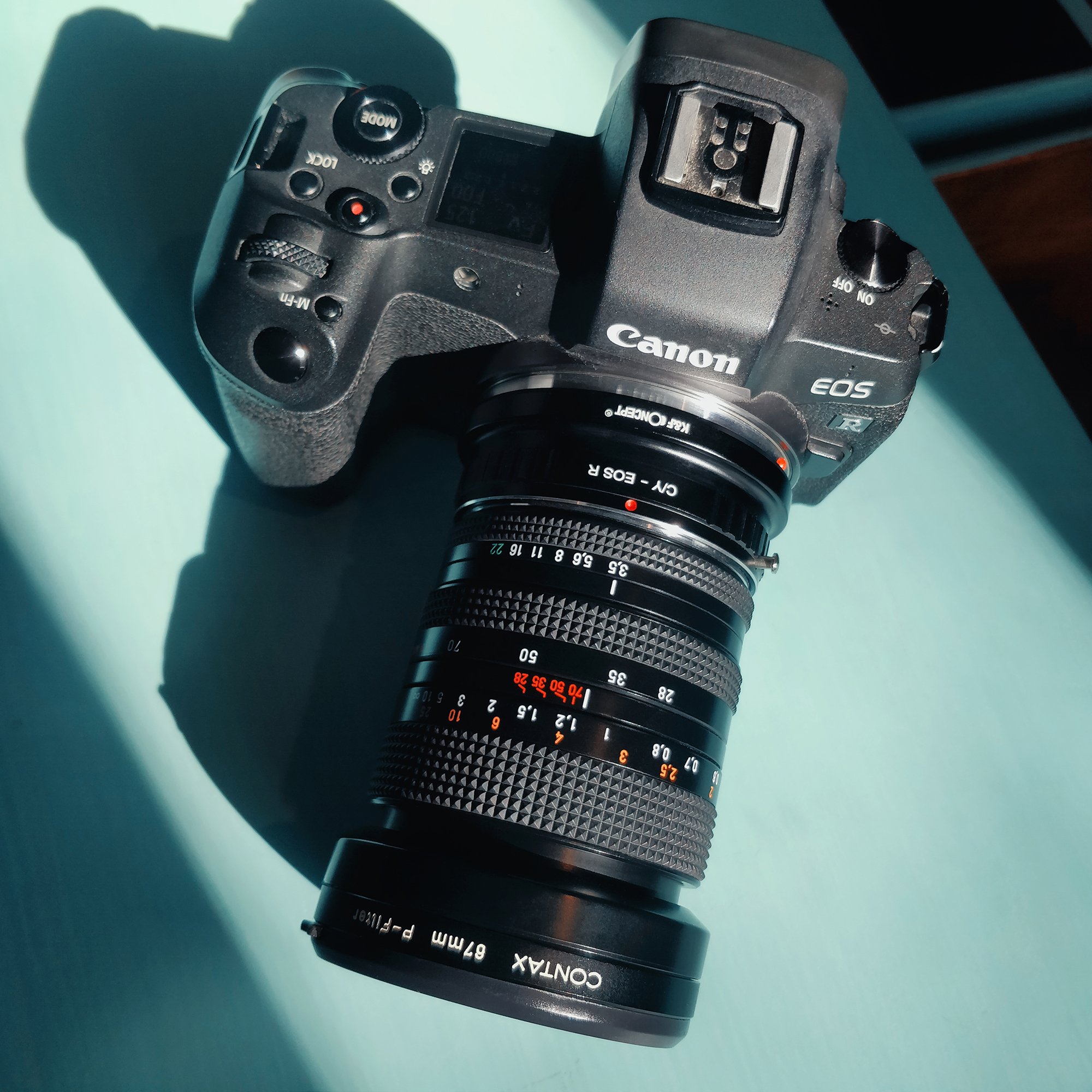
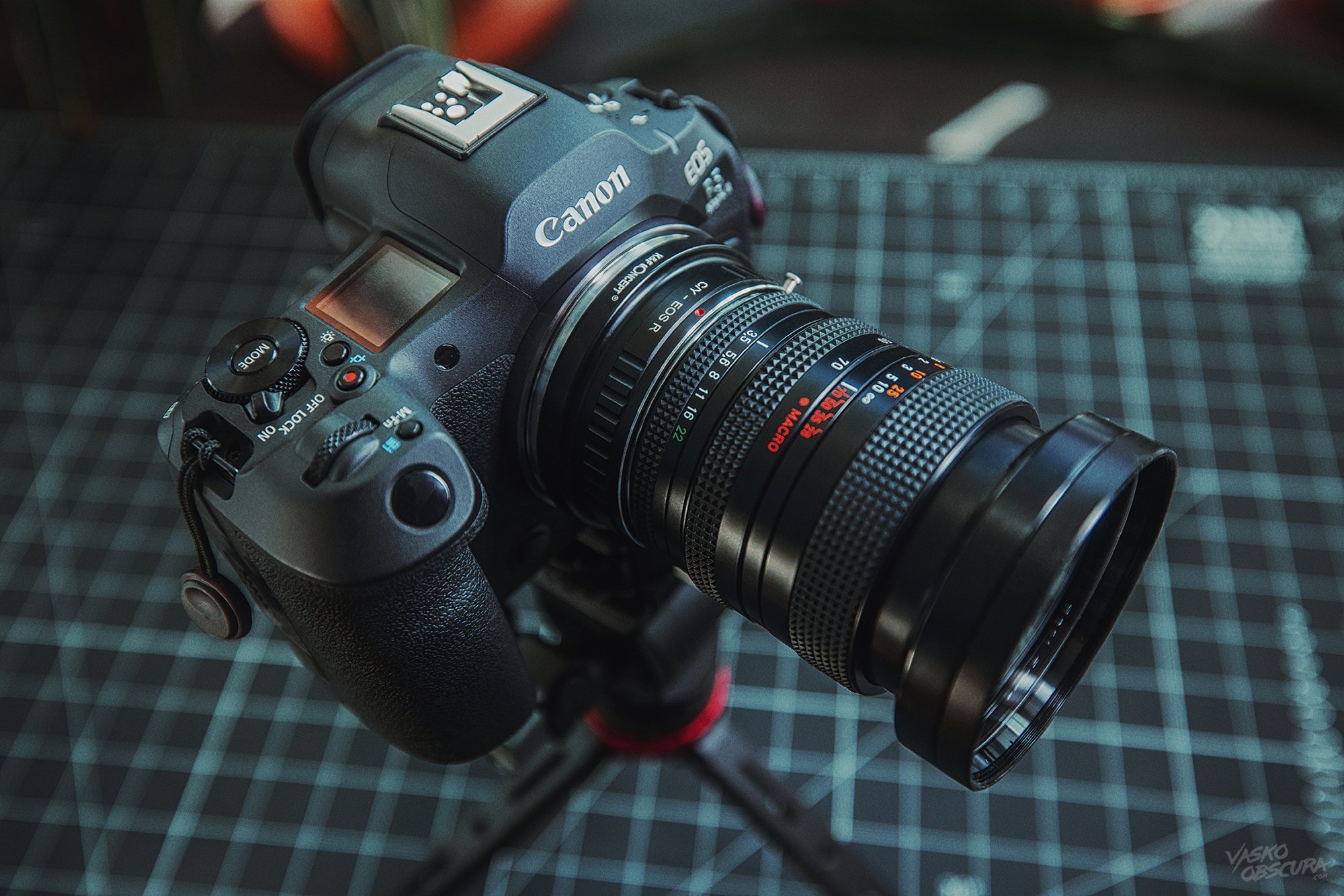
To mount this lens you need a C/Y to (your camera mount) adapter. In my Case C/Y to EOS R adapter. If you want more info on adapting vintage lenses and what menu setting you need to change on your camera to do so check out this link.
Gear Shots

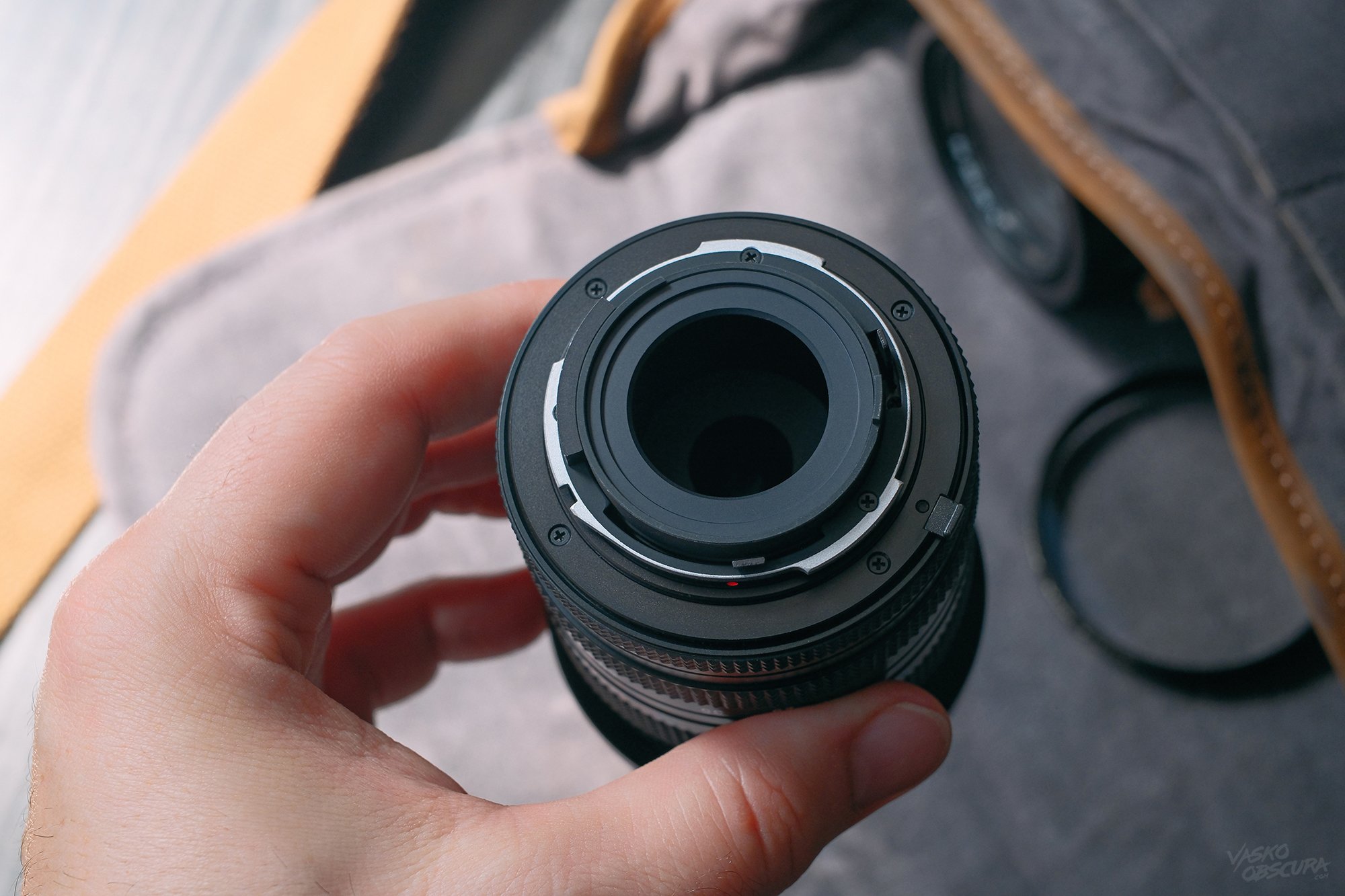
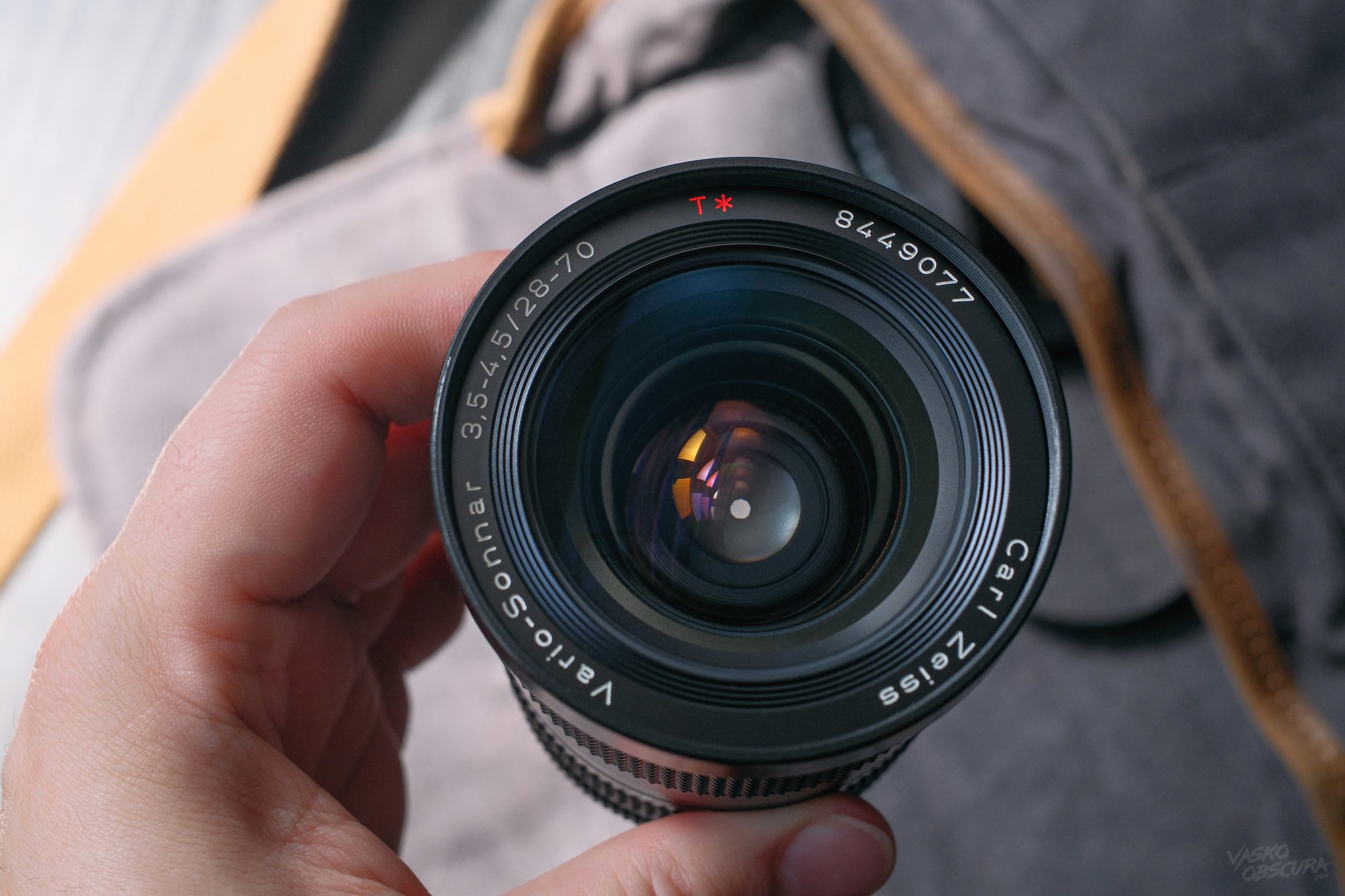
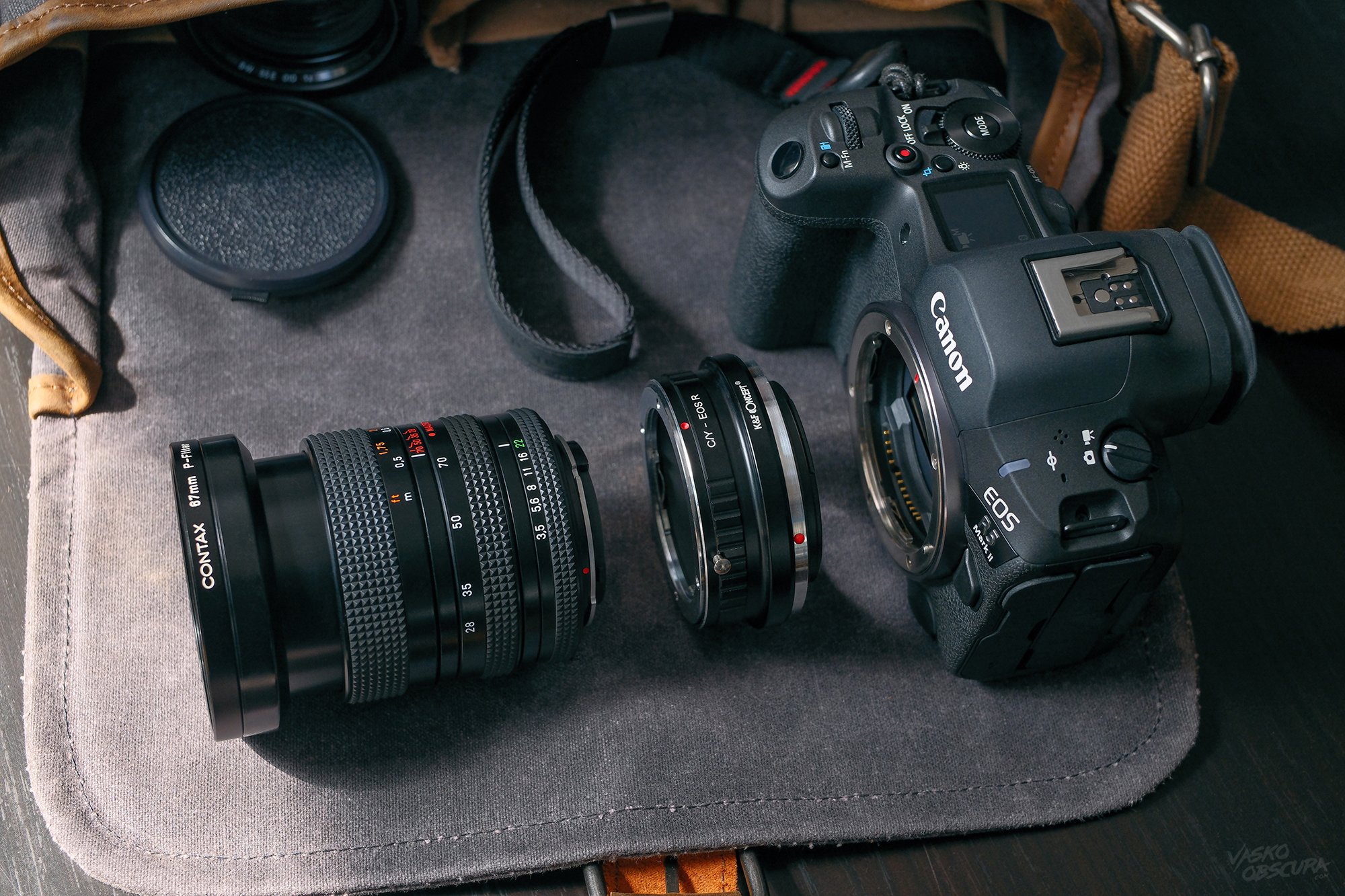


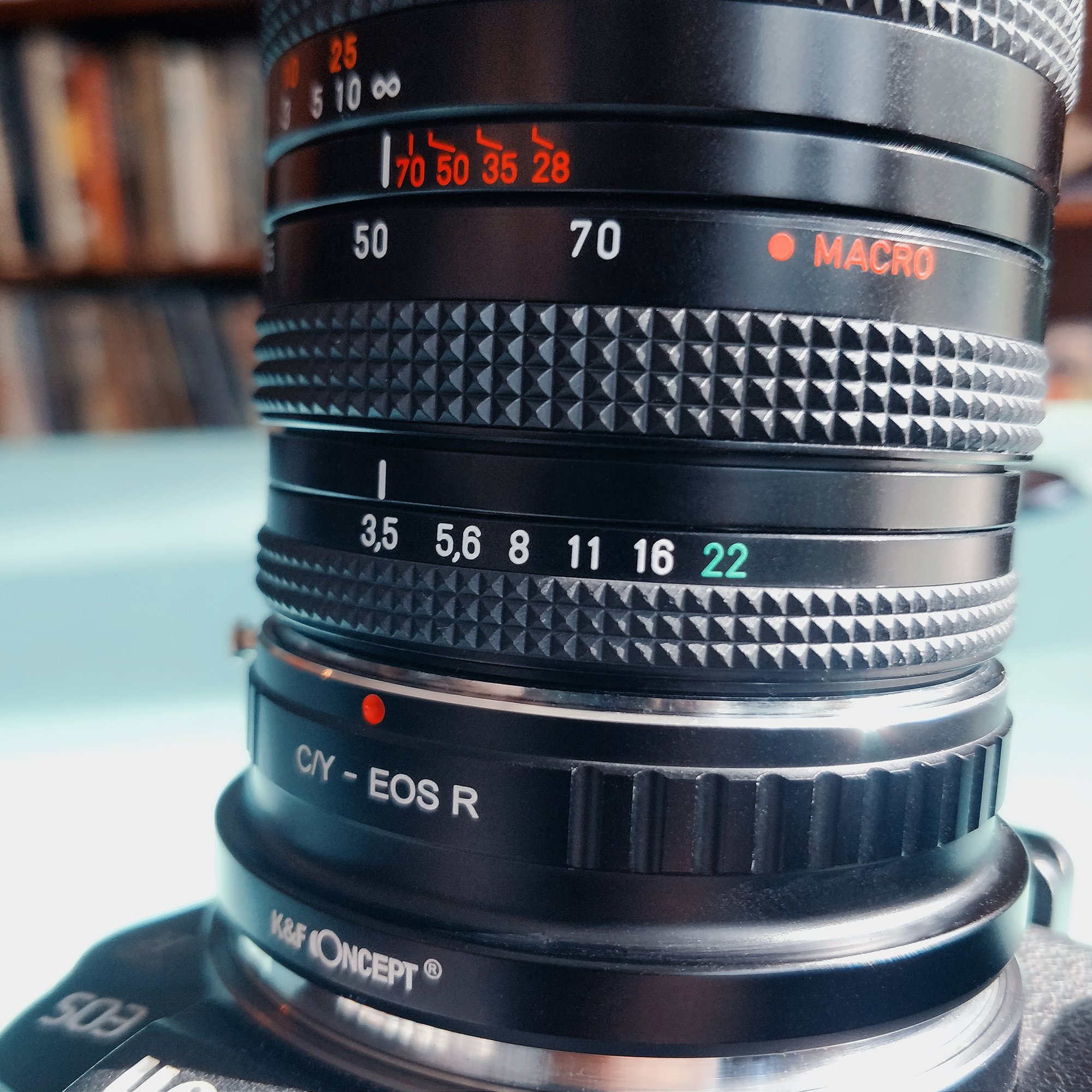



Macro Mode Functionality
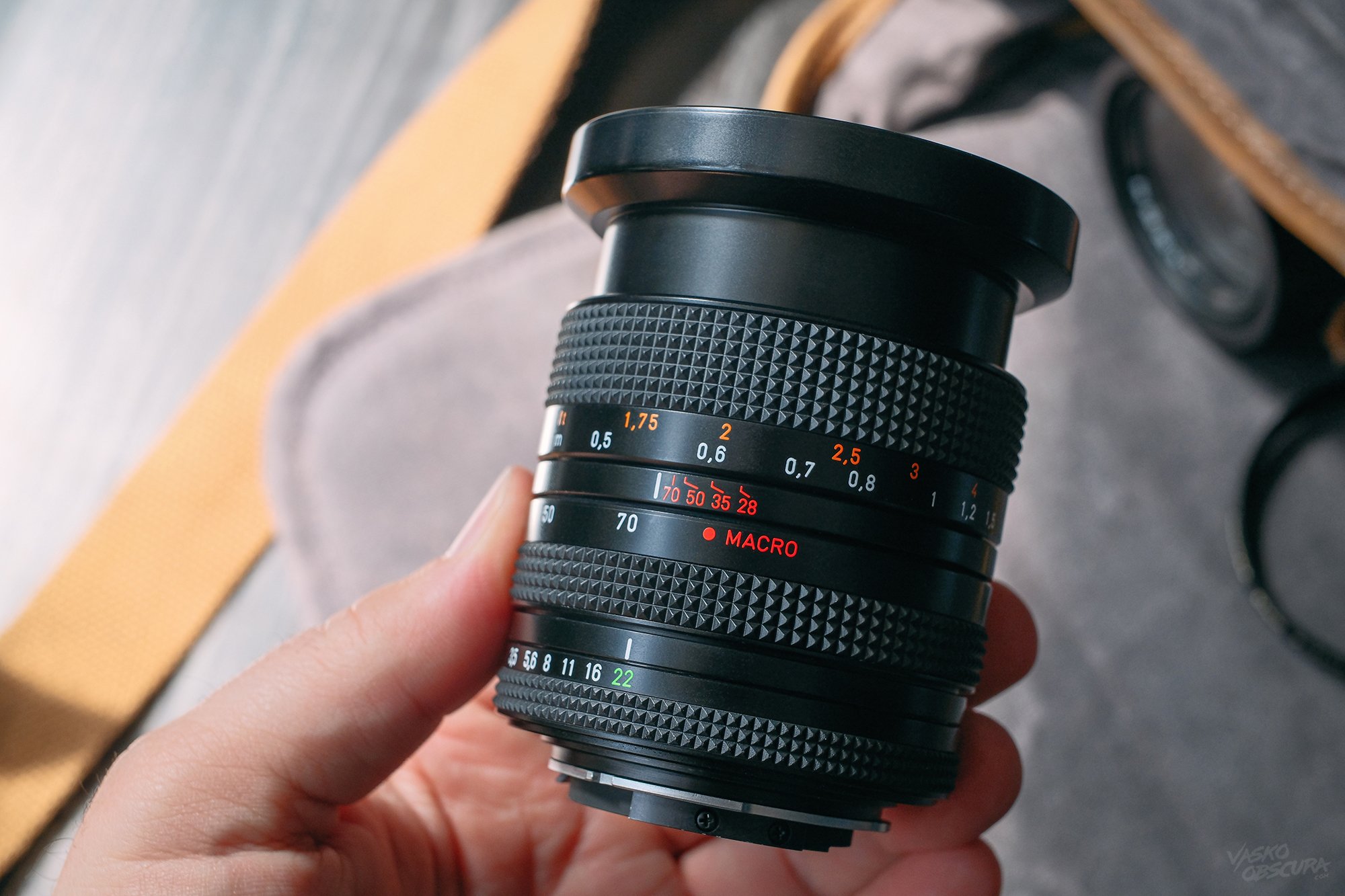
A surprisingly useful feature is the built-in macro mode. By twisting the zoom ring past 70mm, the lens engages macro mode, allowing you to focus much closer than the standard minimum distance. While it’s not a true 1:1 macro lens, it’s more than capable for:
Close-up textures
Product-style shots
Flowers and nature details
Creative subject isolation
It adds a layer of versatility that you wouldn’t necessarily expect from a lens of this era. Here is an image of a lav mic receiver shot in macro mode with the CONTAX Zeiss Vario-Sonnar 28-70mm f/3.5-4.5. More sample photos here.
T* Coating & Flare Resistance
One of the defining features of Zeiss lenses is their T* (T-star) multi-layer coating. You can Identify lense with the T* coating by the bright orange marking. On this lens, it plays a huge role in performance:
Reduces flare and ghosting
Maintains contrast in backlit scenes
Produces rich, saturated colors
Even when shooting into challenging light, the lens holds contrast surprisingly well for its age. That “Zeiss pop” is definitely present here. Every time I shoot with this lens I’m surprised at how well it performs.
Historical Context: Zeiss vs Zoom Skepticism
To really appreciate this lens, you have to understand the era it came from. In the 1980s, zoom lenses were widely considered inferior to primes. They were softer, had more distortion, and lacked consistency across the zoom range. Zeiss entering this space was significant. The Vario-Sonnar line was their attempt to prove that zoom lenses didn’t have to be a compromise, and this 28-70mm was a key part of that effort. It didn’t completely replace primes, but it absolutely narrowed the gap.
One detail that vintage Zeiss enthusiasts love to point out is that this lens exists in two versions: AE and MM. Optically, they are identical, the difference is purely mechanical and tied to camera compatibility. The easiest way to tell them apart is on the aperture ring: the MM version has its minimum aperturef/22 marked in green, while the AE version uses all white markings. That green marking indicates support for program (P) mode on later Contax bodies, whereas AE lenses are limited to aperture priority and manual modes. For modern shooters adapting the lens to mirrorless, there’s no difference in image quality, but the MM version is often a bit more desirable among collectors. This post features the MM version.
My lens has a serial number of 8449077. According to that I was able to find on the interwebs my copy, with a serial number in the 8.4 million range, appears to be a later MM production from the late 1990s or early 2000s, likely from the final years of the Contax/Yashica system. The benefit of these newer lense is slightly improved coatings consistency. Still T*, but manufacturing refined over time. Does it really make a difference? Who knows.
Shooting Experience & Handling
Shooting with this lens is a very different experience compared to modern glass. There’s no autofocus. No stabilization. No digital corrections. But what you get instead is:
A deliberate, hands-on shooting process
Smooth manual focus control
A strong connection to your subject
While the variable aperture (f/3.5–4.5) isn’t the fastest, it’s perfectly usable in most conditions especially on modern mirrorless cameras which can shoot at high ISO without incurring a lot of noise. It’s as if Contax built this lenses for mirrorless. lol. On high resolution sensors, the lens performs best when stopped down slightly, but even wide open, it delivers a pleasing, organic rendering that feels far from clinical.
Final Thoughts
The CONTAX Zeiss Vario-Sonnar 28-70mm f/3.5-4.5 is a reminder of a transitional moment in lens design, when zooms were evolving from convenience tools into serious optical instruments. It’s compact, well-built, and optically impressive for its time. But more importantly, it has character. One thing I’ll say here is that there are two types of vintage lens enthusiasts. Those that hunt quality and those that hunt character. If it’s character that you want than perhaps this isn’t the lens for you. Let me point you in the direction of the Helios-44.
In the next post, we’ll dive deeper into what really matters:
👉 Optical performance, image quality, sharpness, and real-world results
📸 If you want to see a list of all the vintage lenses I have check out this link