
Canon EF-S 10-18mm f/4.5-5.6 IS STM Mini Review - Hands-On, Technical Breakdown

Canon EF-S 10-18mm f/4.5-5.6 IS STM Mini Review
The Canon EF-S 10-18mm f/4.5-5.6 IS STM is one of those under ratted lenses that can quietly became a staple in your kit. On paper, it’s a budget friendly ultra-wide designed for APS-C DSLRs, often marketed toward beginners but in real-world use, it consistently delivers results that feel far more refined than its price tag suggests. I bought this lens as a vlogging lens for my YouTube channel but honestly I was surprised by the image quality.
With an effective full-frame equivalent of roughly 16–29mm and image stabilization, this lens opens up a huge range of creative possibilities, from expansive landscapes and dramatic architectural lines to tight interiors and immersive vlog-style framing. What really makes it stand out to me, though, isn’t just the focal length, it’s how much Canon managed to pack into such a compact, lightweight, and accessible lens. Between the built-in image stabilization, smooth STM autofocus, and it’s easy adaptability to modern RF mirrorless systems, this lens ends up being far more versatile than most people give it credit for.
Can you mount the Canon EF-S 10-18mm on a full frame RF body? Just to get this question out of the way because I get it often. Yes you can mount this lens on a full frame RF body. Your mirrorless camera will recognize it and switch in to APS-C crop mode automatically you don’t have to change any settings. More on that below.
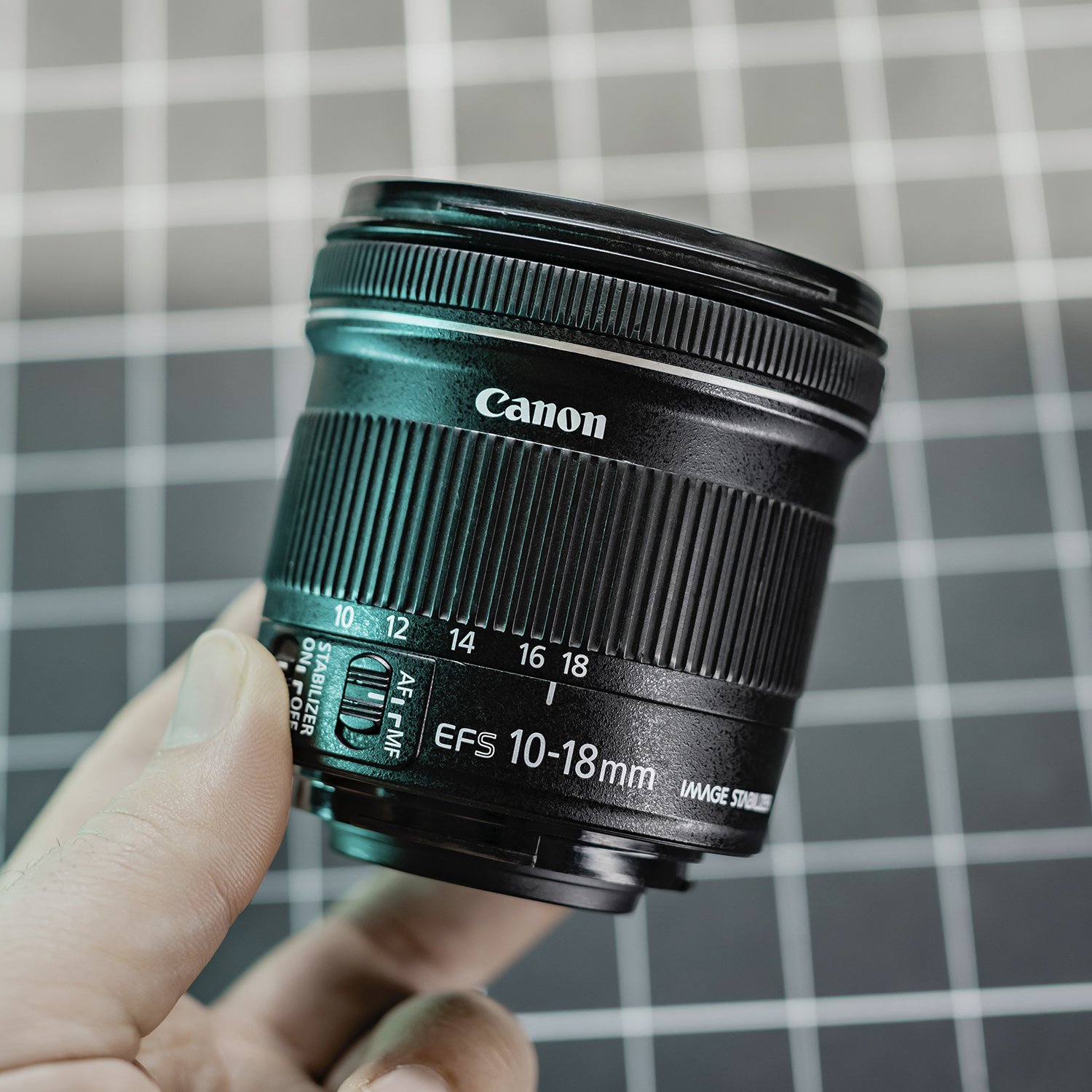
LENS SPECS
Release Date: 2014
Format: APS-C
Mount: EF-S / EF
Filter: 67mm
Aperture Blades: 7
Aperture Range: 4.5 - 29
Min Focus Distance: 0.22m
Weight 240g
Lens IS: Yes
Weather Sealing: No
Optical Design: 14 elements in 11 groups
Full Frame Conversion Approx.: 16-29mm
Build Quality & Design
Lightweight but Purposeful
One of the first things I noticed when I picked up the EF-S 10-18mm is just how light it is. At only 240g, it feels almost weightless on a camera body, which makes it ideal for travel, handheld shooting, vlogging and long days out shooting content. That said, this is very clearly a plastic-heavy construction, including the lens mount. (BTW there is a metal lens mount kit you can buy for this lens to upgrade it yourself) Some people see that as a downside, but in real-world use, I’ve never noticed any issues with it.
The trade-off is durability. This isn’t a lens I’d want to abuse in harsh conditions, especially since there’s no weather sealing. Treat it appropriately and it will be just fine.
Zoom & Focus Rings
The zoom ring is smooth and well-damped for a lens in this price range. It doesn’t feel premium, but it’s predictable and easy to control, which matters more in practice. The focus ring is electronically coupled (focus-by-wire), which is typical for STM lenses. It’s not designed for heavy manual focus work, but for occasional adjustments or video use, it performs just fine.
Buttons & Switches
Simple and Functional, Canon kept things minimal here, which I have no issues with at this price point:
AF/MF Switch
Image Stabilization ON/OFF Switch
That’s it, no unnecessary clutter. The switches are firm and tactile, with enough resistance that I’ve never accidentally bumped them while shooting. This simplicity aligns perfectly with the lens’s intended audience: creators who want reliability without overcomplication.
Image Stabilization (IS) Performance
The built-in Image Stabilization (IS) is surprisingly effective for an Ultra-Wide and one of the most underrated features of this lens. In my experience, I can comfortably shoot handheld at slower shutter speeds than expected, especially useful for:
Indoor real estate or architecture
Handheld video and vlogging
Low-light travel scenes
Canon rates it around 4 stops of stabilization, and honestly, that feels pretty accurate in real-world use. I made a YouTube video showing the stabilization of this lens in action. You can watch it here. For video creators, this pairs beautifully with the STM motor, giving you smooth, stable footage without needing a gimbal in many situations.
Gear Shots





STM Autofocus System
The STM (Stepping Motor) is exactly what you’d expect, quiet, smooth, and reliable. For photography, autofocus is fast enough for most use cases (though not sports). But where it really shines is video:
No harsh focus jumps
Minimal focus noise
Smooth transitions for subject tracking
If you’re shooting YouTube content or vlogging, this lens is incredibly easy to work with.
Using This Lens on Mirrorless (RF Mount)
One of the biggest advantages of EF and EF-S glass right now is how easily it adapts to Canon’s RF system. With an EF to RF adapter, I’ve had zero issues using this lens on mirrorless bodies. Autofocus works flawlessly, and performance feels native. If you’re trying to save some money, you don’t need to go with Canon’s official adapter. I’ve personally been using the third-party JJC EF to RF Adapter along with my official Canon adapter on my R5 cameras and haven’t noticed any difference.
Important note:
When mounted on a full-frame RF body, the camera automatically switches into 1.6x crop mode, so you won’t get full sensor coverage but that’s expected with EF-S lenses. When you put a regular full frame lens on the camera it will automatically switch back to full frame mode.
Real-World Use Cases
Where does this lens shine? Based on my experience:
Landscape Photography: Very good
Vlogging / YouTube Content: Very good
Travel Photography: Good
Street Photography: Good
Walkaround Use: Good
Where It Falls Short
Wildlife / Birding: Poor
Sports: Poor
Macro: Poor
This isn’t meant to be an all-in-one lens, it’s a specialist ultra-wide, and it performs best when used that way.
Final Thoughts
The Canon EF-S 10-18mm f/4.5-5.6 IS STM is one of the best value ultra-wide lenses Canon has ever made and it still performs well on modern mirrorless cameras. It’s not built like a tank, and it doesn’t try to be but what it does offer is incredible usability, portability, and surprisingly strong performance for the price.
From my perspective, this is a lens that makes ultra-wide photography accessible without sacrificing too much in terms of quality. Add in solid image stabilization, smooth STM autofocus, and seamless RF compatibility, and it becomes an easy recommendation, especially for creators and hybrid shooters. If you’re building out a budget-friendly kit or adapting older glass to a mirrorless system, this lens absolutely deserves a spot on your shortlist.