
Fujinon GF 45mm f/2.8 R WR Mini Review - Optical Performance Breakdown

Introduction: A Compact Prime Built for Medium Format Precision
Shooting portraits with the Fujinon GF 45mm f/2.8 R WR is an absolute joy. The 45mm focal length, roughly a 36mm full-frame equivalent, hits a sweet spot that feels immersive and natural, without introducing the kind of distortion that can compromise facial features. It’s a perspective that works beautifully for environmental portraits, documentary work, and everyday storytelling. What really stands out, though, is how the lens balances character with precision, it’s tack sharp where it needs to be, yet transitions into a soft, organic falloff that gives images a subtle depth and separation. The f/2.8 aperture adds just enough background blur for subject isolation, but this lens isn’t just about look, it’s about performance. On high-resolution GFX sensors, its optical quality becomes the real story, and in this review, we’ll take a closer look at its sharpness, rendering, aberration control, and overall image quality.
This review will focus on optical performance but if you want a more technical look at this lens read this post next.
Optical Design and Engineering
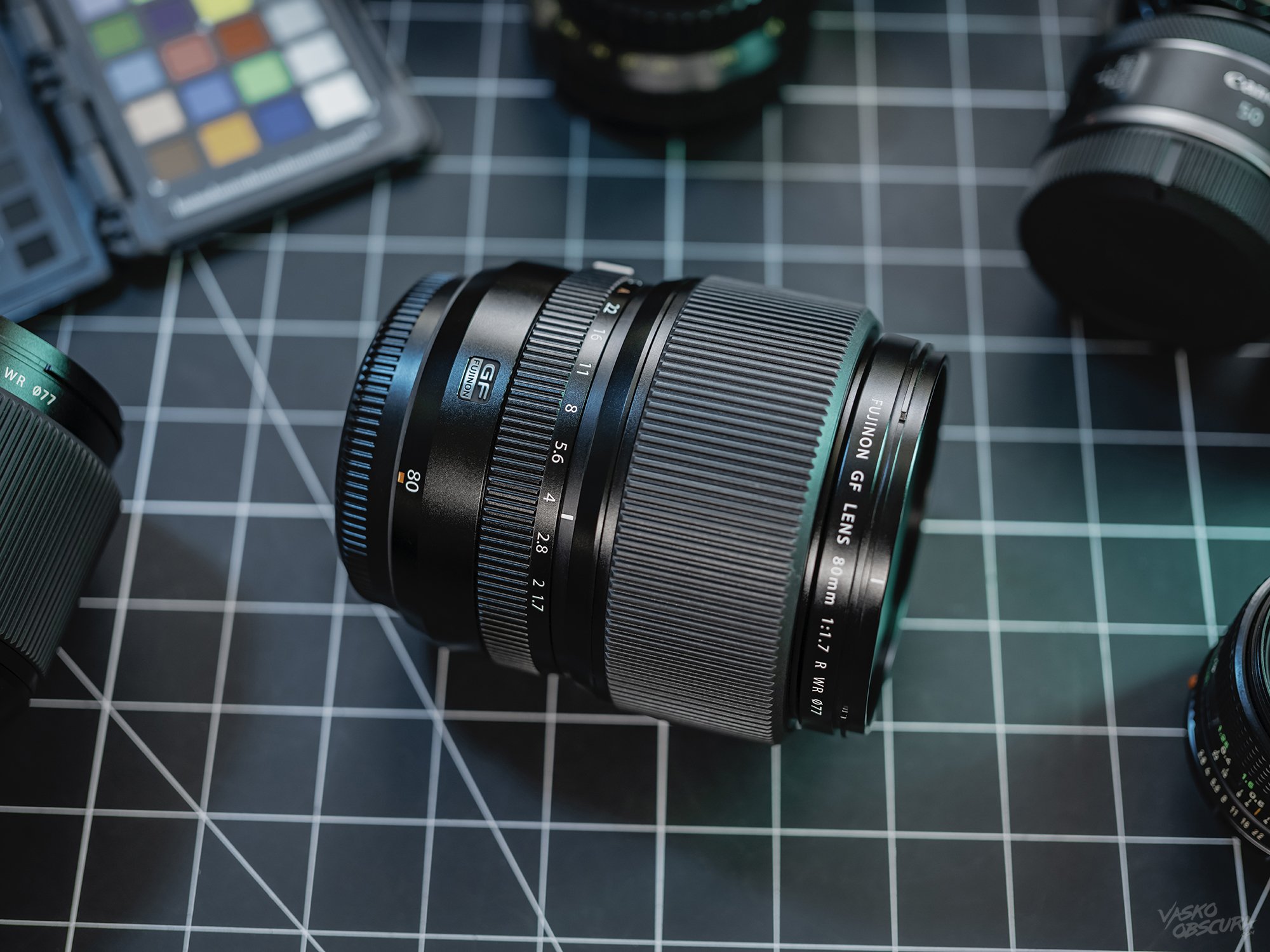
At the core of the GF 45mm f/2.8 is a relatively simple but highly refined optical formula, 11 elements in 8 groups, including one aspherical element and two extra-low dispersion (ED) elements. These are paired with Fujifilm’s Nano GI coating to minimize flare and ghosting. This design is clearly optimized for resolution and clarity across a large image circle, which is essential when covering a (cropped) medium format sensors. The inclusion of ED elements helps suppress chromatic aberrations, while the aspherical element contributes to edge-to-edge sharpness and distortion control.
A stylized optical diagram of the Fujinon GF 45mm f/2.8 R WR lens. The image features a cross-section of the lens elements arranged horizontally, with select elements highlighted in accent colors to represent specialized glass such as ED and aspherical elements.
Sharpness and Resolution Performance
Sharpness is where the GF 45mm f/2.8 truly shines. Even at its widest aperture, the lens delivers impressive detail and clarity, particularly in the center of the frame. Wide open at f/2.8, images are already highly usable with strong micro-detail, making it practical for real-world shooting without needing to stop down. As you move into the f/4 to f/5.6 range, sharpness increases further, reaching peak performance with excellent consistency across the frame. Corner performance tells a slightly more nuanced story. While center sharpness is strong at f/2.8, the edges and corners improve noticeably when stopping down, becoming well-balanced around f/5.6 to f/8. Real-world shooting reinforces this behavior, I’d say this is one of the sharpest lenses I have ever used. But hold that thought is it the lens that’s sharp or is it simple the incredible resolution of the sensor that gives detail to the image? Probably a little bit of both.
Micro-Contrast and Rendering
Beyond pure sharpness, the GF 45mm f/2.8 excels in micro-contrast and tonal rendering, which is where medium format lenses separate themselves from full-frame counterparts. Images exhibit a clean, crisp look with a subtle depth that gives files a more “three-dimensional” feel. This micro-contrast helps subjects stand out naturally without appearing overly processed or harsh. If you haven’t used a medium format camera yet it truly is an experience to view your picture after a shoot. The rendering is often described as organic and lifelike, producing files that retain fine tonal transitions and natural color separation, especially noticeable in skin tones and environmental textures. This is both a gift and a curse. Cleaning up skin can take forever and have you wishing you were shooting with a low resolution APS-C sensor at time. 😭 True Story.






Chromatic Aberration and Optical Corrections
Chromatic aberration is extremely well controlled on this lens. Thanks to its ED elements, color fringing is minimal and typically only appears in extreme high-contrast scenarios. However, I will say that out of all the GF lenses I’ve used so far this is the one that performs the best when it comes to chromatic aberration. The others arn’t so good. In most real-world shooting conditions, lateral and longitudinal chromatic aberrations are virtually invisible, which is impressive given the resolving demands of medium format sensors. Distortion is also well managed, with only minor barrel distortion present and easily corrected in post-processing when needed.
Vignetting and Light Fall-Off
Like many fast wide-angle medium format lenses, the GF 45mm f/2.8 exhibits some vignetting when shooting wide open. However, it is relatively mild and becomes negligible by f/4. In practical use, this slight fall-off can actually enhance images by subtly drawing attention toward the center of the frame. For critical work, it is easily corrected in post without degrading image quality.
Bokeh and Depth Rendering
While not a traditional “bokeh lens,” the GF 45mm f/2.8 still delivers smooth and pleasing out-of-focus rendering. The 9-blade rounded aperture contributes to soft transitions between in-focus and out-of-focus areas. The depth rendering is particularly interesting on medium format. Even at f/2.8, the larger sensor creates a more gradual falloff, producing a natural separation that feels less abrupt than full-frame equivalents. The result is a subtle, cinematic look, especially effective for environmental portraits and storytelling compositions.
Flare Resistance and Contrast
Fujifilm’s Nano GI coating plays a key role in maintaining contrast when shooting into challenging light. Flare and ghosting are well controlled, allowing the lens to retain strong contrast even in backlit scenes. This contributes to the overall consistency of the lens, ensuring that image quality remains high across a wide range of lighting conditions.
Real-World Optical Performance on High-Resolution Sensors
When paired with high-resolution bodies like the GFX 100s, the GF 45mm f/2.8 proves capable of resolving extremely fine detail. Many tests show that it maintains excellent clarity even at 100+ megapixels, particularly when stopped down slightly. This lens has been an absolute joy to use. However, like most lenses, it performs best within its optimal aperture range (f/4–f/8), where it delivers maximum resolving power across the entire frame. Once you move towards f/11 diffraction makes images soft.
Final Verdict: A High-Performing Medium Format Prime
The Fujinon GF 45mm f/2.8 R WR is an impressive optical performer that really highlights what makes medium format so special. It delivers excellent sharpness, beautiful micro-contrast, and well-controlled aberrations, all in a compact and highly usable form factor. While stopping down brings out its absolute best edge-to-edge performance, it’s already incredibly strong wide open, making it reliable in real-world shooting scenarios. What makes this lens stand out even more is its versatility, the roughly 35mm full-frame equivalent focal length hits that perfect everyday perspective, ideal for everything from portraits to documentary work. Personally, I see this as a must-have lens for anyone invested in the GFX system. It strikes that rare balance between portability and image quality, producing files that truly showcase the depth and character of medium format.