

AsAhi Auto Takumar 35mm f/2.3
AsAhi Auto Takumar 35mm f/2.3
When I first mounted the Asahi Auto Takumar 35mm f/2.3 on my camera, I wasn’t expecting perfection I was chasing character. In a world where modern lenses are engineered to be clinically sharp, flare-resistant, and almost too perfect, this little piece of late-1950s glass feels like stepping into a completely different philosophy of image-making. The first few frames I shot immediately told me this wasn’t going to be a typical vintage lens. There was a softness, a glow, and a kind of unpredictability that made each image feel more like an interpretation than a recording but as I stopped down the lens it’s character totally changed. It’s like two lenses in one. And honestly, that’s what hooked me.
This is one of those vintage lenses that doesn’t try to compete with modern optics on technical metrics. Instead, it delivers something far more interesting, a distinct visual signature that feels organic, nostalgic, and just a little unpredictable. In this review, I’m focusing purely on optical performance, how this lens renders the world, how it behaves in different lighting conditions, and whether it’s actually worth buying today if you’re chasing that vintage look. If you’re looking for a more of a technical breakdown of this lens with a little lens history check out this post next.
Optical Design Overview
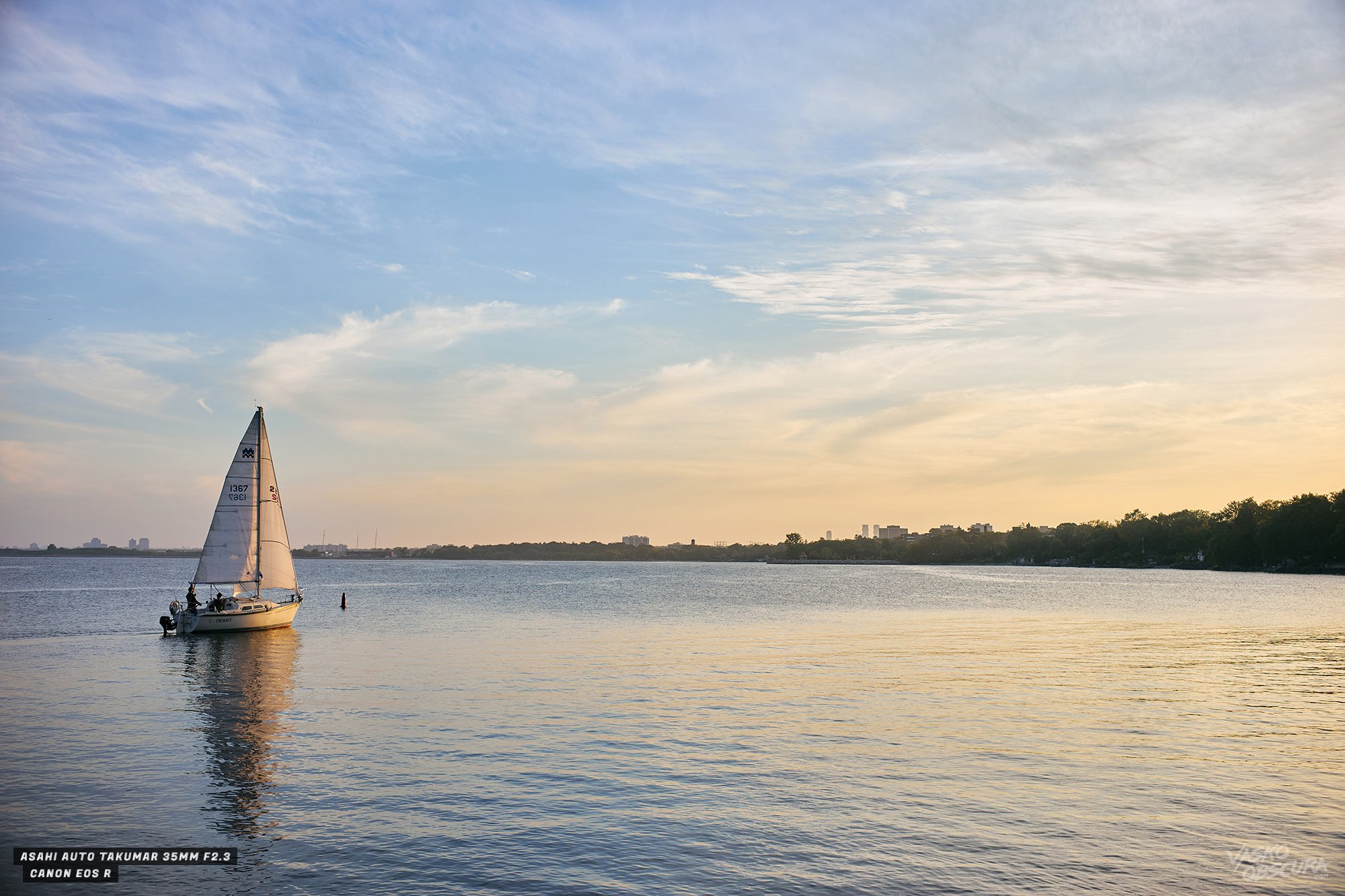
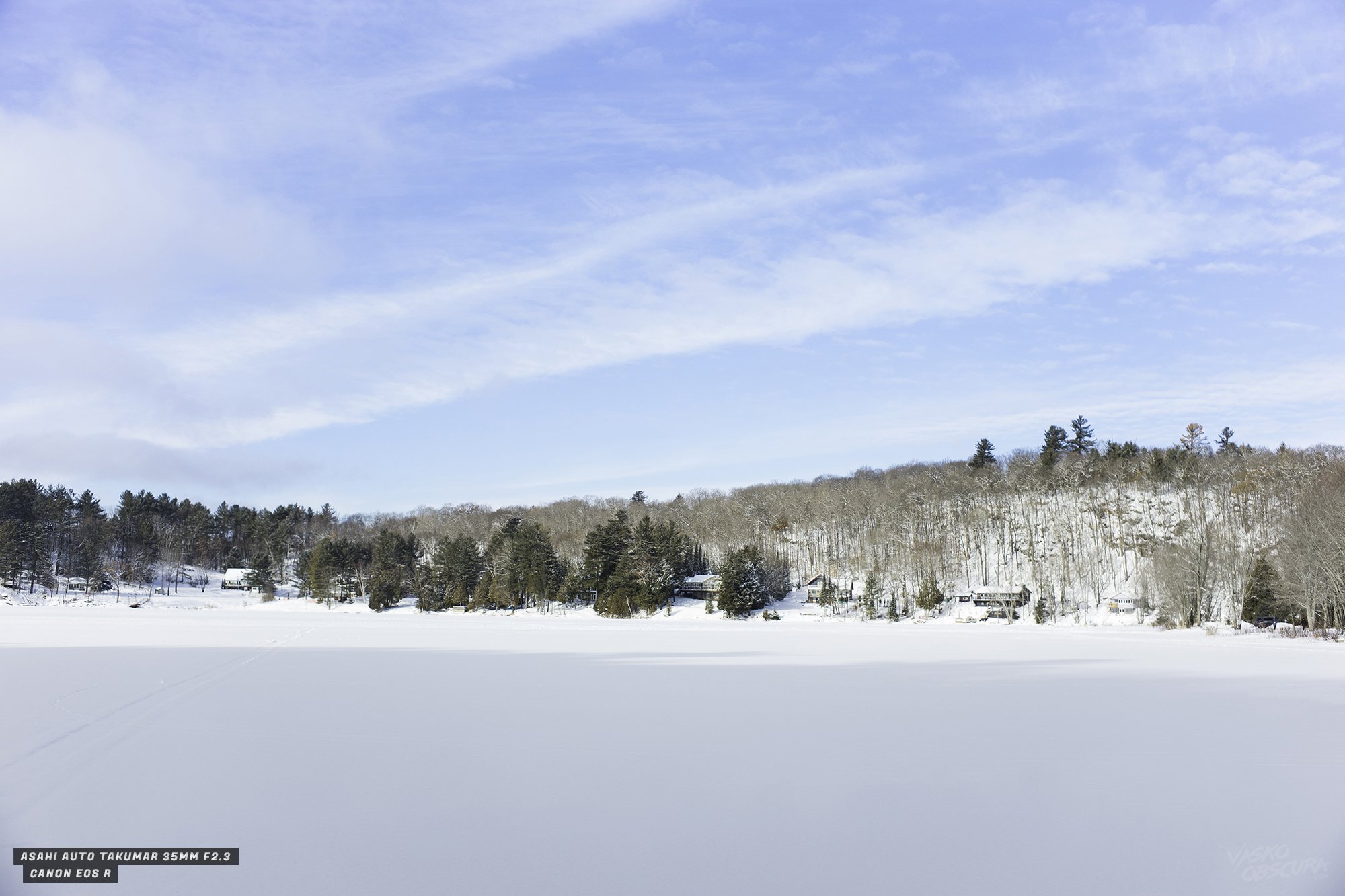
The optical design of the Auto Takumar 35mm f/2.3 reflects its late-1950s origins. This was a time when wide-angle lenses were still evolving, and designers were balancing size, cost, and performance with fewer tools than we have today. The formula is relatively simple compared to modern lenses, and just as importantly, it uses early single-coating technology. This has a massive influence on how the lens performs especially in terms of contrast, flare, and color transmission. What stands out to me is that this lens doesn’t aim for clinical perfection. Instead, it produces a softer, more interpretive image that feels closer to film-era rendering but at the same time it can also produce sharp images. Below are two examples shots taken with this lens. The first image what shot wide open using an ND filter and you can see soft edges. The second image was shot stopped down and the lens completely sharpens up.


Wide Open Performance (f/2.3)
Shooting wide open at f/2.3 is where this lens really shows its personality. There’s a noticeable softness across the frame, especially toward the edges. The center is usable, but it has a gentle glow that gives images a slightly dreamy quality. For portraits or atmospheric street shots, I actually love this look, it feels uniquely vintage. Contrast is lower at f/2.3, and highlights tend to bloom slightly. Combined with the softer rendering, this creates a very cinematic feel that’s hard to replicate with modern glass. If you’re expecting razor-sharp performance wide open, this isn’t the lens for you. But if you’re chasing mood and character, this is where it shines.
Stopped Down Sharpness & Contrast
Once I stop the lens down to f/4 and beyond, things tighten up significantly. Sharpness improves across the frame, and contrast becomes more defined. By the time you hit around f/5.6 to f/8, the lens delivers surprisingly solid performance for its age. It never becomes clinically sharp, but it reaches a point where detail is more than acceptable for most real-world uses.
What I find interesting is that even stopped down, the lens retains a subtle softness in its rendering. It doesn’t lose its character it just becomes more controlled.
Color Rendering & Tonal Character
One of my favorite aspects of this lens is its color rendering. Because of the older coatings, colors tend to feel slightly muted compared to modern lenses. There’s a warmth to the tones, especially in skin and highlights, that gives images a film-like quality. However take this with a grain of salt because with modern editing and presets you can make the colors look however you want.
Real-World Shooting Experience
Using this lens in the real world has been a fun experience. With an M42 screw mount it adapters easily to any modern mirrorless camera with the right adapter. The aperture and focus ring turn smoothly which make it easy to focus.
Because modern mirrorless cameras have their sensors more forward mounted than the film plane on olde film camera this lens extends farther then you would expect a 35mm to extend. Just something to keep in mind if you’re walking around with your camera and lens bobbing off your belly as you walk around.
Sample Images






Flare, Coatings & Shooting Into Light
This is where the Auto Takumar 35mm f/2.3 becomes either magical or frustrating depending on how you shoot. The single coatings mean flare resistance is limited. Point this lens toward the sun, and you should get flare, ghosting, and contrast loss almost immediately. But Sometimes you don’t. There is a randomness to this lens, probably because I have to spend more time getting to know it. Flare can look nice with this lens if you can get it to flare. lol. I know that sounds strange. Here are some sample images. The first image has the sun off to the right side of the frame and you can see some flare in the shot. In the second image I’m pointing the lens at the sun and there is no flare.
Bokeh & Depth Rendering
For a 35mm lens, the bokeh is surprisingly characterful. Out-of-focus areas aren’t perfectly smooth there’s a bit of texture and structure to them and sometimes there is a strange ghosting fade going on. You can see an example of that in the sample images below on the right side of the Christmas tree. Highlights created with this lens can take on slightly geometric shapes depending on the aperture. And perhaps the most exciting thing is that you can get a bit of swirly bokeh in certain conditions.
What I really appreciate is the transition from focus to out-of-focus. It feels gradual and natural, which helps subjects stand out without looking artificially separated from the background.
Distortion & Aberrations
As expected for a vintage wide-angle lens, there are some optical imperfections. There’s mild distortion, though it’s not overly distracting in most real-world scenarios. Chromatic aberration can appear in high-contrast areas, especially when shooting wide open. Edge performance lags behind the center, particularly at wider apertures. But again, these aren’t deal-breakers, they’re part of the lens’s overall character.
Here is a sample photo showing the edge softness. It’s interesting that the softness is stronger on one side of the image.
Final Thoughts
The Asahi Auto Takumar 35mm f/2.3 is a unique lens with a lot of quirks. Its softness wide open, flare-prone coatings, and unique tonal response, strange ghosting boke all come together to create something that feels distinct. For photographers looking to buy a vintage lens with real character, this is an underrated option. It’s not the easiest lens to use, it has quirks and it won’t deliver modern sharpness, but it will give you images that stand out. If you’re into vintage lenses with unique character this lens is one you’ll really enjoy having in your collection.
FAQ
Is the Asahi Auto Takumar 35mm f/2.3 sharp?
It’s moderately sharp when stopped down, but soft wide open. This lens is more about character than sharpness.
Does the Auto Takumar 35mm f/2.3 have good image quality?
Yes if you value vintage rendering, unique tones, and artistic imperfections over clinical performance.
Is this a good lens for mirrorless cameras?
Absolutely. With an M42 adapter, it works very well on modern mirrorless systems.
Does it have lens coatings?
Yes, but they are early single coatings, which result in lower contrast and more flare compared to modern lenses.
Is the Auto Takumar 35mm f/2.3 worth buying?
If you’re looking for a vintage lens with strong character and unique rendering, it’s definitely worth considering.
What kind of photography is this lens best for?
Street photography, environmental portraits, and creative shooting, especially in challenging or backlit conditions.