
Canon nFD 17mm f/4 Mini Review - Vintage Ultra-Wide Lens with Character
Canon NFD 17mm F4 mounted on the Canon EOS R5 Mark II
Canon nFD 17mm f/4 Mini Review
The Canon nFD 17mm f/4 is an ultra-wide-angle vintage lens released in 1979, offering an expansive 104° field of view. And like many lenses from this era, it’s not about perfection, it’s about character. Wide open, you’ll notice some vignetting and softer corners. But that’s exactly what makes vintage glass so appealing. The imperfections create a look that modern software often try, and fail, to replicate. Thanks to Canon’s Super Spectra Coating (S.S.C.), flare is surprisingly well controlled for such a wide lens. Even when shooting into the sun, contrast holds up nicely, and images don’t completely fall apart. Instead, you get a subtle glow around highlights, a signature vintage rendering that adds atmosphere and depth. Overall, I would have to say this lens delivers a unique visual style that feels nostalgic, cinematic, and full of personality. This mini review will go over the technical aspects of this lens. If you want to read about the image quality of this lens than check out this post next.
Lens Specs
Release Date: 1979
Format: 35mm Full Frame
Mount: Canon FD (FL/FD/nFD compatible)
Filter: 72mm
Aperture Blades: 6
Aperture Range: f/4 – f/22
Min Focus Distance: 0.25m
Weight 360g
Optical Design: 9 elements in 8 groups
Weather Sealing: No
Lens IS.: No
APS-C Conversion Approx.: 27mm
Price
At the time of writing this post, the Canon nFD 17mm f/4 is selling for around $350 USD on eBay. I was lucky and picked up this lens before the vintage lens hype started and got if for $280 then several months later I saw it sore to $700 which was absurd. Now it’s coming back down again to something more reasonable. What’s interesting is how quickly prices have climbed. Just a couple of years ago, this lens could be found closer to $100. Ultra-wide vintage lenses were never produced in the same volume as standard focal lengths, making them increasingly scarce, and more desirable. If this trend continues, this lens will likely keep appreciating in value.
Canon FD 17mm f/4 Lens History (Complete Evolution Guide)
The Canon FD 17mm f/4 is more than just a vintage ultra-wide lens, it represents a key moment in Canon’s transition into modern optical engineering. Originally developed in 1969, this lens was designed by Akira Tajima and Kikuo Momiyama, two influential Canon optical engineers responsible for advancing wide-angle lens design during the film era. The 17mm f/4 was released alongside the FD 24mm f/2.8 and shares a similar retrofocus optical architecture, which allowed ultra-wide lenses to function on SLR cameras without interfering with the mirror mechanism. Back in this era a 28mm was considered a really wide lens so anything beyond that was impressive.
What made this lens especially advanced for its time was the introduction of a floating element system, a feature that dramatically improved close-focus performance and edge-to-edge sharpness. This was a big deal in the early 1970s, where most ultra-wide lenses struggled with softness and distortion.
Evolution of the Canon FD 17mm f/4
Over nearly a decade, Canon refined this lens into three distinct versions:
1. FD 17mm f/4 (1970) – Original Release
The first version featured Canon’s breech-lock mount system, known for its solid build and precision.
Heavy, all-metal construction
Early coating technology
Strong optical performance for its time
2. FD 17mm f/4 S.S.C. (1973) – Improved Coatings
Canon introduced Super Spectra Coating (SSC) to reduce flare and improve contrast.
Better resistance to ghosting
More consistent color rendering
Same core optical formula
3. Canon New FD (nFD) 17mm f/4 (1979) – Final Refinement
The version most people use today and the one being reviewed in this post.
Lighter, more compact design
Transition to a bayonet-style mount
Improved ergonomics and handling
Retained the proven optical formula
This final version represents the peak of Canon’s FD lens engineering, just before the system was eventually replaced by the EF mount in the late 1980s.
Canon nFD 17mm f/4 Optical Formula Explained
The Canon nFD 17mm f/4 may look simple from the outside, but internally it’s a highly engineered ultra-wide lens built to solve some very difficult optical challenges.
It features:
11 elements in 9 groups
A retrofocus design for SLR compatibility
A floating element system for close-focus correction
A 104° field of view, making it one of the widest lenses of its time
Optical Construction Breakdown
An optical cross-section diagram of the Canon nFD 17mm f/4 ultra-wide vintage lens, showcasing its 11-element, 9-group retrofocus design. The diagram highlights key optical components including aspherical elements, low dispersion glass, and the floating element system, with labeled sections for the aperture (f/stop) and internal lens groups.
How the Optical Design Works
Front Elements (Ultra-Wide Control)
The large front elements are responsible for capturing the extremely wide field of view. Their curvature helps manage distortion while maintaining light transmission.
Floating Element Group (Critical Feature)
This is where the lens separates itself from simpler designs.
As you focus, this group shifts independently, helping:
Maintain sharpness at close distances
Reduce field curvature
Improve overall rendering consistency
Aperture Placement (f/4 System)
Positioned near the center of the lens, the aperture controls:
Light intake
Depth of field
Contrast behavior
Rear Elements (Image Refinement)
These elements fine-tune the image before it reaches the sensor or film plane, correcting:
Distortion
Chromatic aberration
Edge softness
Why This Optical Design Still Matters Today
Even by modern standards, this lens holds up surprisingly well, and that’s largely due to its optical formula. Compared to many vintage ultra-wide lenses, the Canon nFD 17mm f/4 holds up pretty well. It’s not clinically perfect, and that’s exactly what makes it interesting.
Design & Build Quality
The Canon nFD series marked a shift toward lighter construction, and the 17mm f/4 follows that philosophy.
It features:
A high-quality plastic barrel
A solid metal mount
A compact, travel-friendly form factor
Despite the plastic construction, it doesn’t feel cheap. The aperture ring clicks confidently, and the rubberized focus ring is well textured and comfortable to use. The lens starts compact at the mount and flares outward to a 72mm front element, giving it that classic ultra-wide profile. Canon also did an excellent job standardizing the design across the nFD lineup, everything feels cohesive and intentional. In fact the nFD era of lenses in my opinion are visually the best looking lenses Canon ever made.
🎯 Pro Tip: If you intend of using filters with this lens get a 72mm to 82mm step up ring and use 82mm filters. This will prevent vignetting when stacking filters.
Menu Setting
In order to use this lens on your modern mirrorless camera you’re going to need to do two things. First you’ll need an FD to (your mount adapter) I’ve been using the Fotodiox Pro FD to to R adapter for the past several years and highly recommend it. Note that the FL, FD and nFD mounts are all the same and generally called FD mounts in the world of adapters.
The second thing you’ll need to do is change your camera menu settings so that it will release the shutter without a lens on the front. Vintage lenses don’t have any electronics that communicate with the camera so the camera sees them as a lens cap.
You can get more info about it on this blog post: Canon Menu Settings for Shooting With Vintage Lenses
Special Features
The Canon nFD 17mm f4 features Canon’s S.S.C. (Super Spectra Coating), a proprietary multi-coating technology designed to reduce lens flare and ghosting while improving contrast and color fidelity. This coating is especially helpful when shooting in challenging lighting conditions, like backlit scenes or areas with strong reflections, as it minimizes unwanted artifacts and ensures your photos retain rich detail and vibrant colors. With S.S.C., images have better overall clarity, and colors appear more natural and well-saturated. For a lens of its time, this coating was a significant advancement, and it remains a key reason why this vintage gem still delivers stunning results when paired with modern cameras.
A nice feature of this lens is that the filter thread does not turn as you focus the lens. This was a major annoyance with some older lenses as your polarizer would turn as you focused.
The front of this lens opens up to a nice wide 72mm filter thread which helps prevent vignetting caused by filters. Pro tip: get a 72mm to 82mm step up ring and use 82mm filters. That way you can stack multiple filters without having to worry about vignetting.
The Canon nFD 17mm f4 does not have dedicated distortion-corrective optics like some modern ultra-wide-angle lenses. However, distortion was optically corrected for using traditional lens design techniques. Overall there is some barrel distortion in images but overall for a 17mm ultrawide its very minimal.
Gear Shots
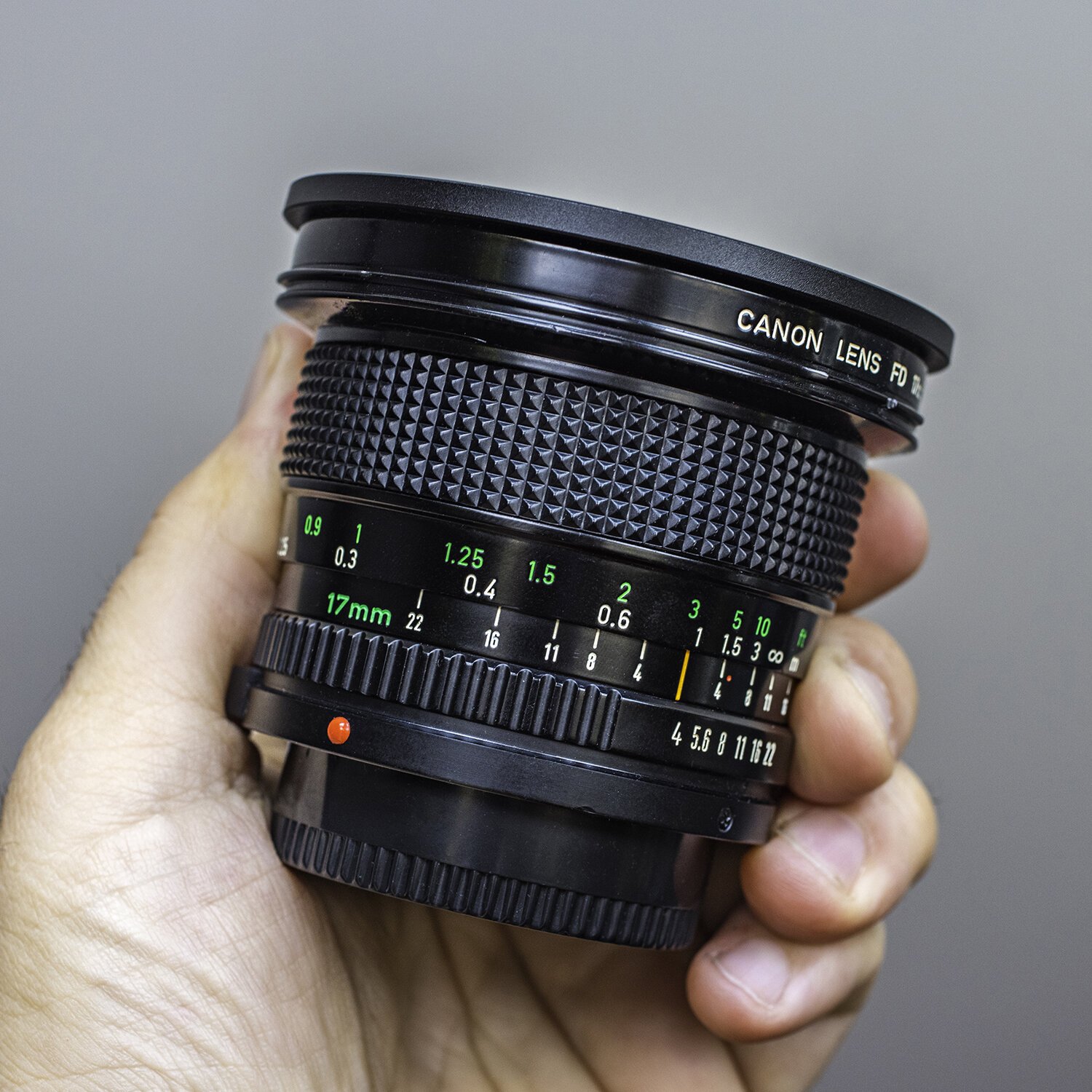

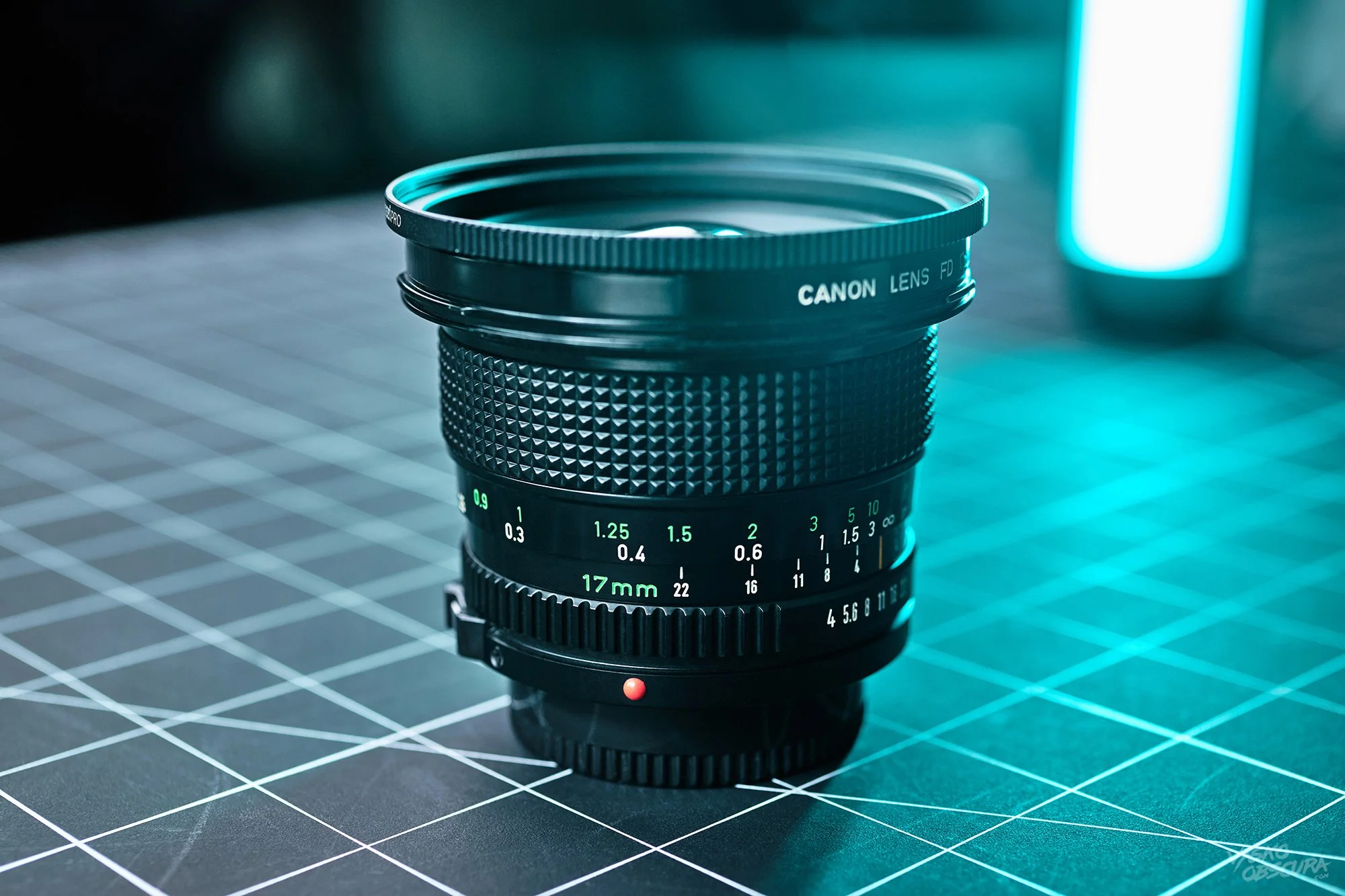
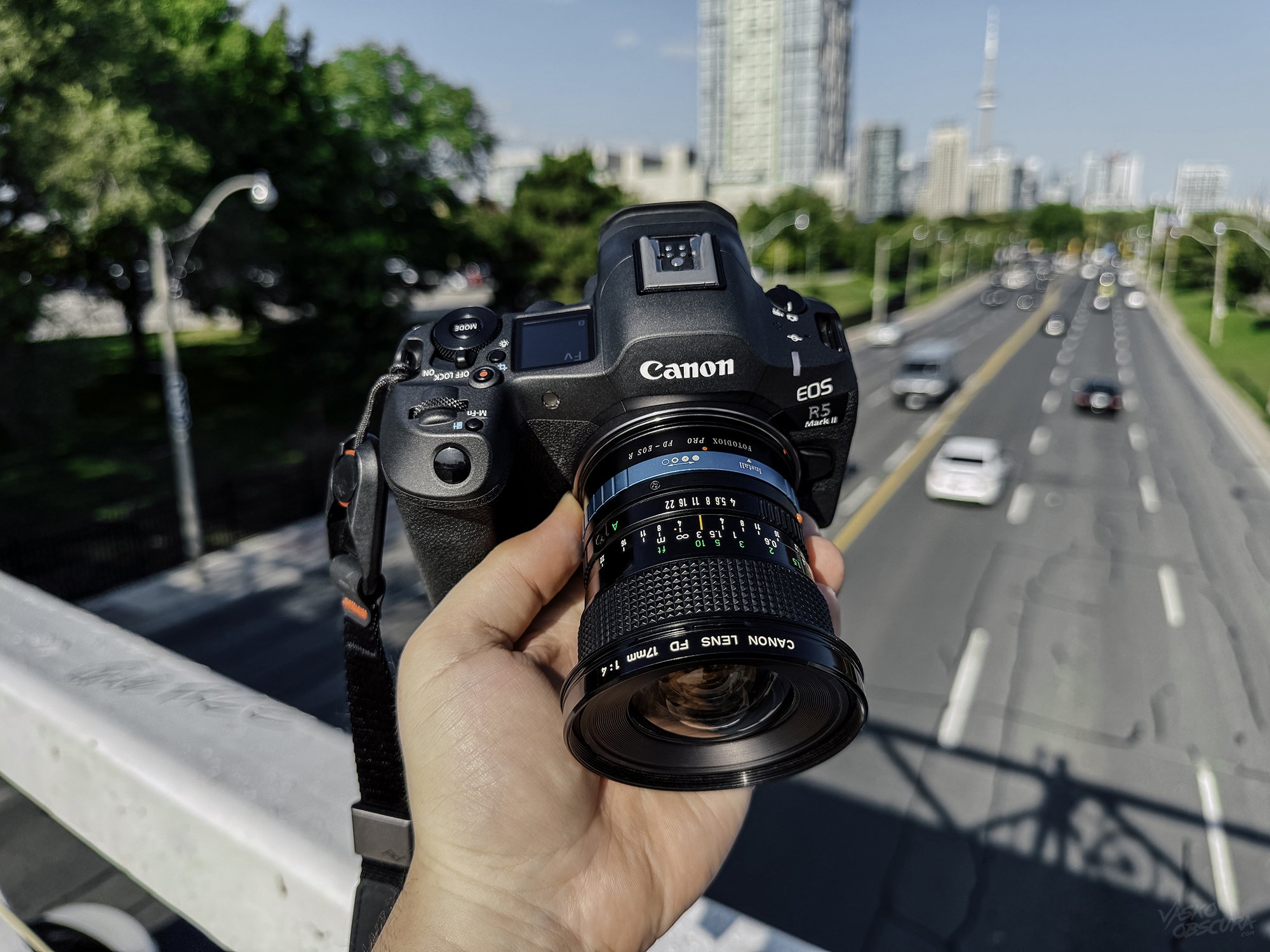


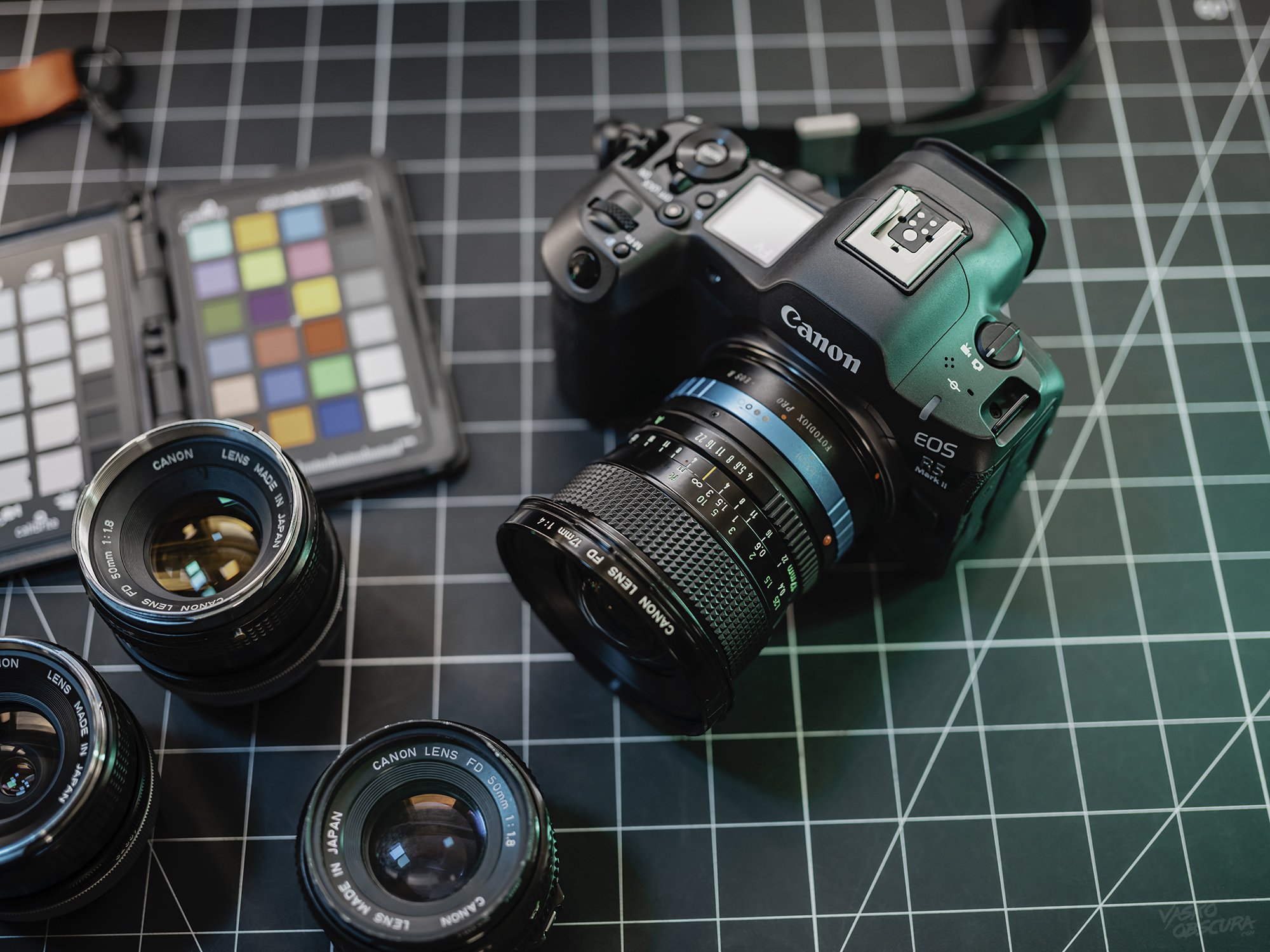


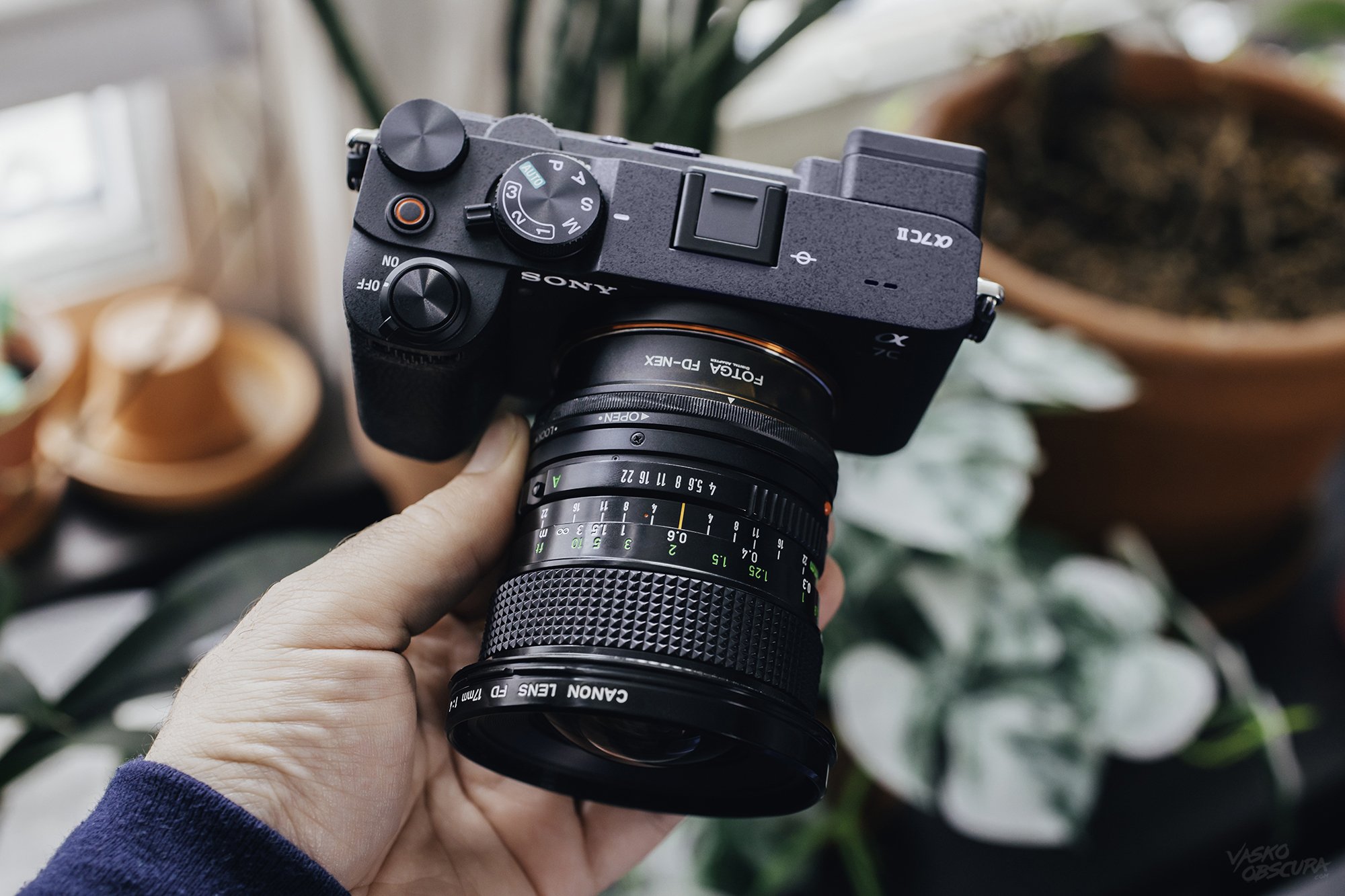


Focusing
Since this is a vintage lens it is a fully manual focusing lens. The focus ring is smooth and perfectly dampened, giving just the right amount of resistance for precise adjustments. The focus throw is relatively short, typically around 90 degree. Hitting critical focus isn’t as difficult on a ultra wide angle lens as the depth of field is naturally wider than longer focal lengths. Overall the focusing experience with this lens has been great. I have no complaints.
Who is it for?
If you love shooting wide-angle shots, the Canon nFD 17mm f4 is a lens worth having in your kit. It shines in some very specific use cases. For videographers, especially those who love the ultra-wide CinemaScope look (2.39:1), this lens is a fantastic choice. It lets you capture your subject while leaving plenty of negative space, giving your composition room to breathe for that cinematic feel. For photographers, this lens is a gem for landscapes and architecture, excelling at capturing vast, sweeping scenes with a natural perspective. If you’re into shooting with the APS-C sensor this lens converts to about a 27mm full frame equivalent. Which obviously isn’t ultra wide but is still wide enough for street photography and landscapes. Whether you're shooting epic landscapes, dramatic cityscapes, or immersive video, the nFD 17mm f4 is a unique and valuable addition to your kit.
User Experience
Over the years I’ve used this lens for photography as well as videography including some YouTube content. It’s a relatively easy lens to use. What you see is what you get there aren’t any strange quarks with this lens. In terms of final product the images and videos it produces are really beautiful especially to those of us who enjoy those vintage characteristics. It’s a lens from the late 70s early 80s and the images it creates are very nostalgic to those times. Personally this is one of my favorite lenses to shoot with.
Final Thoughts
The Canon nFD 17mm f4 ultrawide is a seriously fun lens to use, whether you're a photographer or videographer. Its ultra-wide 17mm focal length lets you capture expansive landscapes, towering architecture, and immersive street scenes with a dramatic sense of depth and scale. The compact, lightweight design makes it easy to carry around, while the manual focus ring is smooth and precise, adding a tactile, hands-on feel to shooting. For videographers, this lens pairs beautifully with widescreen aspect ratios, creating that epic CinemaScope look with plenty of room for dynamic compositions. The 0.25m minimum focus distance also lets you get up close while keeping the background in frame, making shots feel more immersive. Whether you’re capturing vast environments or getting creative with perspective, the nFD 17mm f4 is a joy to shoot with, offering both vintage character and cinematic charm in a compact package. I took a chance when buying this lens and I'm glad I did. If you’re thinking about buying this lens I would jump on the opportunity. They aren’t making any more of these and the price keeps going up.
🤓 Read Next:
Canon nFD 17mm f/4 Image Quality Review - Optical Performance Breakdown
Vintage lens hub with more lens review