
Canon nFD 24mm f/2.8 Mini Review: A Lightweight Vintage Wide-Angle Gem

Canon nFD 24mm f2.8
The Canon nFD 24mm f/2.8 is one of the best affordable vintage wide-angle lenses available today, offering an excellent balance of image quality, size, and price. For photographers building a vintage lens kit, a 24mm focal length is essential, and this lens stands out as one of the most practical options in the Canon FD lineup. While Canon also produced faster 24mm lenses such as the f/2 and f/1.4 versions, those models often sell for $900 to over $5000 on the used market. In comparison, the nFD 24mm f/2.8 can typically be found for around $150, making it an incredibly strong value for both photographers and filmmakers.
Introduced in 1979, this lens delivers sharp images with natural color rendering and solid contrast. Like many vintage lenses, it does exhibit some vignetting and softer corners when used wide open at f/2.8, but performance improves noticeably when stopped down. Thanks to Canon’s Super Spectra Coating, flare is reasonably well controlled, although bright light sources can still produce a pleasing halo effect that adds character. In this review, I’ll take a detailed look at the Canon nFD 24mm f/2.8, including its build quality, optical design, coatings, and how it compares to earlier FD versions. If you’re looking for a review that focuses on image quality check out this post.
LENS SPECS
Release Date: 1979
Format: 35mm
Mount: Canon FD
Filter: 52mm
Aperture Blades: 6
Aperture Range: f/2.8 - f/22
Min Focus Distance: 0.30m
Weight 240g
Optical Design: 9 elements in 8 groups
Weather Sealing: No
Lens IS.: No
APS-C Conversion Approx.: 38mm
A Brief History of the Canon FD 24mm Line
Canon’s FD mount system was introduced in the early 1970s, and over time it evolved through several iterations. The original FD lenses (often referred to as “breech-lock FD”) were followed by the “new FD” or nFD series in the late 1970s and early 1980s. If you want to read about the full history of Canon mounts from screw mounts to RF read this post. The Canon nFD 24mm f/2.8 is part of that later generation. It was designed during a time when manufacturers were trying to reduce weight, simplify handling, and modernize lens ergonomics without sacrificing optical performance.
Compared to earlier FD versions of the 24mm f/2.8, the nFD model is noticeably lighter and more streamlined, which was a design style Canon implemented across all of their (New) FD lenses.
Optical Design and Lens Coatings
Optical diagram comparing four Canon FD 24mm lenses, including the FD 24mm f/1.4 SSC Aspherical, FD new 24mm f/2, FD 24mm f/2.8 SSC, and FD new 24mm f/2.8. Each lens is displayed as a vertical cross-section showing its internal optical elements
Image shot with the Canon nFD 24mm f/2.8 against a bright background to show the SSC coating at at work.
From a technical standpoint, the Canon nFD 24mm f/2.8 uses a classic wide-angle optical formula designed to balance sharpness, distortion control, and size. It features a multi-element design (9 elements in 9 groups), which was fairly standard for wide-angle lenses of this era. Canon also applied their Super Spectra Coating (SSC) to reduce flare and ghosting, something that was becoming increasingly important as color film improved.
In real world use, I’ve found the coatings to perform quite well. You’ll still get some flare if you shoot directly into strong light sources, but it’s controlled and often aesthetically pleasing, something many vintage shooters actually look for. Here is an example image with bright sunlight coming in through a window. You can see how the SSC cating is doing a great job of preventing the image from becoming washed out. Contrast is solid, colors are natural, and there’s a subtle vintage softness wide open that tightens up nicely when stopped down.
Build Quality and Physical Design
Canon nFD 24mm f/2.8
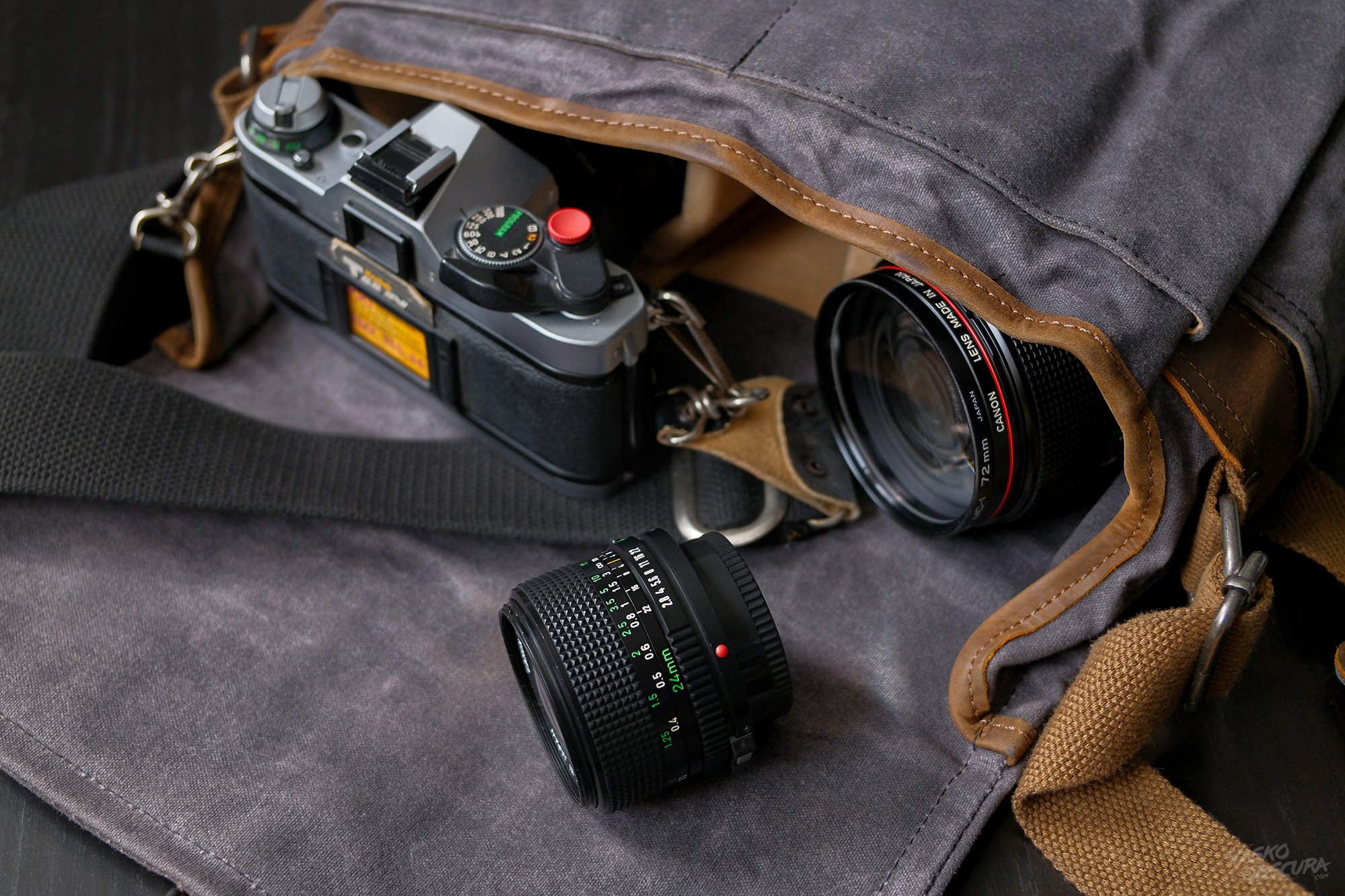
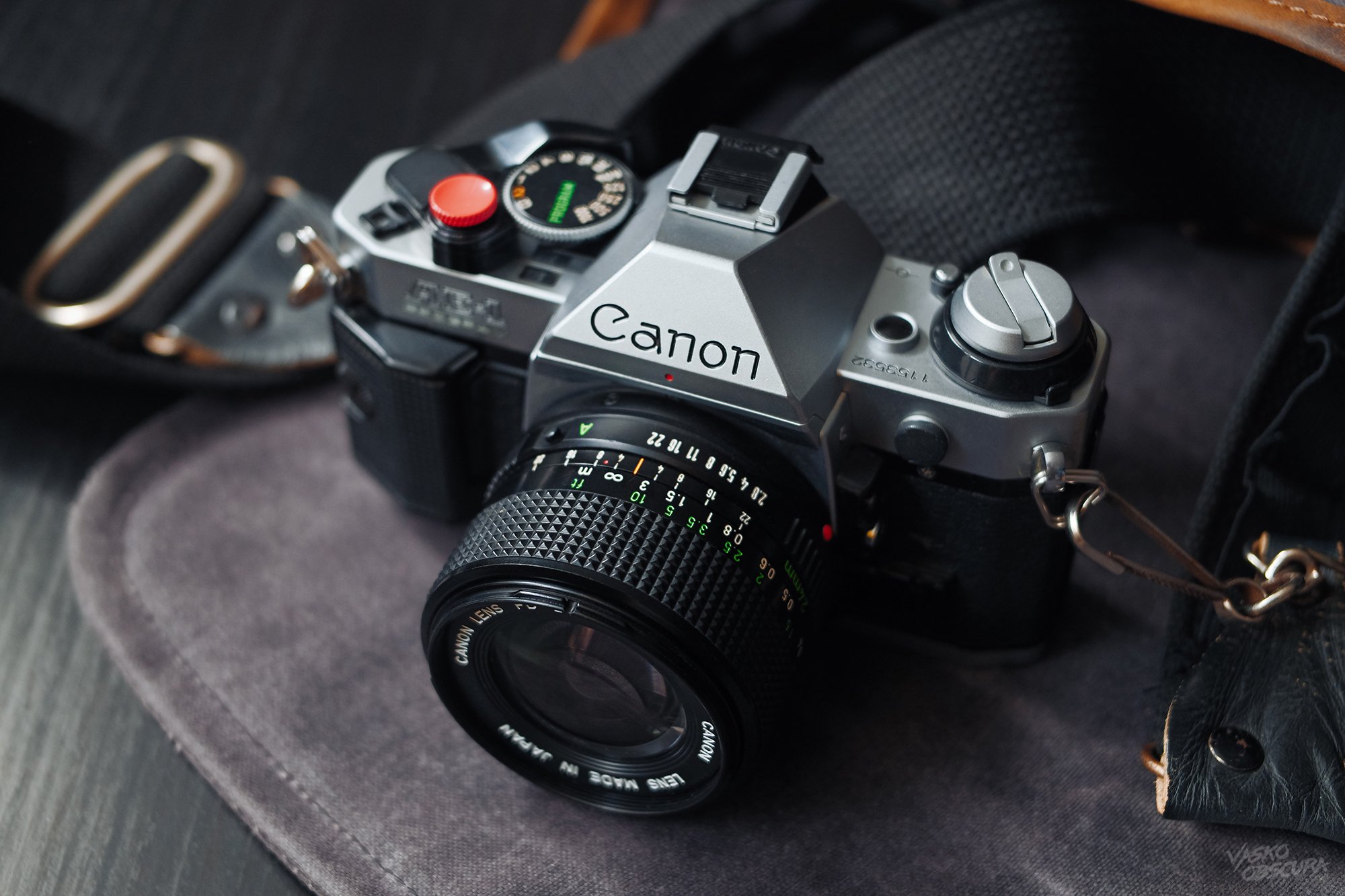
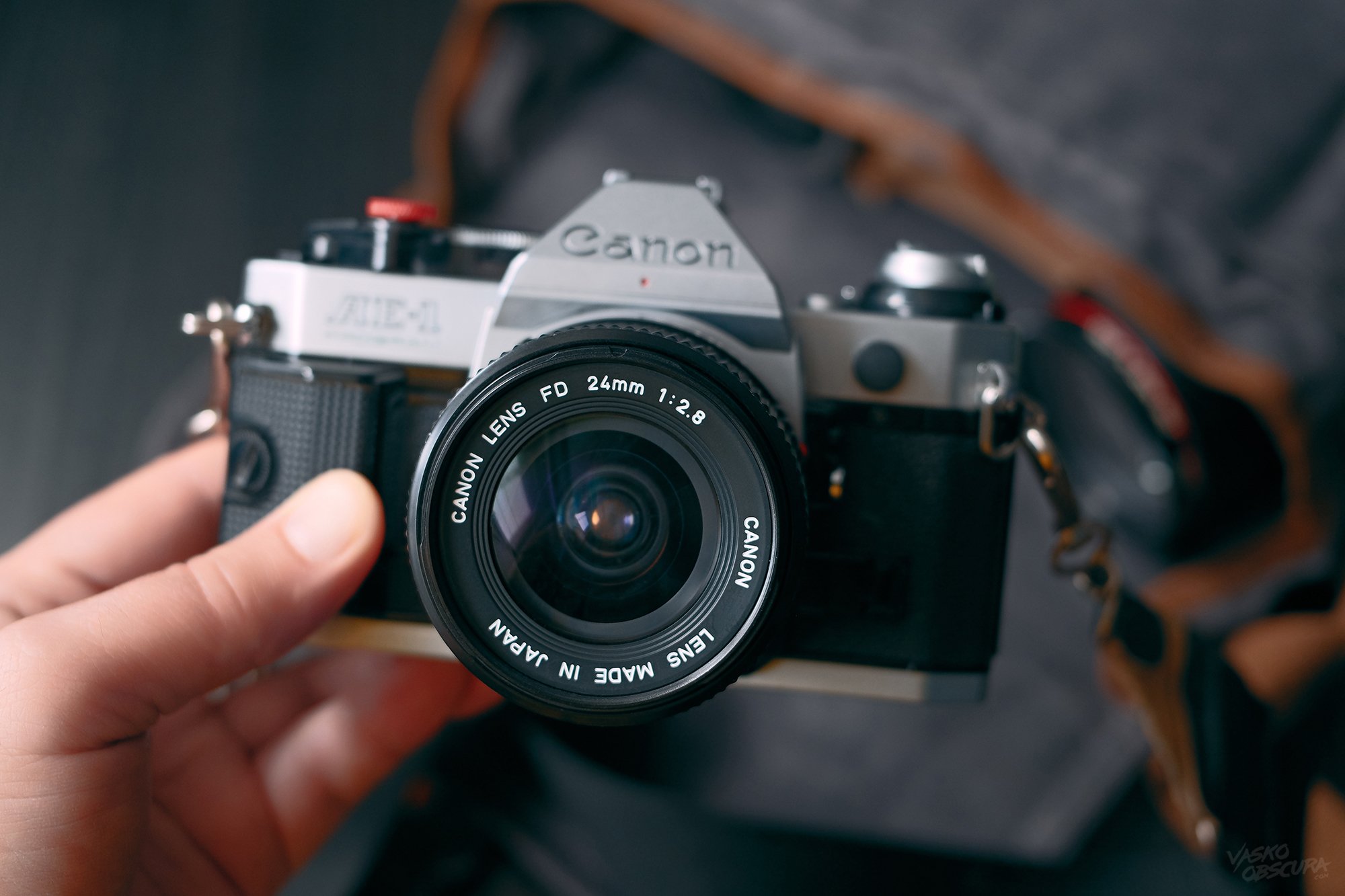
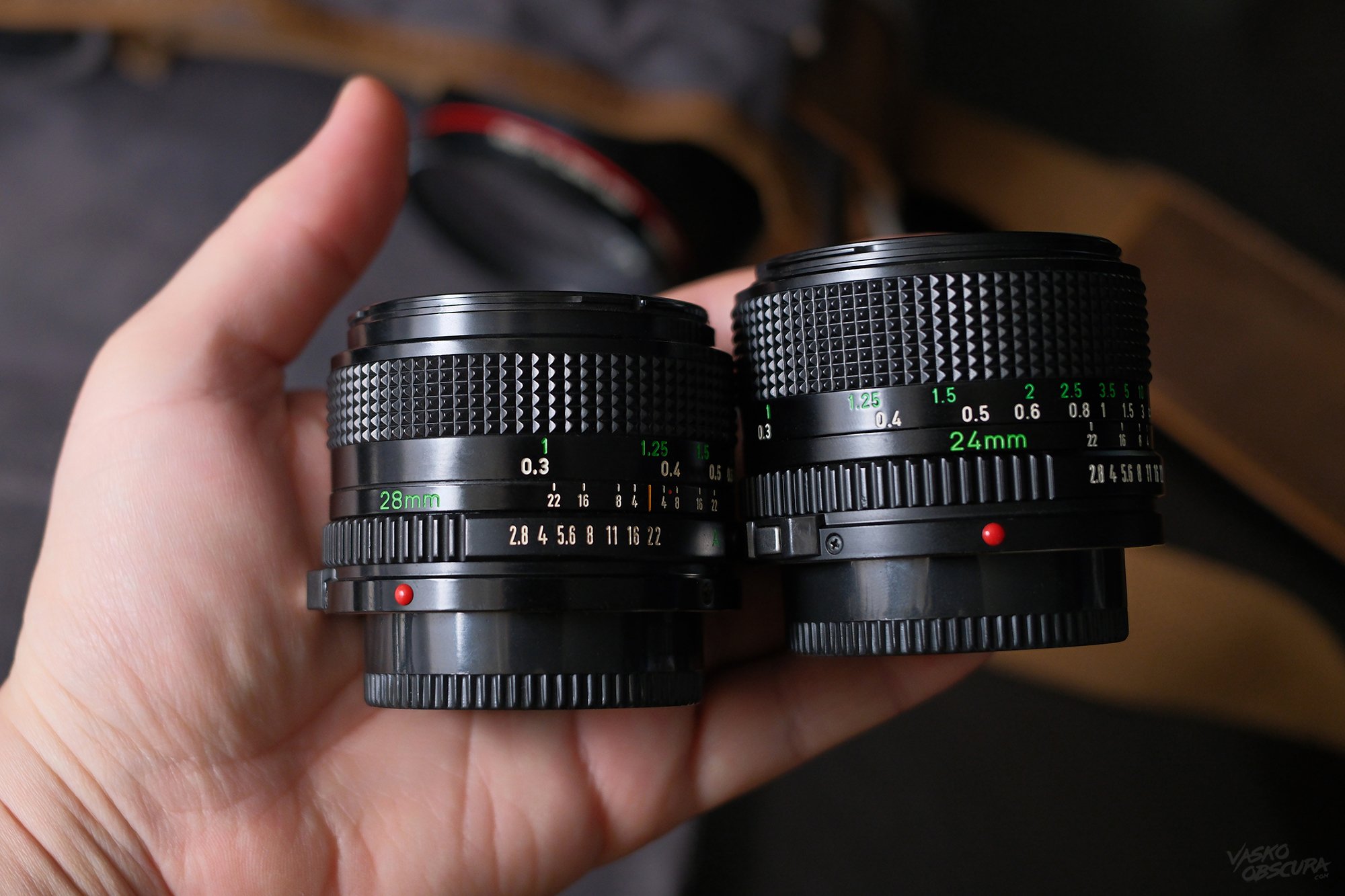
One of the first things I noticed when picking up the nFD 24mm f/2.8 is just how compact and lightweight it is. Unlike earlier FD lenses that leaned heavily into metal construction, the nFD series introduced more engineering plastics into the design. That said, it still feels solid in the hand.
The focusing ring is smooth and well damped, with a throw that strikes a nice balance between precision and speed. The aperture ring clicks confidently in full stops, giving that tactile feedback I always appreciate when shooting manually. The lens features a 52mm filter thread, which is incredibly convenient if you’re already using other Canon FD or vintage lenses, Canon kept a lot of consistency here. The mount itself is the updated (new) FD bayonet style, meaning you don’t rotate the mount ring to mount it. Instead, you simply twist it into place, making lens changes quicker and more intuitive compared to the older breech-lock system.
Gear Shots






Menu Settings
In order to use this lens on your modern mirrorless camera you’re going to need to do two things. First you’ll need an FD to (your mount adapter) I’ve been using the Fotodiox Pro FD to to R adapter for the past several years and highly recommend it. Note that the FL, FD and nFD mounts are all the same and generally called FD mounts in the world of adapters.
The second thing you’ll need to do is change your camera menu settings so that it will release the shutter without a lens on the front. Vintage lenses don’t have any electronics that communicate with the camera so the camera sees them as a lens cap.
You can get more info about it on this blog post: Canon Menu Settings for Shooting With Vintage Lenses
Handling and User Experience
Canon nFD 24mm f/2.8 mounted on the Canon EOS R5 Mark II
This is where the lens really shines for me. Because of its size and weight, the nFD 24mm f/2.8 is incredibly easy to carry around. It’s the kind of lens you can leave on your camera all day without thinking about it. The 24mm focal length is also one of my favorites, it’s wide enough for environmental shots, street photography, and landscapes, but not so wide that it introduces extreme distortion or feels difficult to compose with. So it’s kind of one lens for almost any situation. Minimum focusing distance is quite usable, allowing for some semi-close-up work with a nice sense of depth and perspective. On modern mirrorless bodies, adapting this lens is straightforward, and it pairs especially well with focus peaking and magnification tools.
What Makes the nFD Version Different
The biggest differences between the original FD 24mm f/2.8 and the nFD version come down to usability and weight. The earlier FD lenses used a breech-lock mounting system, where you would rotate a locking ring to secure the lens. While solid, it was slower and less intuitive. With the nFD version, Canon switched to a more modern bayonet-style mount, which feels much closer to what we’re used to today.
There’s also a noticeable reduction in weight thanks to the use of lighter materials. Some people prefer the all-metal feel of older FD lenses. Optically, the differences are relatively minor, but coatings and slight refinements in design do give the nFD version a bit of an edge in contrast and flare resistance. I want to get a copy of the older FD 24mm and to an image comparison. I really love the imperfections and character in vintage glass and my hunch is that with the SC coating the older DF lens will give me more flare.
Final Thoughts
The Canon nFD 24mm f/2.8 is one of those lenses that quietly earns its place in your kit. It’s not flashy, it’s not rare, and it’s not overly expensive, but it delivers where it matters. Great size, solid optics, and a focal length that’s endlessly useful. I always recommend the nFD 50mm f/1.8 as the perfect starter lens for people interested in vintage lens photography but if you’re into a wider perspective than maybe the nFD 24mm f/1.8 is great starter lens for you. For anyone building out a vintage lens kit for mirrorless cameras, this is an easy recommendation. It’s a workhorse wide-angle lens with just enough character to keep things interesting.
FAQ
Is the Canon nFD 24mm f/2.8 good for video?
Yes, absolutely. Its manual focus design, smooth focus ring, and compact size make it a great option for video work, especially on mirrorless cameras.
What mount is the Canon nFD 24mm f/2.8?
It uses the Canon FD mount (new FD / nFD variant also sometimes called the FDn as well), which can be easily adapted to modern mirrorless systems like Sony E, Canon RF, and Micro Four Thirds. Keep in mind that Canon FL, FD, nFD and FDn are all the same mount and the same adapter can be used for all of them. I’ve been using the Fotodiox FD to RF adapter for years and strongly recommend it. You can read more about it here.
How sharp is the Canon nFD 24mm f/2.8?
It’s reasonably sharp wide open, with improved sharpness when stopped down to f/4–f/8. For a vintage lens, it performs very well. Sharpness hasn’t been an issue for me with this lens.
Does it have good flare resistance?
Thanks to Canon’s Super Spectra Coating, flare is controlled better than many vintage lenses, though you can still get artistic flare when shooting into light.
What is the filter size?
The lens uses a 52mm filter thread, which is very common and convenient.
Is it better than the older FD version?
It depends on your preference. The nFD version is lighter, easier to handle and has better coatings, while the older FD version has a more classic all-metal build and the older SC coating. Optically, they are quite similar with slight improvements in coatings on the nFD. If you prefer vintage colors with more modern coatings the nFD version is good. If you like vintage character than the older FD version might be more exciting for you.
🤓 Read Next:
Canon nFD 24mm f/2.8 Image Quality Review: Vintage Character & Optical Performance
Read More Vintage Lens Reviews on my Vintage Lens Hub