
Fujinon GF 110mm f2 R LM WR
When I first picked up the Fujinon GF 110mm f/2 R LM WR, it immediately felt like something special. This isn’t just another portrait lens, it’s one of Fujifilm’s flagship optics for the GFX medium format system. Designed to deliver exceptional sharpness, stunning subject separation, and a truly unique rendering, this lens has built a reputation as one of the best portrait lenses available today.
In this technical review, I’m focusing on the physical attributes, optical design, features, and real-world usability of the GF 110mm f/2, everything you need to know if you’re considering adding this lens to your kit. If you want a review of the optical performance of this lens check out this post next where I breakdown the image quality (coming soon)
Fujinon GF 110mm f2 R LM WR
LENS SPECS
Release Date: April 19, 2017
Format: Medium Format
Mount: GF
Filter: 77mm
Aperture Blades: 9 rounded blades
Aperture Range: f/2 - f/22
Min Focus Distance: 0.9m / 3’
Lens IS: No
Weight 1,010g
Optical Design: 14 elements in 9 groups
Weather Sealed: Yes
Full Frame Conversion Approx.: 87mm
Operating Temperature: Down to -10°C / 14°F
Price
This lens isn’t cheap coming in at a wapping $3200 USD (check current price on Amazon) Is it worth that money? I think so. As you’ll see this lens provides a very unique look that no other lens in the GF lineup can create so I guess if you’re invested in the GFX system you’re kinda stuck paying what Fujifilm decides.
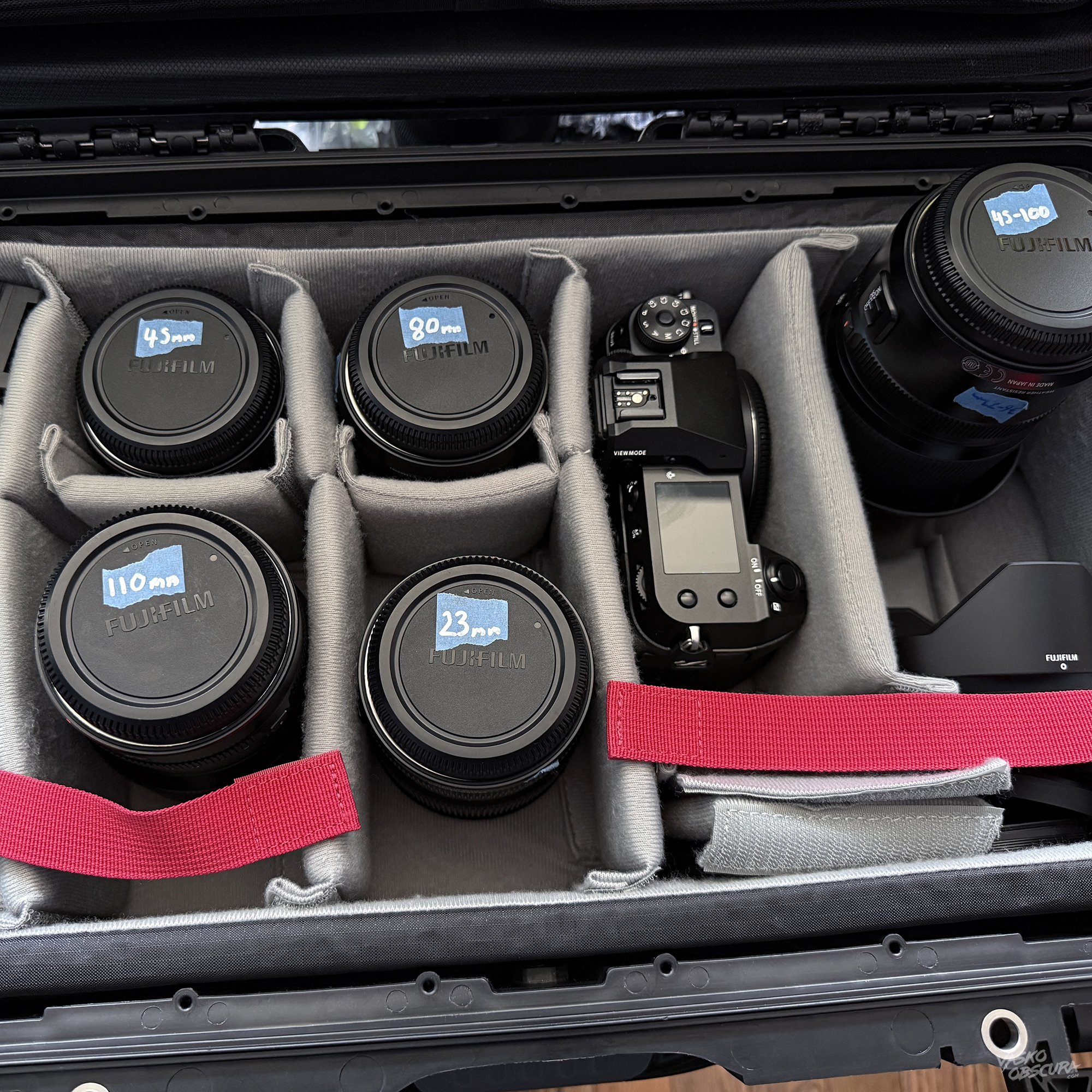
Unless, like me, you buy this lens in a parking lot from a guy you met on Facebook marketplace. hahaha. To be honest my entire system from the GFX 100s to all my GF lense and even the case I keep them in were all bought used over the years. I was in no rush to build my collection so I saved money playing the long game. If you’re unsure about buying used gear check out this post with some helpful tips: Where to Buy Used Lenses and Red Flags to Watch For
A Brief History of the GF 110mm f/2
This lens was released in April, 2017 and just for fun the number one hit song in the US at that time was: Shape of You by Ed Sheeran
The GF 110mm f/2 was introduced as part of Fujifilm’s early push into the GFX medium format ecosystem. When Fujifilm launched the GFX system, they weren’t just trying to compete, they were trying to redefine what medium format could be in a more accessible, mirrorless form and they did an amazing job.
This lens quickly became a cornerstone of that lineup. With a full-frame equivalent field of view of roughly 87mm, it was clearly designed with portrait photographers in mind. But what really set it apart was the f/2 aperture, extremely fast for medium format, paired with modern autofocus and weather sealing. This lens became a game changer for GFX system shooters.
Build Quality and Physical Design
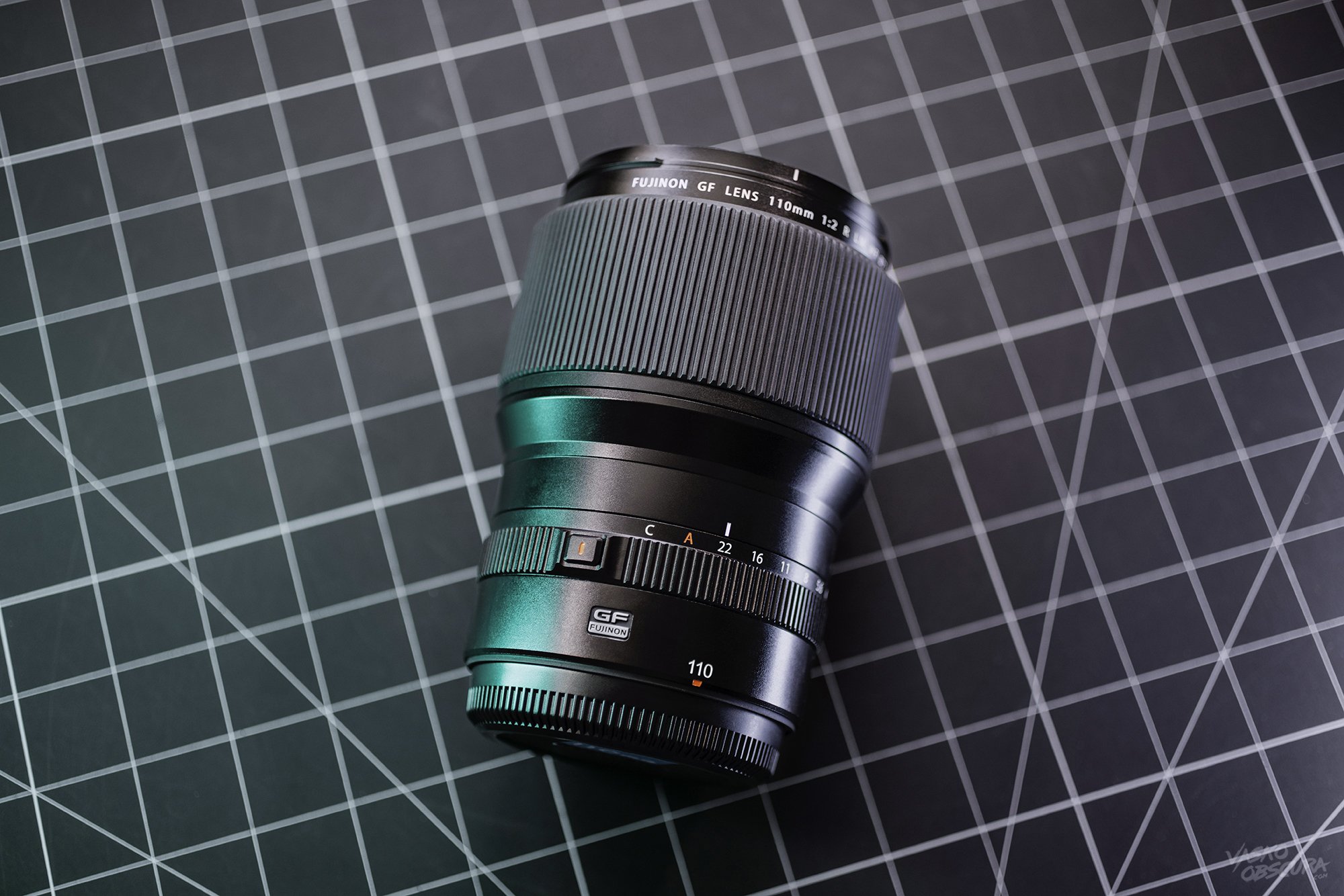
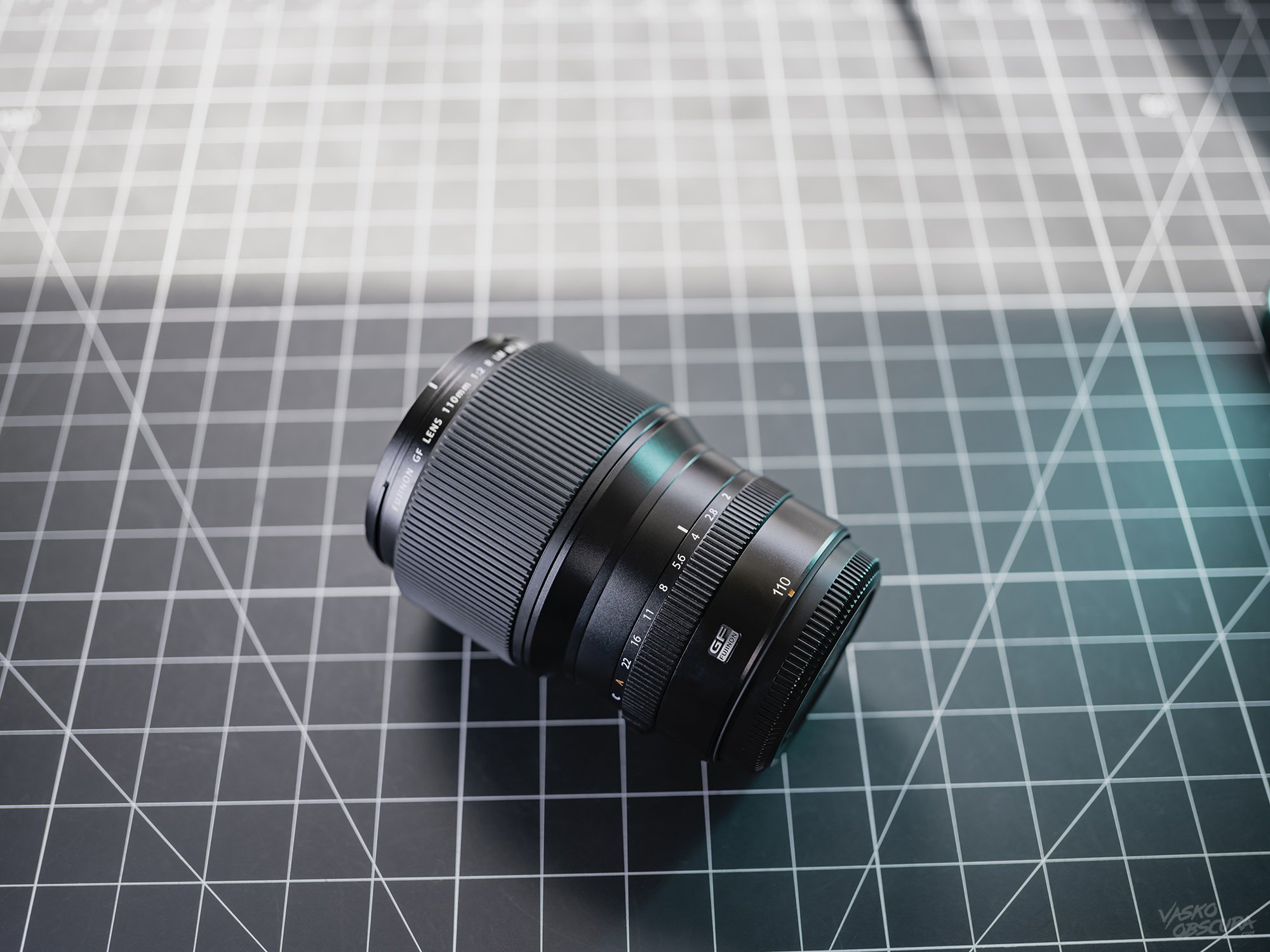
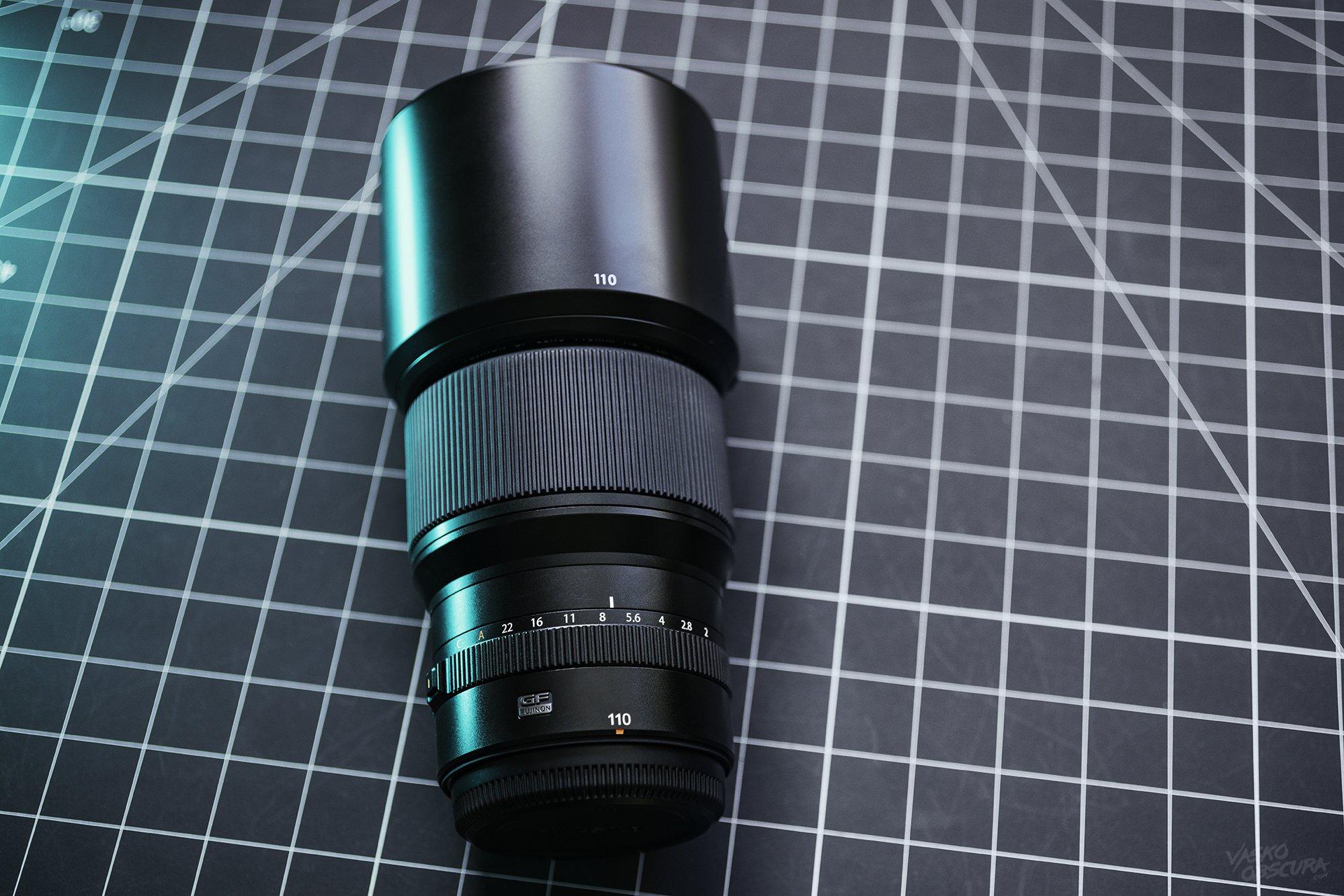
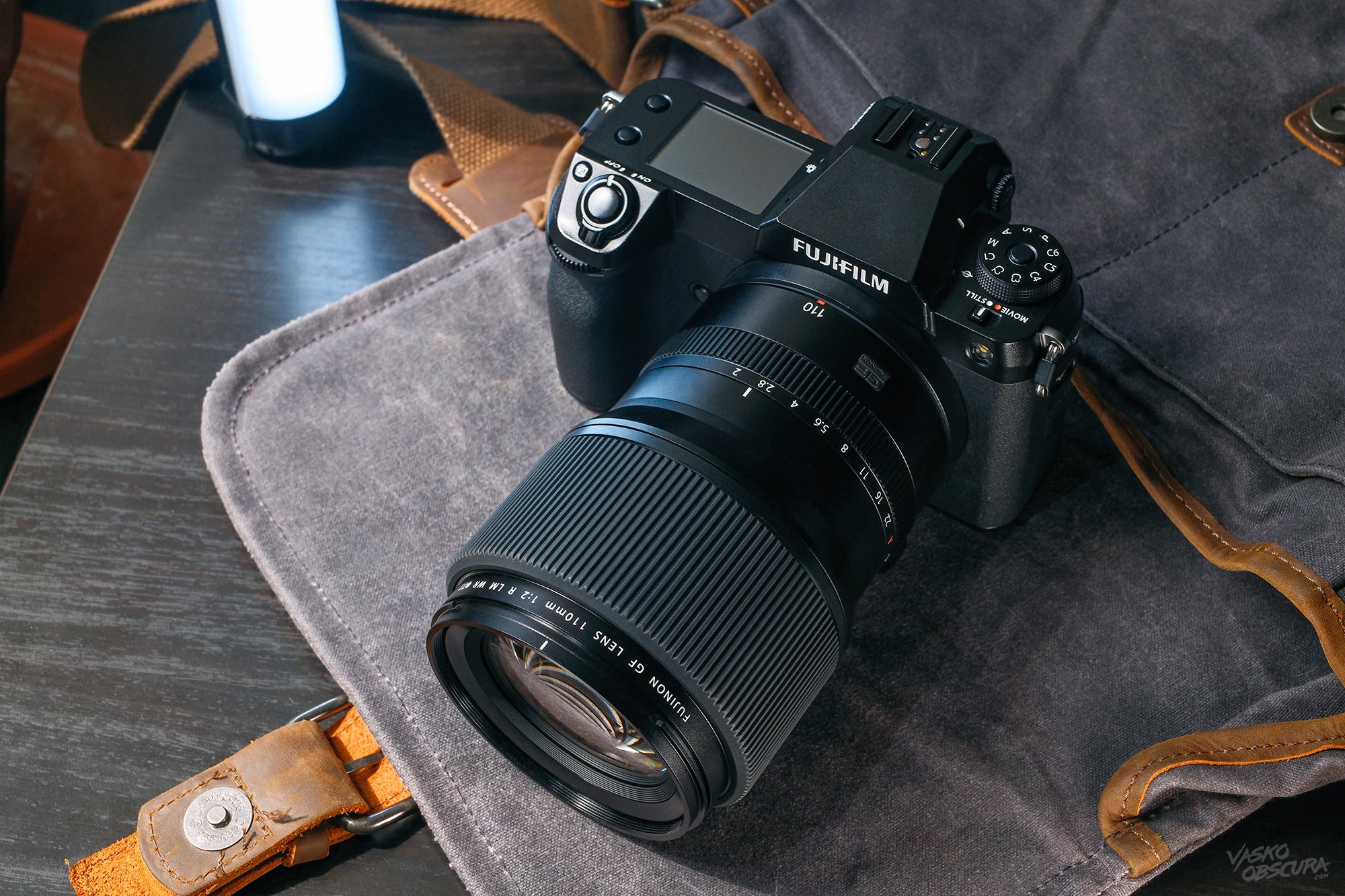
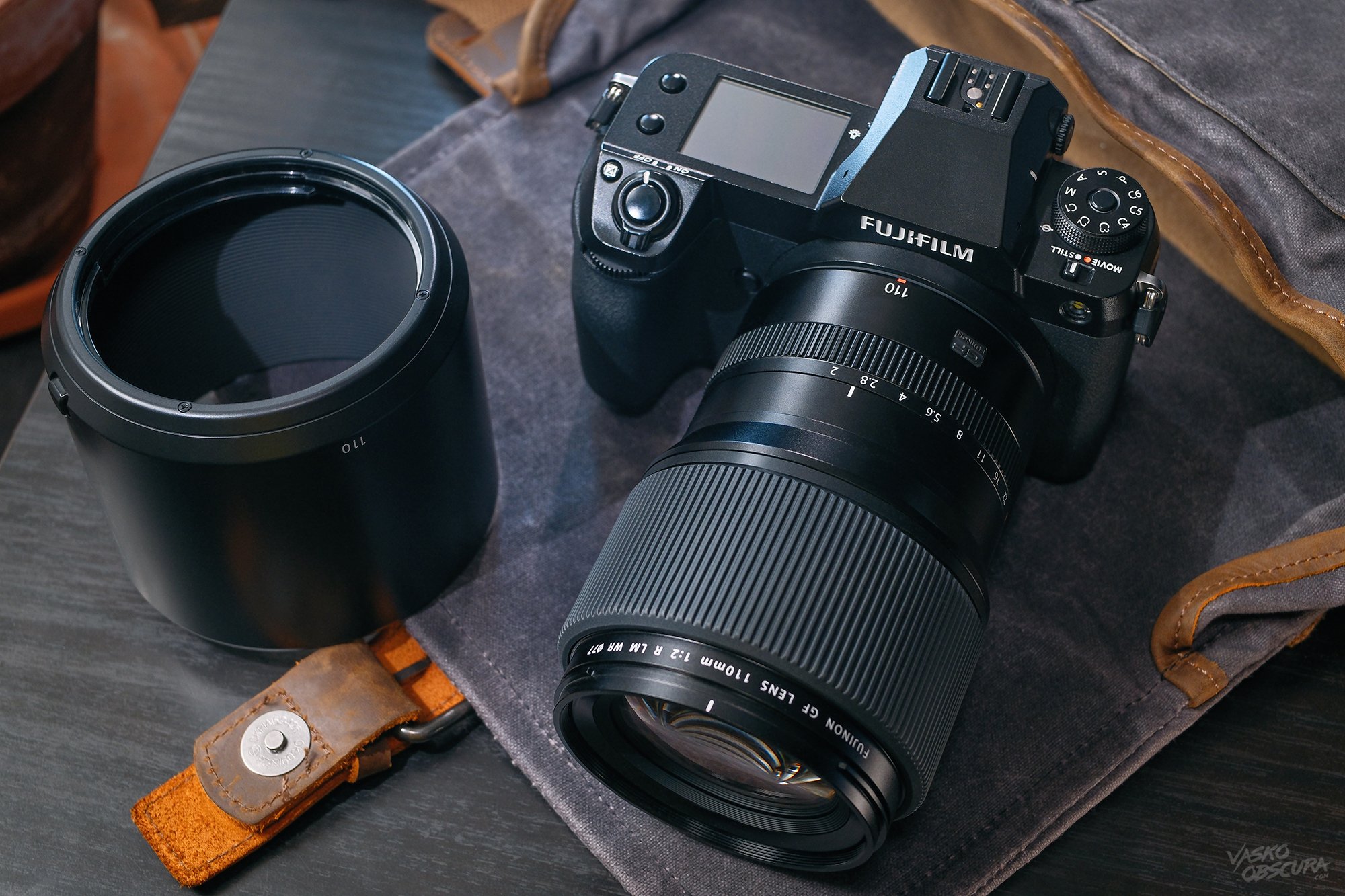
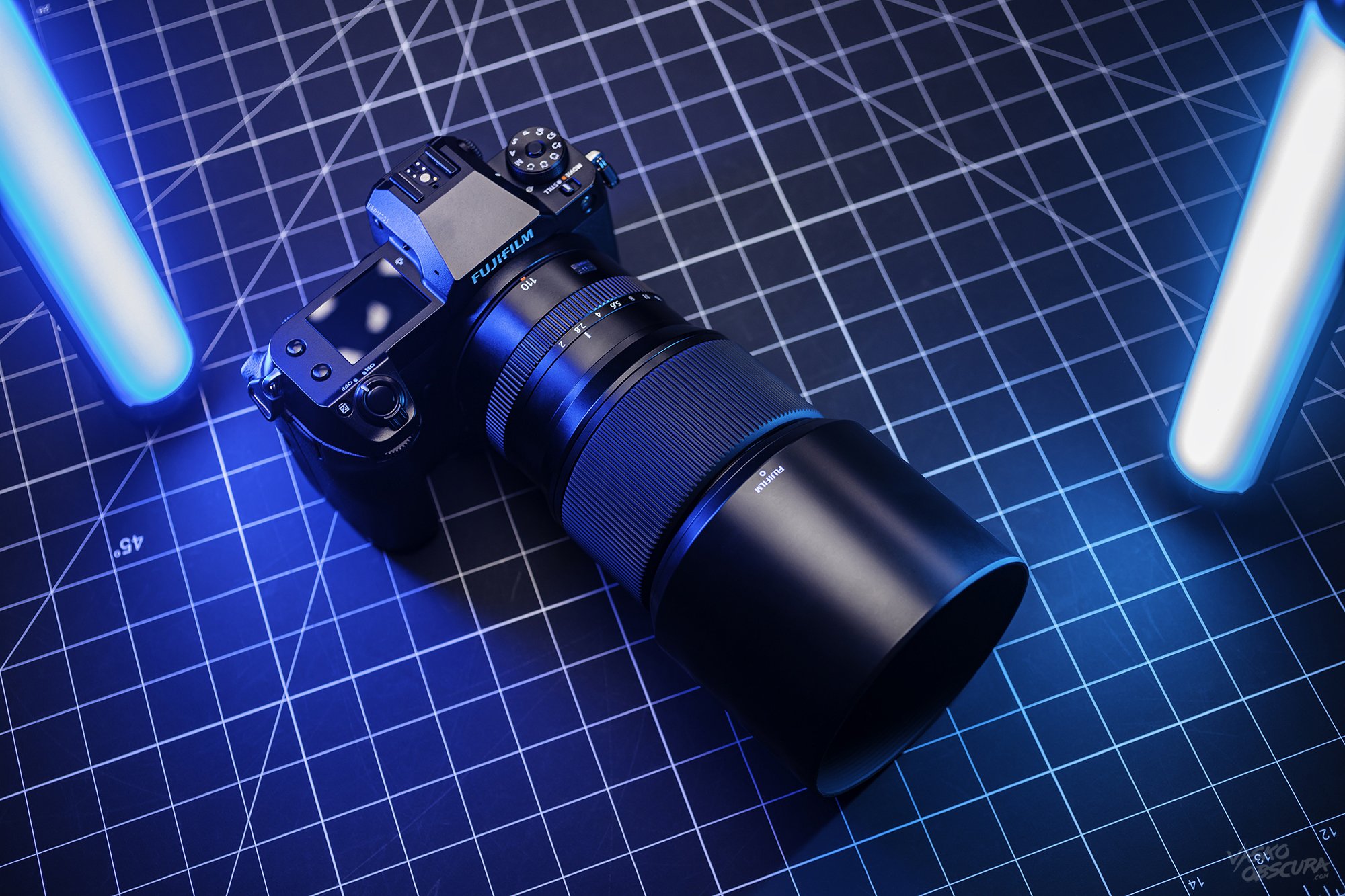
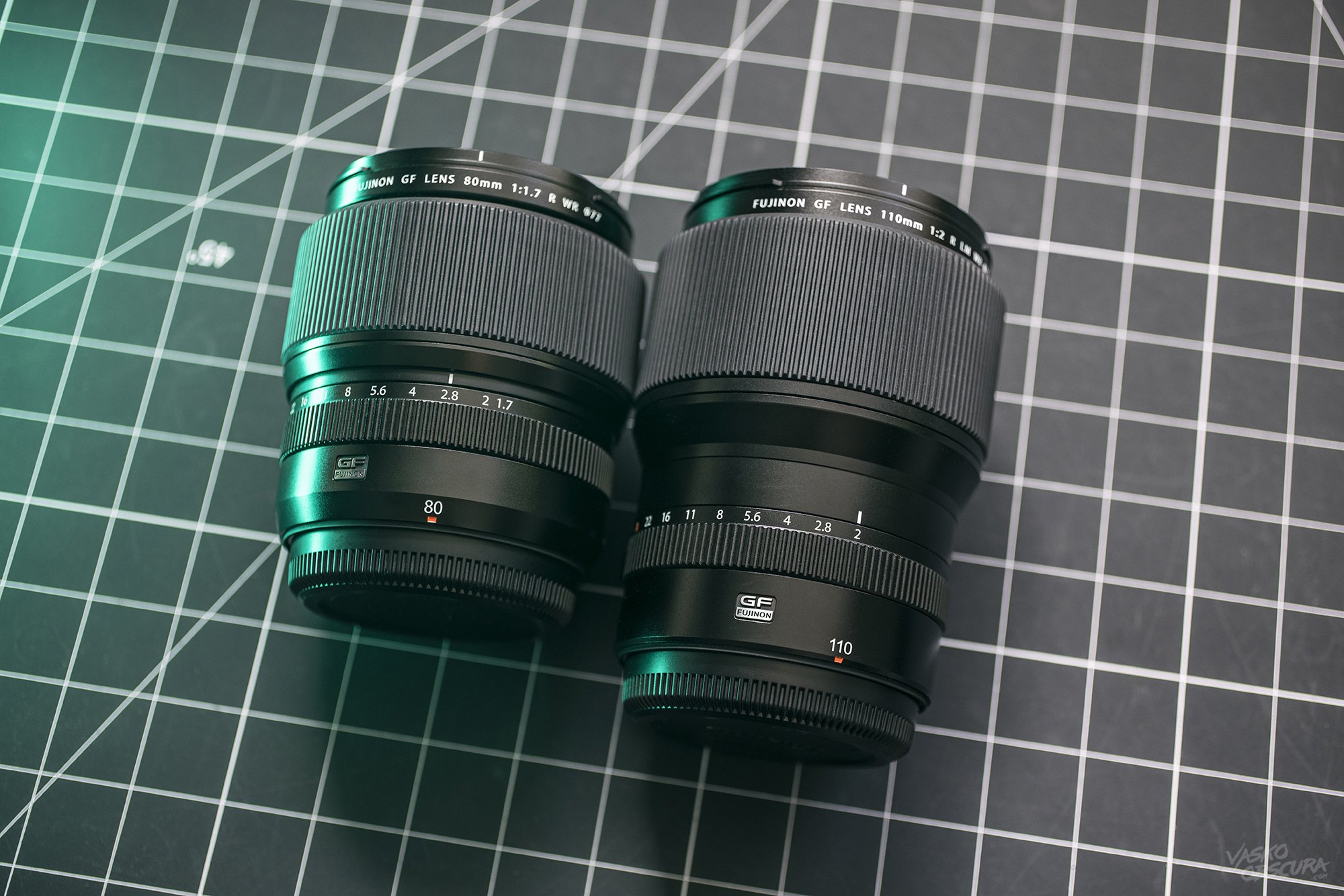
The first thing I noticed when handling the GF 110mm f/2 is its solid, premium construction. This lens feels dense and purposeful without being overly cumbersome for its class. It also comes with a large lens hood wish is a nice thumbs up.
The outer barrel is made from high-quality metal, giving it a professional, durable feel. Despite its robust build, the lens maintains a clean and minimal aesthetic that fits perfectly with the GFX system.
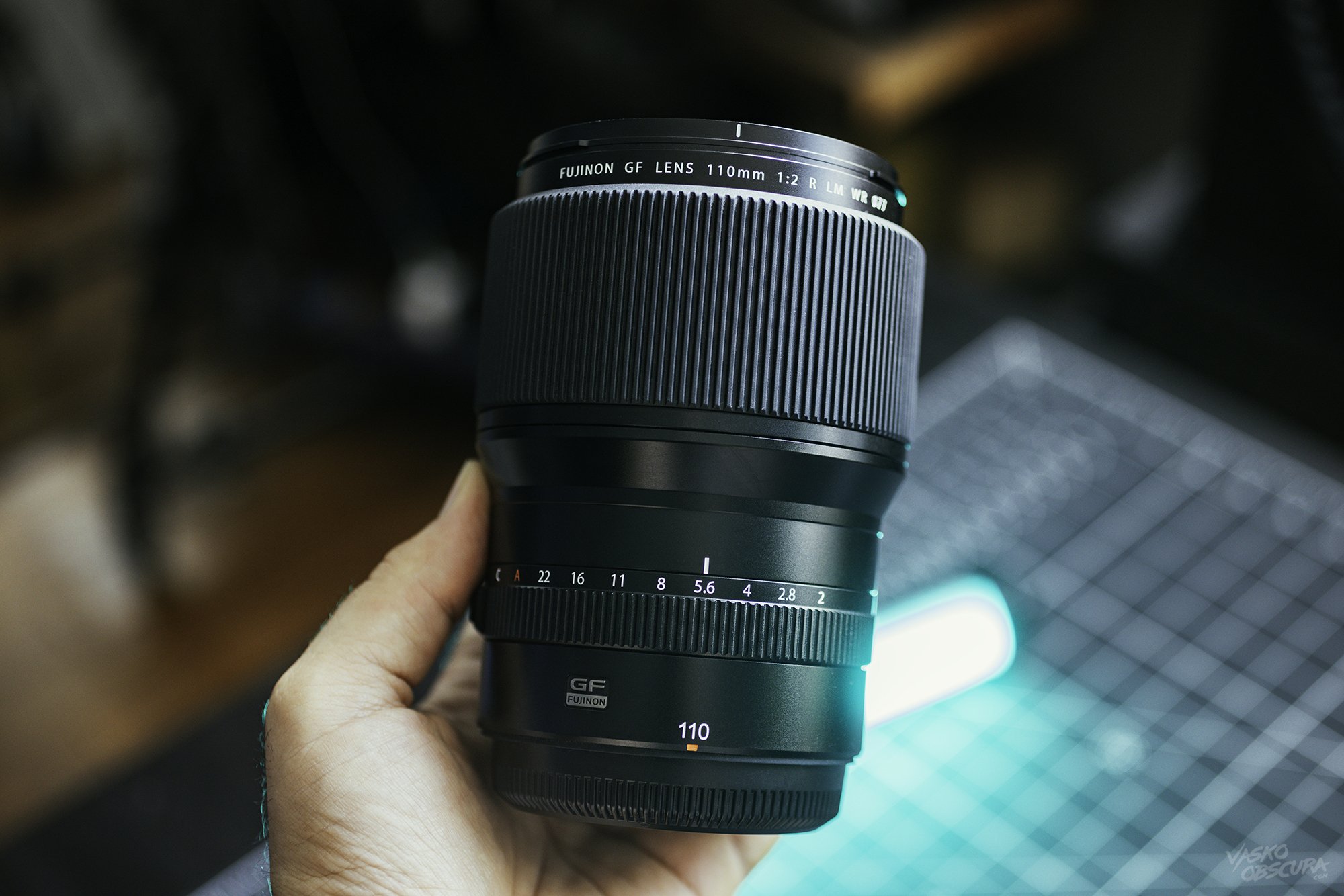
Sitting at around 1,010 grams (just over 1 kg), this lens is a heavyweight by today’s standardbreds, but for medium format glass with an f/2 aperture, it’s surprisingly manageable delivering knockout punch after knockout punch for your clients. Mounted on my GFX 100s, with it’s nice deep grip, the balance feels natural, especially when shooting portraits. I’ve never felt like it was too heavy in the hands.
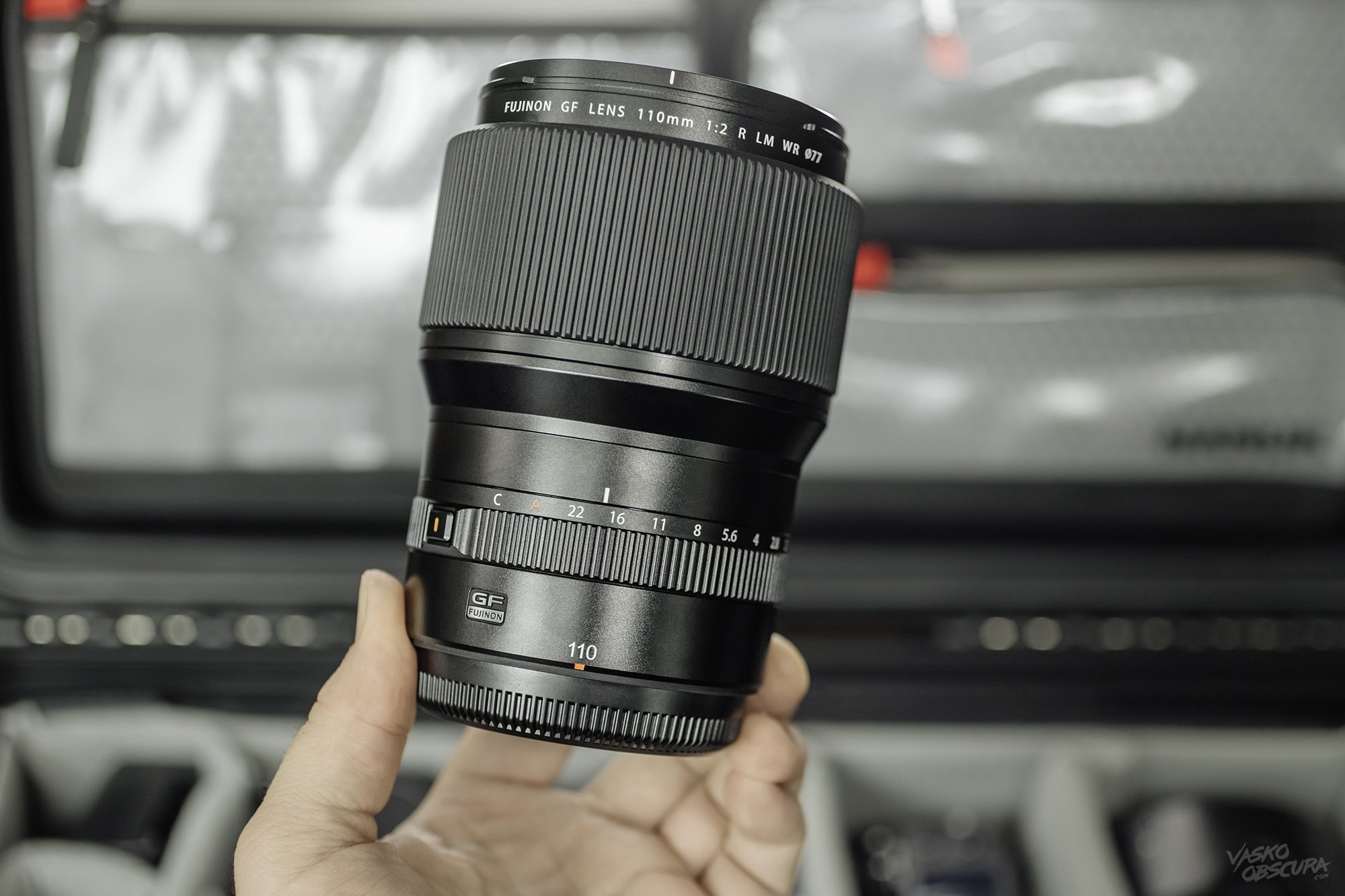
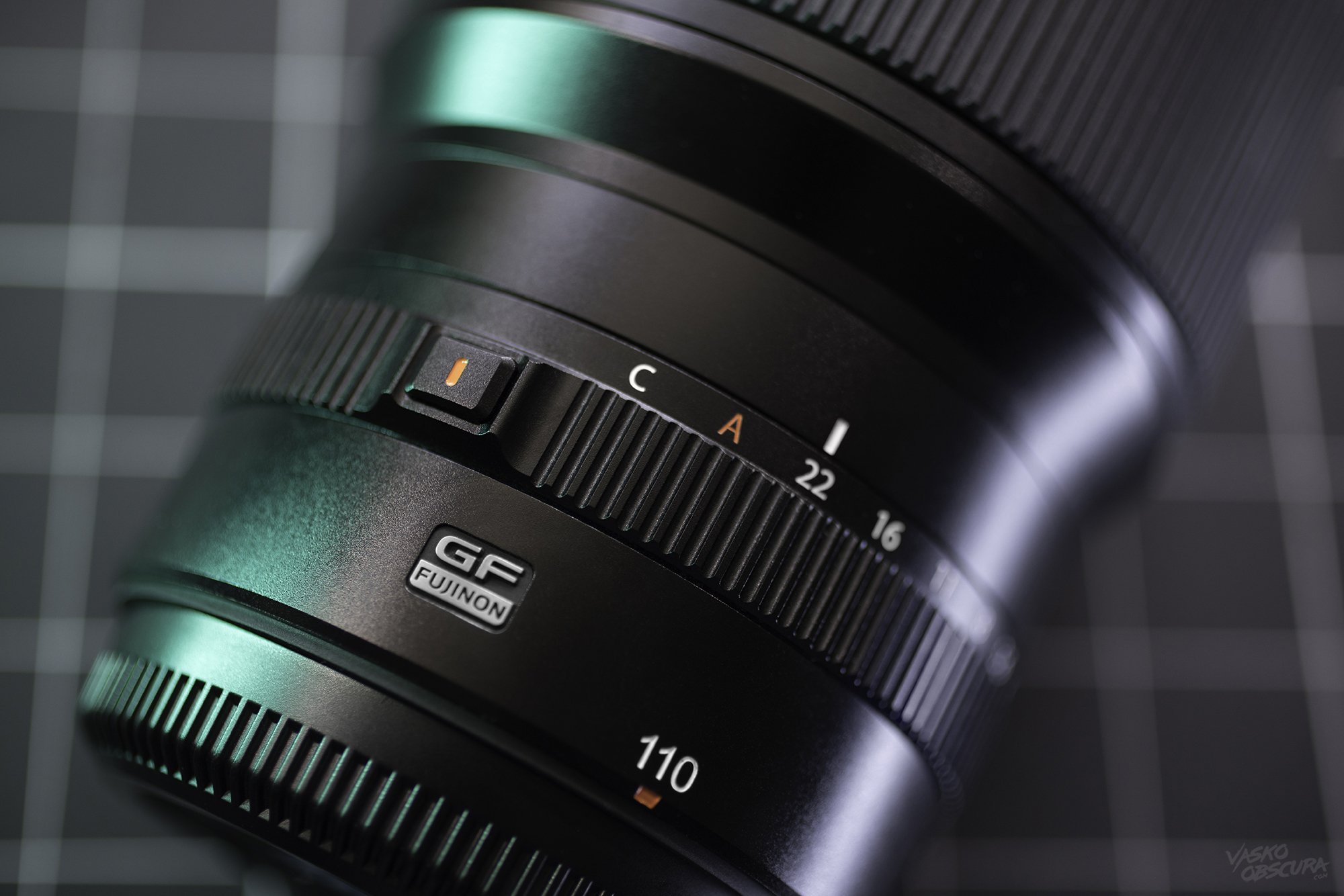
The aperture ring is nice and clicky with 1/3 stops between each stop which is appreciated for fine tuning exposure. There is a button on the aperture ring to switch in the C or A mode and that’s it.
The 110mm features weather resistance (WR). The lens is sealed to protect against dust and moisture and it can handle light rain, dusty environments, and cold temperatures down to -10°C.
Optical Design and Lens Construction
Optical design diagram of the Fujinon GF 110mm f/2 R LM WR lens, illustrating the internal lens element structure and the placement of extra-low dispersion (ED) elements.
Under the hood, the GF 110mm f/2 features an advanced optical design consisting of 14 elements in 9 groups, including four extra-low dispersion (ED) elements. This design is clearly optimized for minimizing chromatic aberration, maintaining sharpness across the frame and producing smooth, pleasing bokeh.
ED (Extra-Low Dispersion) glass is designed to reduce chromatic aberration, which happens when different wavelengths of light don’t focus at the same point. By controlling how light disperses through the lens, ED elements help maintain sharper images with cleaner edges and more accurate color. The result is better contrast, improved clarity, and more natural-looking images, especially in high-contrast scenes.
The nine-blade rounded aperture diaphragm plays a huge role in rendering out-of-focus areas beautifully. The transition from sharp focus to blur is incredibly smooth, something that medium format shooters will immediately appreciate.
Special Features and Coatings
Fujifilm applied their Super EBC (Electron Beam Coating) to this lens, and it shows in real-world use. Flare and ghosting are very well controlled, even when shooting into challenging light. Contrast remains strong, and colors have that signature Fujifilm richness without feeling overly saturated. Though that could also be the camera’s film emulations too. This coating is especially important for portrait photographers who often shoot in backlit or high-contrast environments. I’ve found that it holds up extremely well in those situations.
Gear Shots




Autofocus and Handling Experience
For a lens of this size and optical complexity, autofocus performance is impressive. The linear motor (LM) system delivers smooth, quiet, and relatively fast focusing. BUT is it as fast as a modern full-frame mirrorless portrait lens? Not quite, but for medium format, it’s more than capable. The thing to keep in mind here is that AF on medium format systems is slow and cumbersome compared to full frame cameras tp when I way that the AF on this lens is fast that’s fast compared to other medium format lenses. Don’t be expect to shoot any fast action content with this lens.
What I appreciate most is the precision. When shooting at f/2 on medium format, depth of field is razor thin. The autofocus system consistently locks on accurately, which is critical for portrait work.
Real-World Shooting Experience
This is where the GF 110mm f/2 really shines. Shooting with this lens feels almost effortless. The rendering is what truly sets it apart, images have a depth and dimensionality that’s hard to describe until you see it. Shooting with medium format even the cropped medium format of the GFX system is a visual experience you can’t get with full frame or APS-C.
At f/2, the subject separation is incredible. Backgrounds melt away into a creamy blur while the subject remains tack sharp. Skin tones render beautifully, and there’s a natural falloff that gives portraits a cinematic quality. Even stopped down slightly, the lens maintains exceptional sharpness and contrast. In the hands the lens camera combo feels good and just works which is all you can ask of your gear. I think that mark of good equipment is that it gets out of your way and lets you focus on creating the shot and this lens certainly does that.
Who This Lens Is For
With an 87mm full frame equivalent this lens is clearly designed for:
Portrait photographers
Studio shooters
Wedding and fashion photographers
Anyone looking for maximum image quality in the GFX system
It’s probably overkill for casual shooters, but if your work demands top-tier optical performance, it absolutely delivers. The best way to understand the GF 110mm f/2 lens would be to think of it as the medium format equivalent of the Canon RF 85mm f1.2 L. Both top tier lenses designed for portrait photography. When I have some time i’m going to make a post comparing the image quality of both these lenses. since they both sit at about the same price point which one is the best value for money? Subscribe to the blog and YouTube channel if that’s something you’re into.
The one thing I’ve learned by using these two lenses is that with great resolving power there comes great editing responsibility. lol. The Medium format sensor combined with this lens sees every little detail in a face. And I mean every detail. Is that something you really want? I’ll talk more about that when I compare these two portrait lenses.
Medium format GFX 100s with the GF 110mm f/2 lens and the full frame Canon EOS R5 Mark II with the RF 85mm f1.2 L. Both lense produce amazing bokeh with a razor thin depth of field at an 85mm focal range and sit at the same price point. But which lens produces the better image?
Final Thoughts
The Fujinon GF 110mm f/2 R LM WR is one of those lenses that justifies its existence the moment you start using it. From build quality to optical performance, everything about it feels refined and thought-out. It’s not cheap, and it’s definitely not small, but the level of image quality and rendering it delivers is hard to match. If you’re a portrait photographer looking to stand out and elevate your work, this lens can absolutely give you that visual edge and helps separate you from your competition.
That said, it’s important to understand what this lens is and what it isn’t. This is a highly specialized portrait lens with a fast maximum aperture, designed for a very specific purpose. If that purpose aligns with your workflow, it’s an incredible tool. But if it doesn’t, it’s probably not worth the investment. For photographers serious about portrait work on the GFX system, this isn’t just a good option, it’s the benchmark.
FAQ
Is the GF 110mm f/2 good for portraits?
Yes, it’s widely considered one of the best portrait lenses for medium format thanks to its focal length, fast aperture, and beautiful bokeh.
What is the full-frame equivalent of 110mm on GFX?
Roughly 87mm in full-frame terms, which is a classic portrait focal length.
Is the GF 110mm f/2 sharp wide open?
Absolutely. It delivers excellent sharpness even at f/2, with minimal aberrations. Check out my optical performance review for photo samples.
How heavy is the GF 110mm f/2?
It weighs approximately 1,010 grams (just over 1 kg).
Does it have image stabilization?
No, the lens itself does not include optical image stabilization. It relies on in-body stabilization from compatible GFX cameras.
Is the autofocus fast?
For a medium format lens, autofocus is fast, smooth, and very accurate, but it’s slow when compared to the nappy fast focusing lense you can find in the full frame world.