

Fujinon WCL-X100 II Sample Photos
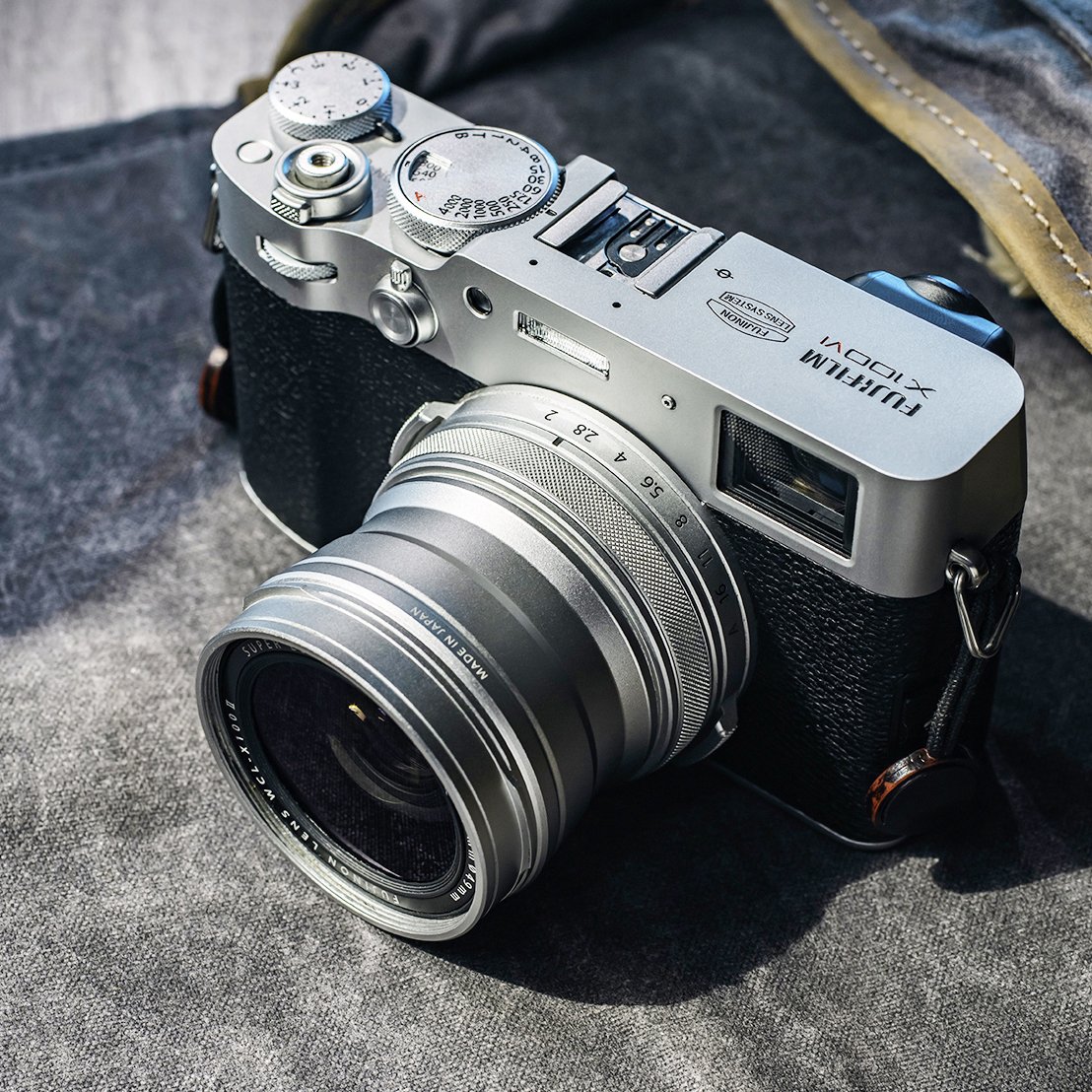
Shooting with the Fujifilm’s X100 series cameras is a joy, blending modern innovation with the hands-on tactile experience of years gone by. The camera really invites me to slow down and immerse myself in the moment of taking a photo. It may not be the best camera I’ve ever used but it is the most fun. It’s a unique experience that you just don’t get with most modern cameras.
But as much as I love the built-in 23mm lens, sometimes I want something just a bit wider without sacrificing that signature rendering or shooting experience. That’s where the Fujinon WCL-X100 II comes in and honestly, I was skeptical at first. But after spending real time shooting with it I’m so glad I added this lens to my kit. This post will focus specifically on optical performance and image quality. If you’re looking for a review looking at the physical attributes of this lens check this post out after.
What is the WCL-X100 II?
The WCL-X100 II is a wide conversion lens designed specifically for Fujifilm’s X100 series cameras. It converts the fixed 23mm lens (35mm full-frame equivalent) into a 19mm lens (28mm full frame equivalent), giving a slightly wider field of view. Unlike generic wide adapters, this one is purpose-built by Fujifilm, meaning the optical design is tightly integrated with the original lens and the camera system.
Optical Design and Construction
The WCL-X100 II features a multi-element optical design that works in tandem with the built-in lens rather than fighting against it. That distinction is important. This isn’t just a piece of glass slapped on the front, it’s engineered to preserve the rendering characteristics of the original lens while expanding the field of view. Fujifilm also applies their Super EBC (Electron Beam Coating) to reduce flare and ghosting, which plays a big role in maintaining contrast.
One of the smartest aspects of the design is that the camera automatically recognizes the conversion lens when attached. This allows in-camera corrections to be optimized specifically for the WCL-X100 II, ensuring consistent results. Keep in mind this only happens with the version II of this lens. If you are using the original version of this lens you’ll have to go into the camera menu and settings and tell the camera you have the WCL attached.
Real-World Optical Performance
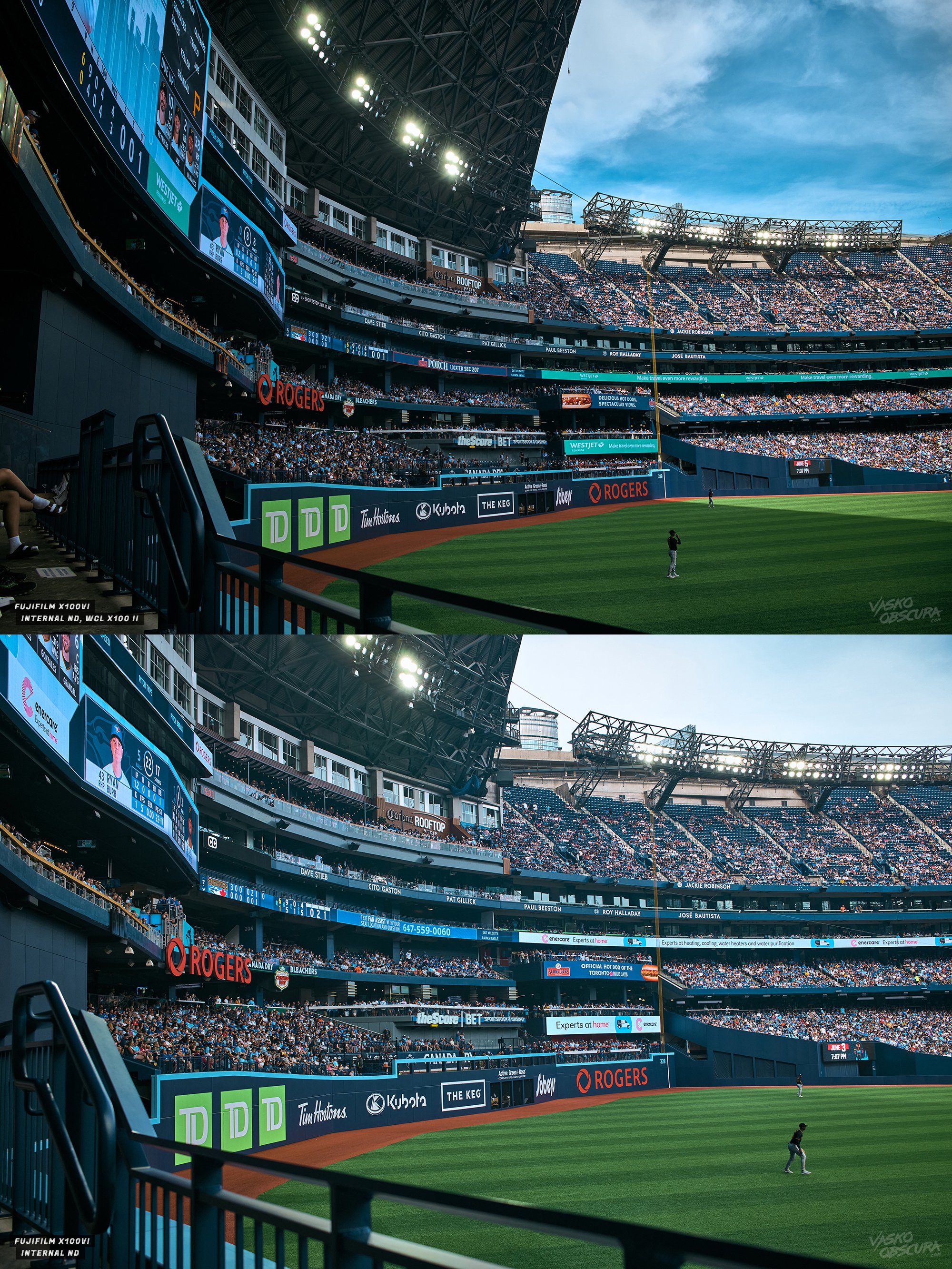
In real-world use, this lens surprised me. I expected compromises, softer corners, maybe some weird rendering artifacts but that’s not what I experienced. Instead, the images feel incredibly cohesive, almost like the camera was designed around this focal length from the beginning. That’s the biggest compliment I can give it: it doesn’t feel like an add-on. Here are some sample shots taken with this lens.






Sharpness and Resolution
Sharpness is where this lens really delivers. Across most of the frame, the WCL-X100 II maintains excellent detail (for an APS-C sensor), especially in the center and mid-frame areas. Corners do soften slightly compared to the native 23mm lens, but not in a way that’s distracting or unusable. For street photography, travel, and environmental portraits, the sharpness is more than sufficient, even for high-resolution sensors like the one in the X100VI. Plus when images are resized to 2 megapixels for social media the images sharpen up completely.
Distortion and Corrections
Example of lens distortion from the WCL-X100 II
Wide-angle lenses often struggle with distortion, but here Fujifilm takes a hybrid approach. There is some inherent barrel distortion in the optical design, but it’s well-controlled and further corrected in-camera. The result is images that look natural, with straight lines staying relatively straight unless you’re pushing extreme compositions. For architecture shooters, it’s not perfect but for everyday photography, it’s passable.
Here is one important thing to note with this lens. If you shoot jpg the camera will correct distortion in camera. If you shoot raw and your raw converter program has the WCL-X100 II lens profile you can fix the distortion in post. But if your raw converter doesn’t have the lens profile you’ll end up with distorted images. Here is an example image to show the distortion.
Vignetting and Light Falloff
Wide adapters typically introduce noticeable vignetting, especially wide open. The WCL-X100 II does show some light falloff in the corners, but it’s subtle and often aesthetically pleasing. In many cases, I actually prefer leaving it uncorrected because it adds a bit of natural depth to the image. If you don’t like it, in-camera corrections or a quick tweak in post will clean it up easily.
Chromatic Aberration and Flare Resistance
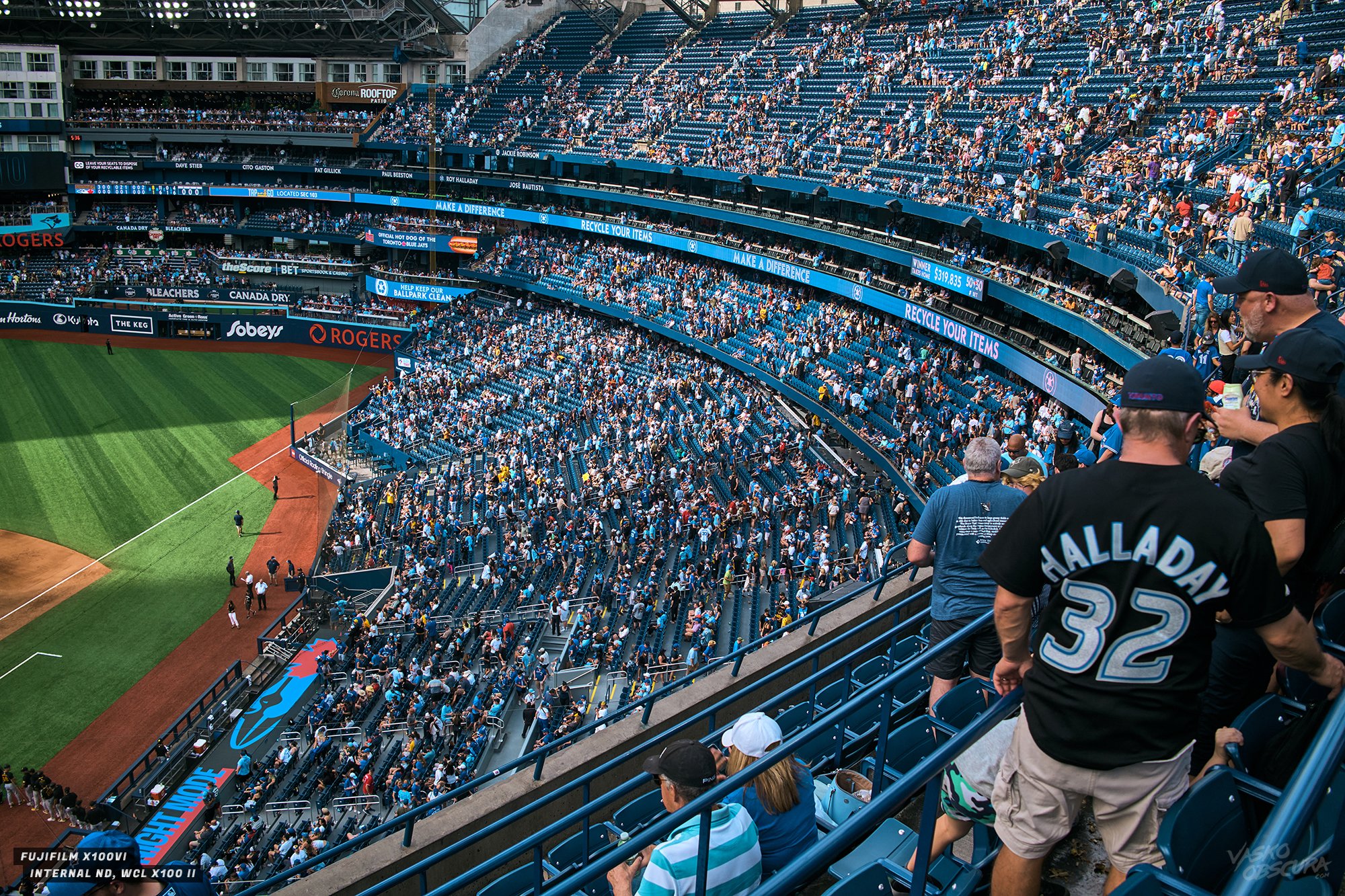
Chromatic aberration is very well controlled here. Even in high-contrast scenes, I didn’t notice any significant color fringing. That’s a testament to both the optical design and Fujifilm’s coatings. Flare resistance is also solid. Shooting into the light still gives you some character (as expected), but contrast holds up better than I anticipated for a conversion lens. Here is a sample image with a bright sky. The sensor was able to expose for the sky and the inside of the stadium. With a bad lens you would expect a lot of CA around the stadium roof and the what hat of the fan.
How It Compares to Native 23mm
The native 23mm lens on the X100VI is still slightly sharper and more optically “pure.” That’s just the reality of adding extra glass. But the gap is smaller than you’d expect. What you gain, a wider 28mm equivalent field of view, often outweighs the minor trade-offs. And more importantly, the rendering stays consistent enough that switching between the two doesn’t feel jarring. Overall i’m really happy with the WCL-X100 II but if i’m being totally honest I wish it was a little wider. Maybe a 20mm full frame equivalent.
Final Thoughts
The Fujinon WCL-X100 II changed how I use my X100VI. It added a fun new layer to using an already really fun to use camera. Optically, it performs far better than most people would expect from a conversion lens. Sharpness is strong, distortion is controlled (with lens profile), and the overall rendering feels true to Fujifilm’s signature look. It’s not perfect, but it’s far from a compromise. If you love the X100 series but occasionally wish it were just a bit wider, this lens feels like a natural extension of the system rather than an accessory. —> Click here to check the current price on Amazon. If you want to see real-world results, side-by-side comparisons, and behind-the-scenes shooting with this lens, check out my YouTube channel for more photography content. I regularly post gear reviews, shooting experiences, and practical tips to help you get the most out of your camera.
FAQ
Is the Fujinon WCL-X100 II worth buying?
Yes if you want a wider field of view without sacrificing image quality. It maintains strong optical performance and integrates seamlessly with the X100 series. However, I think it’s overpriced for what it is. I would suggest waiting for it to go on sale or checking the used market to find one at a good price.
Does the WCL-X100 II reduce image quality?
Slightly compared to the native lens, but the difference is minimal and I don’t think anybody would notice unless they zoomed into to 200%. Sharpness remains high, and most users won’t notice a significant drop.
What focal length does the WCL-X100 II provide?
It converts the 23mm lens into a 19mm lens (which is a 28mm full-frame equivalent).
Does the WCL-X100 II have distortion?
YES but it depends how you use the camera and the RAW files. Jpgs right out of camera are automatically corrected. If your RAW conversion program has the WCL-X100 II lens profile you can correct in post. If you RAW converter doesn’t have the lens profile you’ll have to play with settings to correct the distortion.
Is the WCL-X100 II good for street photography?
Absolutely. The 28mm equivalent field of view is ideal for street, environmental portraits, and travel photography.
Does the camera automatically detect the WCL-X100 II?
Yes, compatible cameras like the X100VI and X100V automatically detect the lens and apply optimized corrections.