
A Complete History of the M42 Lens Mount - The “Universal” Vintage Lens Standard
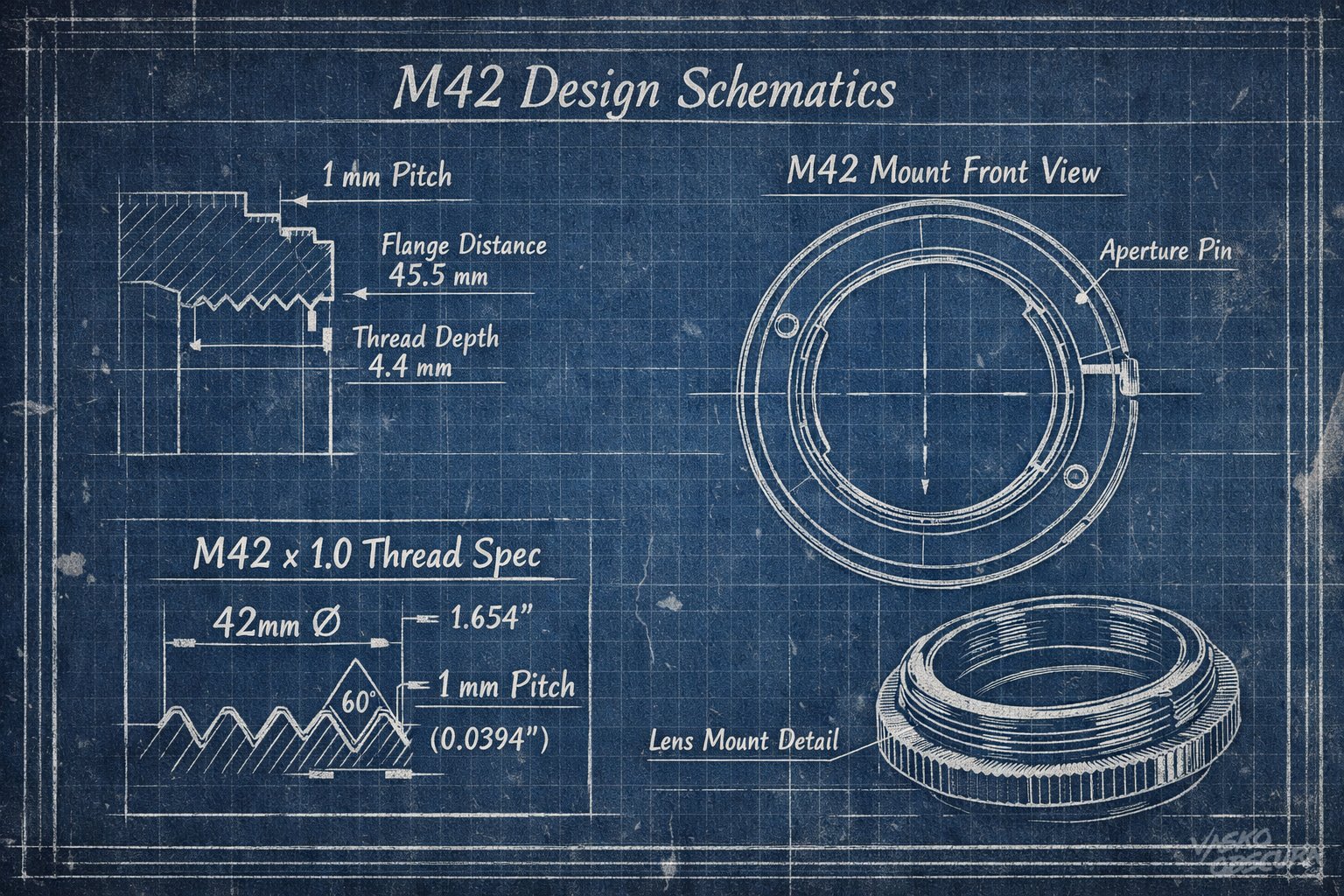
AI generated image of M42 mount blueprints
Table of Contents
Introduction: Why the M42 Mount Matters
If you’re passionate about vintage photography gear, especially classic lenses, you’ve likely heard of the M42 lens mount. Known as one of the most adaptable and prolific mounts ever made, the M42 became a de facto standard for photographers around the world throughout the mid-20th century.
This post explores its development, relationship to earlier mounts like M39, and why it eventually gave way to bayonet mounts, all while giving you the historical and technical insight that vintage lens enthusiasts crave.
Origins of the M42 Mount
Shortly after World War II, camera manufacturers were searching for a lens mounting system that was simple, durable, and easy to mass-produce. The photographic industry was rebuilding after seeing it’s factories destroyed and supply lines erased. Practicality mattered more than complexity. In 1948, the M42 mount was introduced, first appearing on cameras produced by Praktica (Kamera Werkstätten) in East Germany. It was designed to be straightforward, reliable, and mechanically robust, qualities that made it ideal for a rapidly expanding SLR market.
The name “M42” comes directly from its metric thread specification: a 42 millimeter diameter with a 1 millimeter thread pitch. This standardized sizing made it distinct from earlier mounts while remaining easy to manufacture with existing machining techniques. Unlike the more sophisticated bayonet mounts used by some high-end SLR systems, the M42 relied on a threaded screw design. Photographers attached lenses by rotating them directly into the camera body, creating a secure mechanical connection that prioritized simplicity and compatibility over speed.
What Is the M42 Lens Mount?
The M42 mount is a screw-mount standard that allowed interchangeable lenses to be attached to single-lens reflex (SLR) cameras. Here are its key characteristics:
✅ 42 mm diameter × 1 mm thread
✅ Simple and robust mechanical design
✅ Compatible with a huge array of lenses
✅ Supported by many brands and third-party lens makers
This universality helped make M42 the most widely adopted lens mount of its time.
AI generated image of what an engineering design office might have looked like in the late 1940s
Relationship Between M39 and M42 Mounts
To really understand M42, we need to go back to its precursor: the M39 mount.
📌 M39 Mount
Also known as: Leica Thread Mount (LTM)
Introduced: 1930s
Used by: Leica rangefinder cameras, early Soviet and Eastern Bloc cameras
Thread size:39 mm × 1 mm
M39 was originally a rangefinder mount, not ideal for SLRs because it offered limited flange focal distance, the distance between the mount and the film/sensor plane, which made coupling difficult.
The Evolution to M42
As SLRs became more popular, camera makers needed a lens mount with a longer flange focal distance to allow mirror clearance. Simply enlarging the earlier M39 concept led to the M42: same threaded simplicity, but tailored for SLR designs. Because of this lineage, many photographers see M42 as the bridge between classic rangefinder systems (M39) and modern SLR designs.
Before You BUy an M39 Lens You Need to Know This!!!!!
If you are going to buy a vintage lens with an M39 mount such as the old silver bodied Helios-40 it’s important to note that there are two types of M39 mount lense with the exact same mount. One was for Rangefinder cameras and the other was for SLR cameras. The Flange distance for for each system was different so the adapters needed to mount each type of lens onto a modern mirrorless camera is different. For more information about mounting M39 lenses check out this blog post: How to Mount Vintage M39 Lenses to Mirrorless Cameras | Adapter Guide
M39 and M42 adapters for vintage lenses
Why Was M42 So Popular?
The M42 mount became widely adopted for several key reasons:
🔹 Universal Standard
Rather than each manufacturer using a proprietary design, many brands simply embraced M42 as the screw mount for SLRs.
🔹 Affordable & Easy to Manufacture
No expensive bayonet parts or precision machining, just durable, threaded metal.
🔹 Huge Lens Ecosystem
Every major brand, and countless third-party makers like Helios, Pentacon, Carl Zeiss Jena, Takumar, Porst, and more, produced lenses for M42.
🔹 Easy to Modify & Adapt
Because it was threaded, adapting M42 lenses to other cameras (often with simple adapters) became a hallmark advantage for modern digital shooters.
Technical Evolution & Variants
One of the reasons the M42 mount became so successful is that its basic design remained remarkably consistent, even as camera technology continued to evolve. While the threaded mount itself stayed the same, manufacturers gradually introduced new mechanical features to make shooting faster, easier, and more accurate for photographers.
Early M42 lenses were fully manual, meaning photographers had to stop the lens down to their chosen aperture before taking a photo. To improve usability, manufacturers introduced the auto-diaphragm system, which allowed the lens to remain wide open for bright viewing and easier focusing. The camera would then automatically stop the lens down to the selected aperture at the exact moment the shutter was released, a major convenience compared to earlier designs.
As light meters became standard in cameras, additional refinements followed. Some M42 camera bodies added metering couplers, small mechanical linkages that allowed the camera to read aperture information from the lens. This helped photographers achieve more accurate exposures without constantly adjusting settings manually. Different brands also experimented with their own shutter and metering connections, creating slight variations in how lenses communicated with specific camera models.
Despite these improvements, the most important thing never changed: the M42 mount itself. A lens made years earlier would still physically fit newer cameras, which made the system incredibly versatile. This long-term compatibility is one of the main reasons the M42 mount remains so beloved by vintage lens enthusiasts today.
Carl Zeiss Jena Pancolar 50mm f1.8 Zebra notice the pin to activate the aperture.
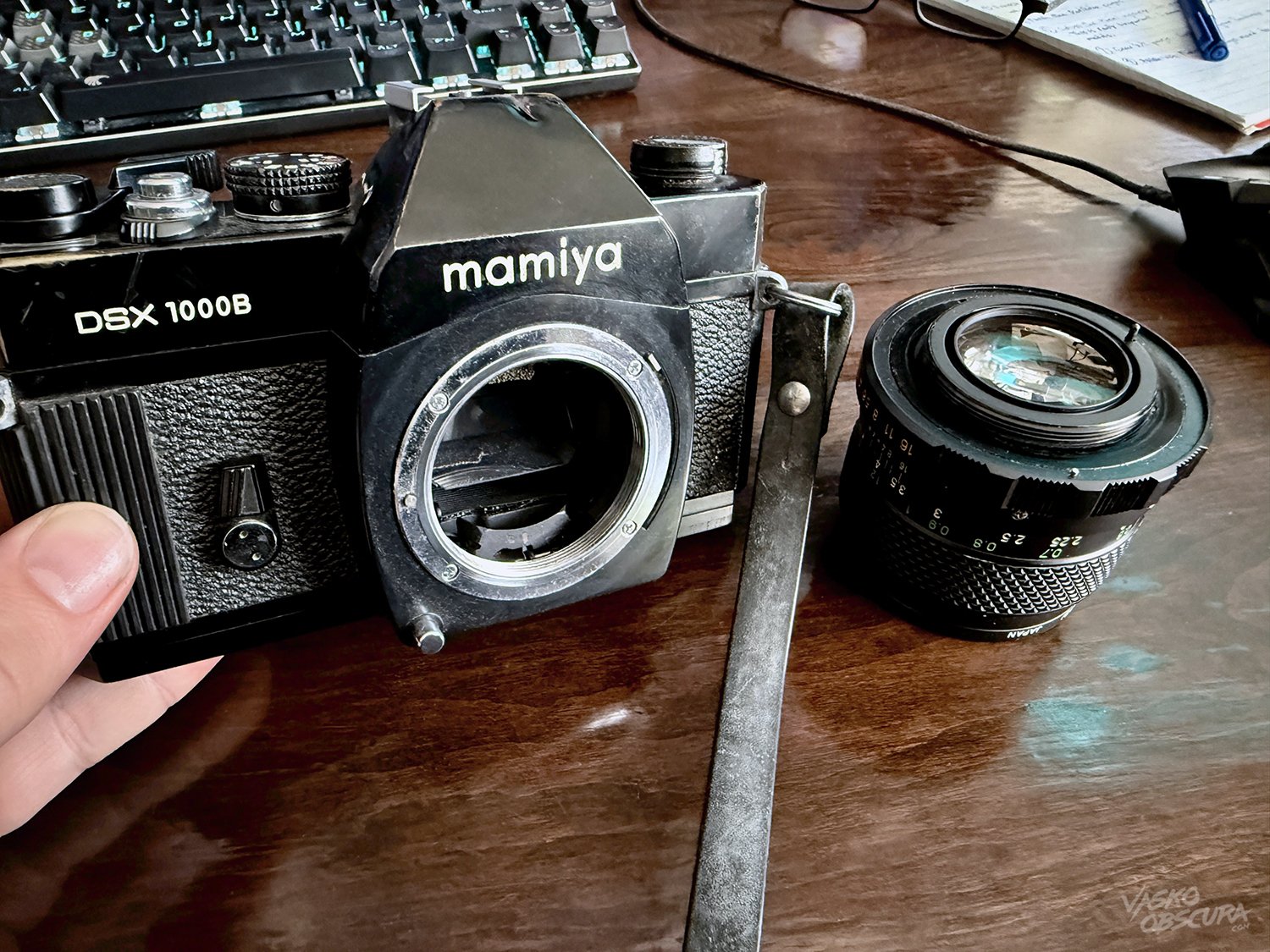
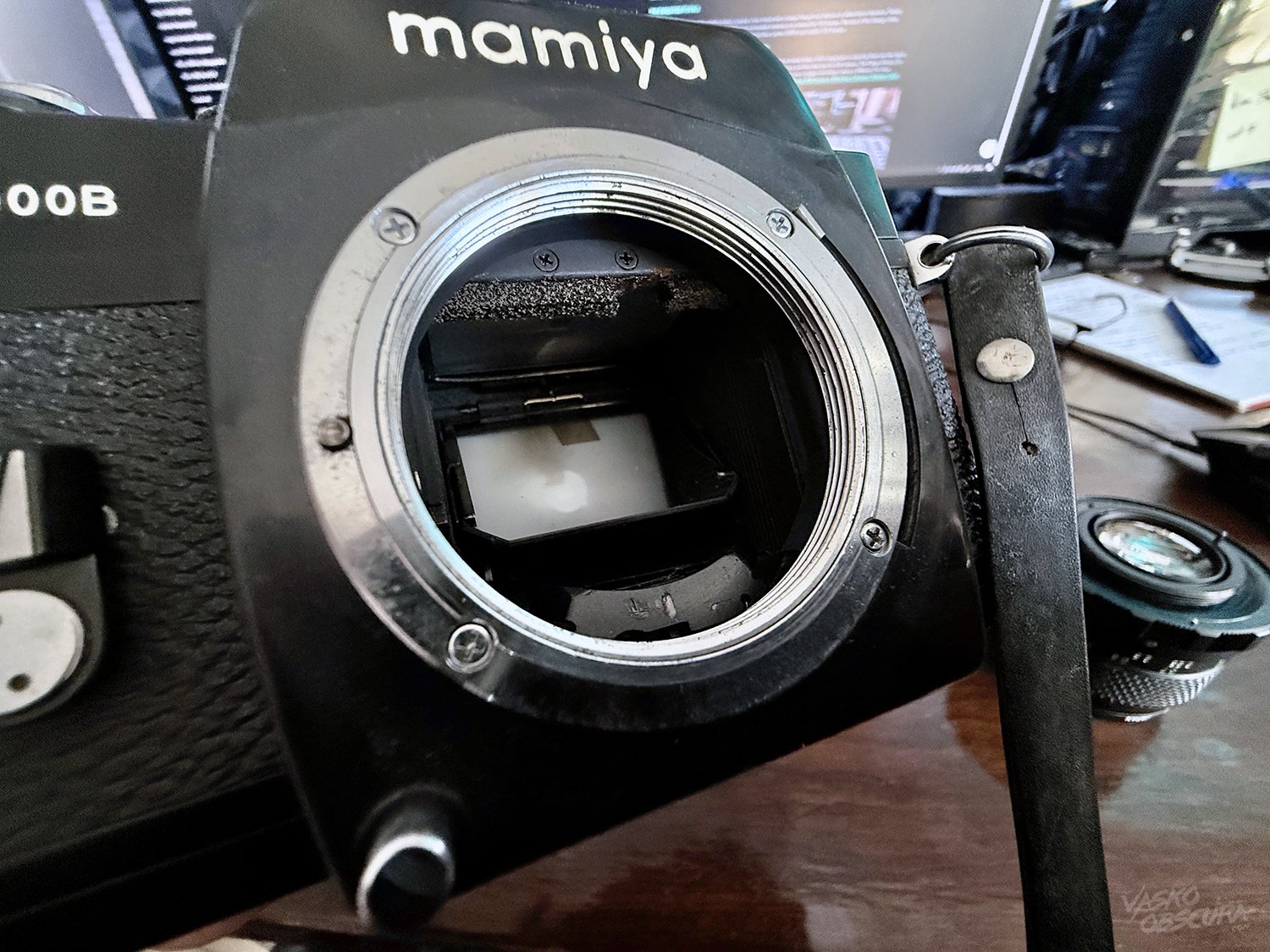
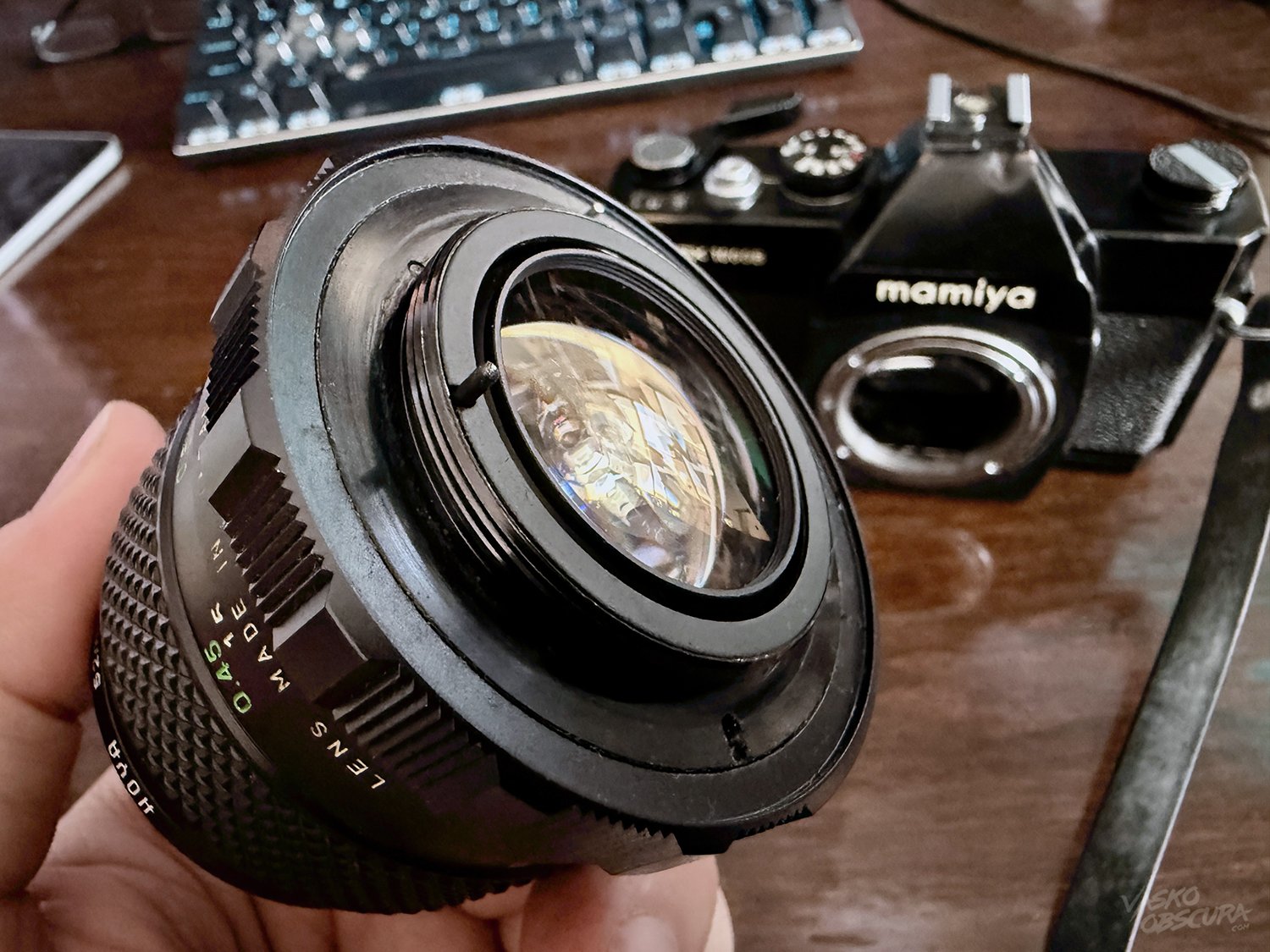
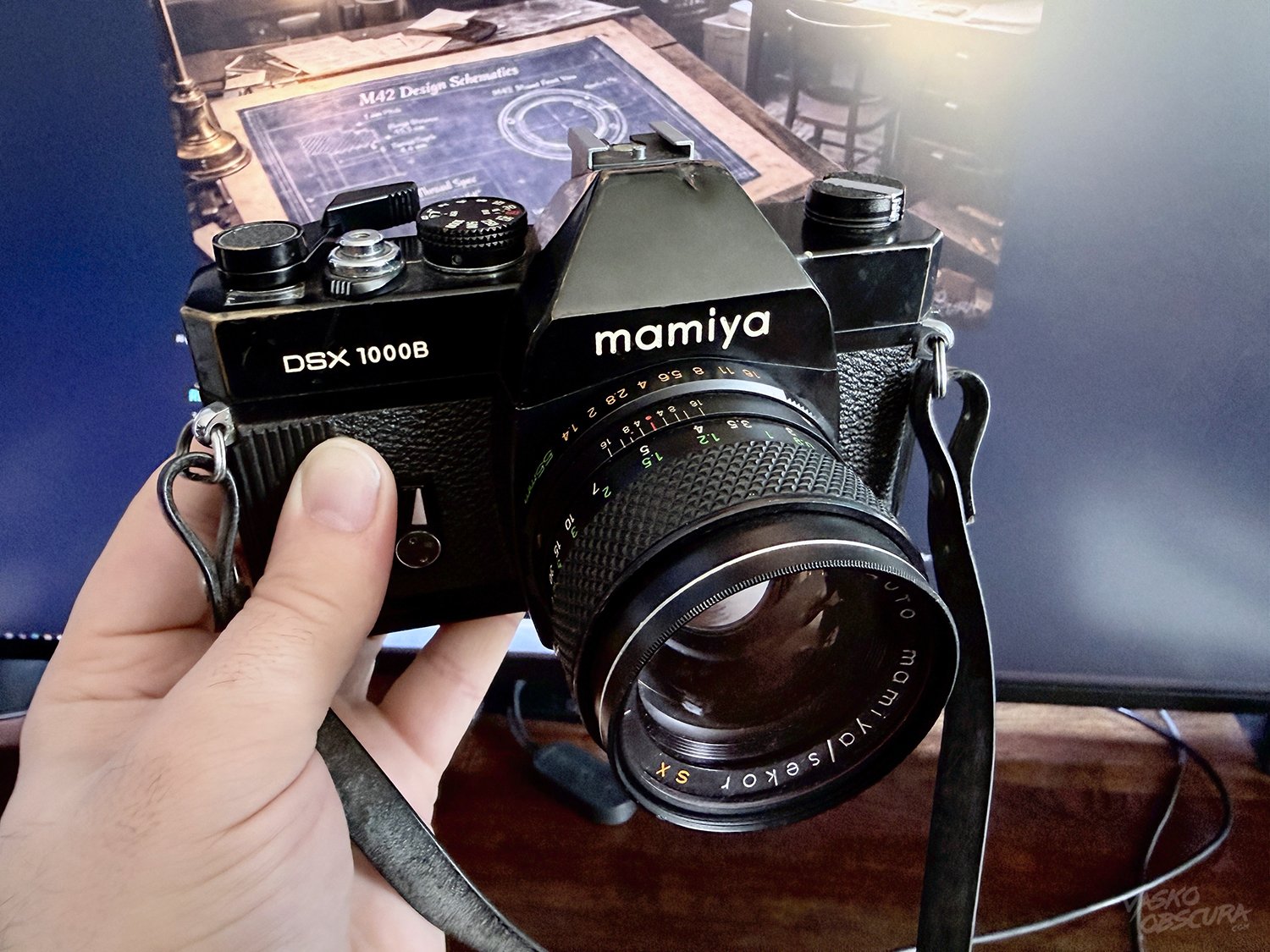
A great example of how widely adopted the M42 mount became can be seen in the Mamiya DSX 1000B and its companion Mamiya Sekor SX 55mm f/1.4 lens. By the time this camera was released in the 1970s, the M42 system was already mature, and manufacturers like Mamiya were refining it with improved metering and lens communication features. The DSX 1000B combined the simplicity of the classic screw mount with more advanced exposure controls, while the fast 55mm f/1.4 standard lens showcased the optical ambition possible within the M42 ecosystem. Together, they represent the later evolution of the mount, proof that even decades after its introduction, the M42 thread was still capable of supporting sophisticated camera systems and high performance glass.
Why the M42 Mount Was Phased Out
Despite its many strengths, M42 eventually lost favor in the 1970s and 1980s, mainly because bayonet mounts offered faster lens changes and more features.
🔹 What’s a Bayonet Mount?
A bayonet mount uses tabs and locking cams that twist and lock lenses into place, faster and more precise than a threaded system.
Bayonet Advantages
✔ Faster lens swaps
✔ More secure mechanical coupling
✔ Electrical contacts possible (future-proofing)
✔ Better support for automation and advanced aperture control
As electronics and automation became more essential, brands like Canon, Nikon, and Pentax launched bayonet mounts with more capabilities, making M42 appear dated by comparison.
How Long Was the M42 Mount Used?
The M42 mount enjoyed a run of roughly 30-40 years of widespread commercial use:
📅 Introduced: Late 1940s
📅 Peak Popularity: 1960s–1970s
📅 Decline: Early 1980s onward
By the mid-1980s, most major camera manufacturers had moved away from the M42 mount in favor of faster and more advanced bayonet systems, leaving M42 primarily in the hands of specialist and budget camera makers. However, the story didn’t end there. Thanks to the wide availability of adapters for nearly every modern camera brand, the M42 mount has taken on a second life as a kind of universal vintage interface. Because it’s so easy to adapt to mirrorless and even many DSLR systems, manufacturers still see value in producing lenses with an M42 thread.
A great example is the TTArtisan 100mm f/2.8 Bubble Bokeh, a modern lens released in M42 mount that recreates the optical formula of a classic vintage design. It intentionally produces the highly sought-after “bubble bokeh” effect, blending old-school rendering with modern manufacturing. In a way, this perfectly captures the enduring appeal of M42, a mount born in the mid-20th century that continues to inspire lens makers and photographers today.
TTArtisan 100mm f/2.8 Bubble Bokeh a modern lens with an M42 mount
Legacy & Influence on Modern Lens Mounts
Even after being phased out, the M42 mount left an immense legacy:
🔸 A Gateway to Lens Adaptation
M42 lenses are easily adapted to modern mirrorless cameras thanks to:
Large flange focal distance
Simple mechanical interface
Enthusiasts today use M42 lenses for their unique character on Sony, Canon R, Fuji X, Fuji GFX, and other systems.
🔸 Vintage Lens Renaissance
M42 optics, like the Pentacon 50mm f/1.8, Helios 44-2 58mm f/2, or Takumar lenses, are adored for vintage rendering, swirly bokeh, and analog heritage.
🔸 Cultural Significance
For many photographers, the M42 mount represents an era of exploration, a time when lens choices were built around optical character and mechanical craftsmanship.
Why Vintage Lens Lovers Still Adore M42
Today’s photographers and filmmakers seek M42 lenses for:
✨ Unique optical qualities
✨ Build quality from the golden age of glass
✨ Inexpensive access to classic lenses
✨ Adaptability on modern digital cameras
The rise of mirrorless systems has brought M42 lenses back in the spotlight, and search interest reflects that resurgence.
Vintage M42 mount Carl Zeiss lenses mounted on a Sony A7C II
Conclusion: Enduring Appeal
The M42 mount may no longer be a mainstream standard, but its importance in photographic history is undeniable. At a time when the industry was still defining what an SLR system could be, M42 helped unify designers, manufacturers, and photographers around a shared mechanical language. Its simple 42mm threaded interface made interchangeable lenses more accessible, more affordable, and more widely distributed than ever before. In many ways, it laid the groundwork for the system-based photography we take for granted today.
What makes the M42 mount especially fascinating is that it represents a transitional moment in camera history, a bridge between fully mechanical craftsmanship and the increasingly automated systems that followed. It belongs to an era when lenses were built from metal and glass with longevity in mind, when aperture rings clicked with confidence, and when focusing required deliberate, tactile precision. That physical connection to the tool is something many modern photographers find themselves missing.
There’s also something deeply enjoyable about stepping back in time and shooting with vintage M42 lenses. Mounting a decades-old lens onto a modern mirrorless body, manually focusing, and watching the scene snap into clarity forces you to slow down. You become more intentional. More observant. The subtle imperfections, swirly bokeh, gentle softness wide open, unique flare patterns, aren’t flaws. They’re character. They remind you that photography is as much about interpretation as it is about technical perfection.
For collectors, M42 lenses offer a tangible piece of photographic heritage. For creatives, they offer a distinctive look that stands apart in a world of clinically sharp optics. And for beginners just discovering vintage glass, the M42 mount provides an affordable and approachable entry point into the past.
Understanding the legacy of the M42 mount isn’t just about thread sizes or flange distances, it’s about appreciating a period when engineering simplicity met artistic possibility. Decades after its introduction, the M42 mount continues to inspire photographers to experiment, explore, and rediscover the joy of making images with tools that have stories to tell.
Read Next:
Check out the Adapter Hub for more info on adapters and adapting lenses
Vintage lens reviews and sample images
Hypothetical blueprint image of the M42 mount