
I just wrote a blog going over why you can’t see any stars in NASA’s Moon photos from the Artemis II Moon fly by. It’s an interesting deep dive into the universe of camera exposure. I was also surprised to see that NASA was still using the Nikon D5 as their main go-to camera in space especially considering the camera is a decade old now and newer cameras have better ISO and Dynamic Range performance. This got me curious. Were these D5 cameras modified? Do they have some sort of advantage that moden mirrorless cameras don’t? Are Nikons better in space? I got on the interwebs and here is what I was able to find out about NASA and the Nikon D5.
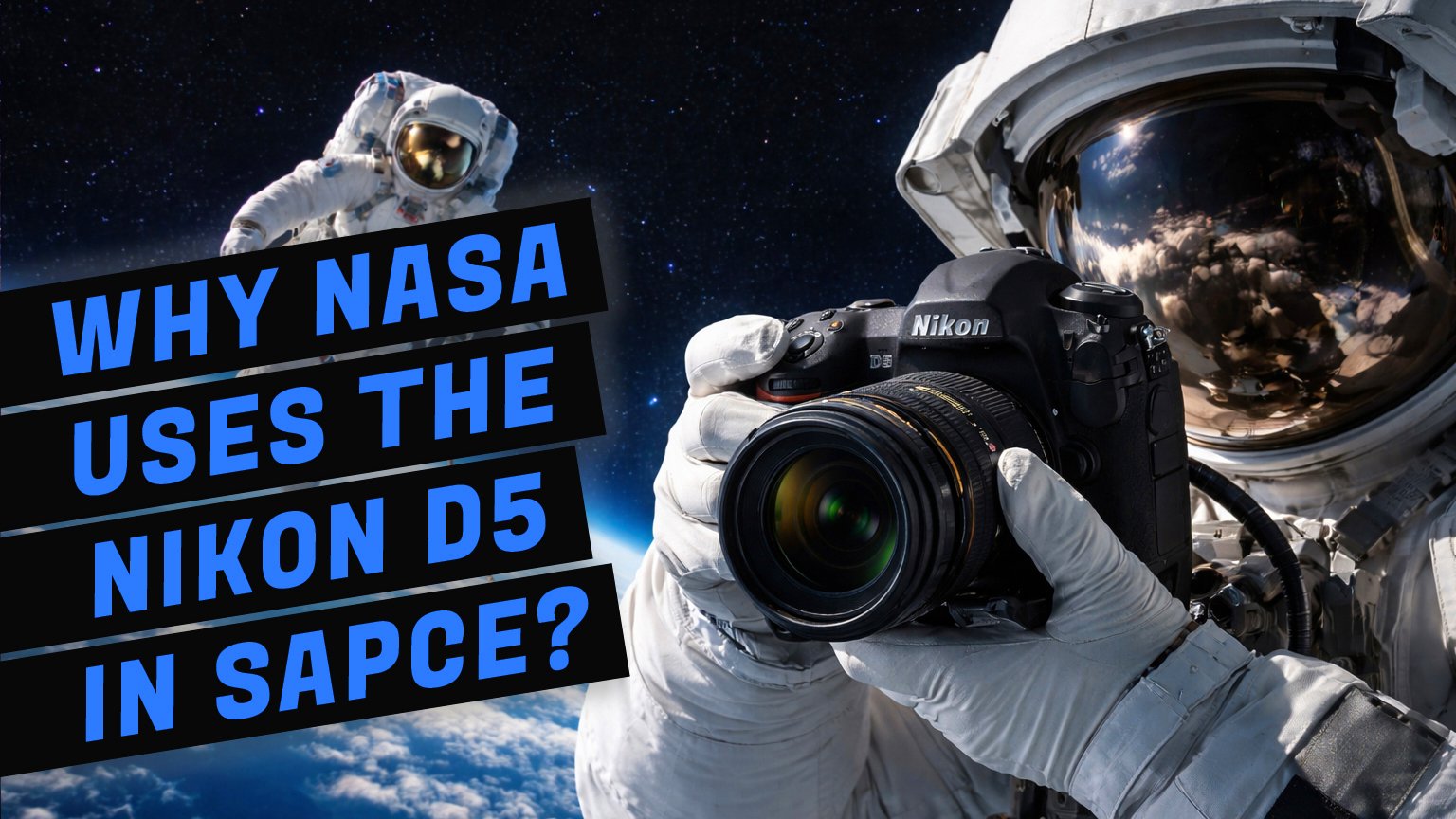
* AI generated image of an astronaut talking a photo of another astronaut in space using the Nikon D5. The camera could not really operate unprotected in space like that but it made for a cool looking image. Temperatures can reach about +120°C (248°F) in Sunlight enough to melt plastic components on cameras and −150°C (−238°F) in the shadows easily cracking LCD screen.
Nikon D5 Specs
Sensor: Full-frame (FX) CMOS
Resolution: 20.8 megapixels
Native ISO: 100 - 102,400
Expanded ISO: 50 - 3,280,000
Nikon F-mount
Continuous Shooting: 12 fps (14 fps with mirror locked)
Buffer: Up to ~200 RAW images
Shutter Speed: 30 sec to 1/8000 sec
AF Points: 153-point AF system
Selectable Points: 55
Low-light AF sensitivity: down to approx. -4 EV
Viewfinder: Optical pentaprism, 100% coverage
Rear Screen: 3.2-inch touchscreen
Resolution: ~2.36 million dots
Battery: EN-EL18a lithium-ion
Weight: ~1,405 g (3.1 lbs)
Build: Fully weather-sealed pro body
So why is NASA using the Nikon D5? At first glance, it might seem strange that NASA is still using a camera like the Nikon D5, a DSLR released back in 2016 for modern missions like Artemis II. After all, today’s mirrorless cameras offer higher resolution, better autofocus, and more advanced features. But when it comes to space photography, the decision isn’t about having the newest gear, it’s about having the most reliable and mission-proven tool. And that’s exactly why the Nikon D5 continues to play such a critical role in NASA’s imaging systems.
The biggest reason NASA uses the Nikon D5 is simple: it’s flight-proven. Before any piece of equipment is used in space, it goes through extensive testing to ensure it can survive extreme conditions like intense vibration during launch, radiation exposure, and the harsh environment of microgravity. The D5 has already passed those tests and has been successfully used in space since 2017. That track record makes it a trusted and predictable tool, something NASA values far more than cutting-edge specs.
Another major advantage of the Nikon D5 is its exceptional high ISO performance. Space presents one of the most challenging lighting environments imaginable, with extreme contrast between bright, sunlit objects and deep, dark shadows. While many modern cameras focus on increasing resolution, they often do so at the expense of low-light performance. The D5, with its larger pixels and lower resolution sensor, excels in high ISO situations, producing cleaner images with less noise. This makes it especially useful for capturing dim subjects like Earth from orbit, shadowed spacecraft interiors, or deep space scenes where light is scarce.
One of the more surprising aspects of NASA’s use of the Nikon D5 is that the cameras are largely unmodified. When NASA initially acquired these cameras, they were purchased off the shelf, just like the ones available to consumers. Instead of redesigning the internal components, NASA focuses on adapting how the camera is used, adding specialized mounts, using protective housings, and integrating it into spacecraft systems. This approach reduces complexity and increases reliability, since the core camera remains a known and tested system.
Durability is another key factor. The Nikon D5 was designed as a flagship professional DSLR, built to withstand extreme conditions on Earth, everything from war zones to harsh weather environments. That rugged design translates well to space, where equipment must endure significant stress and continue to operate flawlessly over long missions. In this context, the D5’s reputation as a “tank” is a major asset.
It’s also important to understand NASA’s broader philosophy when it comes to technology: proven performance always outweighs innovation. While newer cameras like the Nikon Z9 are already being tested aboard the International Space Station, they have not yet fully replaced the D5 because they are still undergoing qualification. NASA needs to fully understand how a camera behaves in space before relying on it for critical missions. Until then, the D5 remains the safer choice.
Or if you’re into conspiracy theories, and let’s be honest, there are plenty of compelling ideas floating around, you might be wondering: if all these NASA images are supposedly fake, why would NASA bother upgrading their camera gear at all? Seems like a pretty expensive way to maintain a green screen hobby. lol. That could also explain why they are using 10 year old gear. But hey, that’s a rabbit hole for another corner of the internet. I try to keep things focused on photography/videography related topics on this blog.
Ultimately, NASA’s continued use of the Nikon D5 highlights an important truth, especially for photographers. Sometimes the best feature is reliability in all conditions. The best camera isn’t always the newest or the most advanced. It’s the one that performs reliably under the specific conditions you’re shooting in. In the extreme environment of space, where there are no second chances, that reliability is everything.